
PDC Permaculture Design Course: A Complete Guide for Diploma Seekers

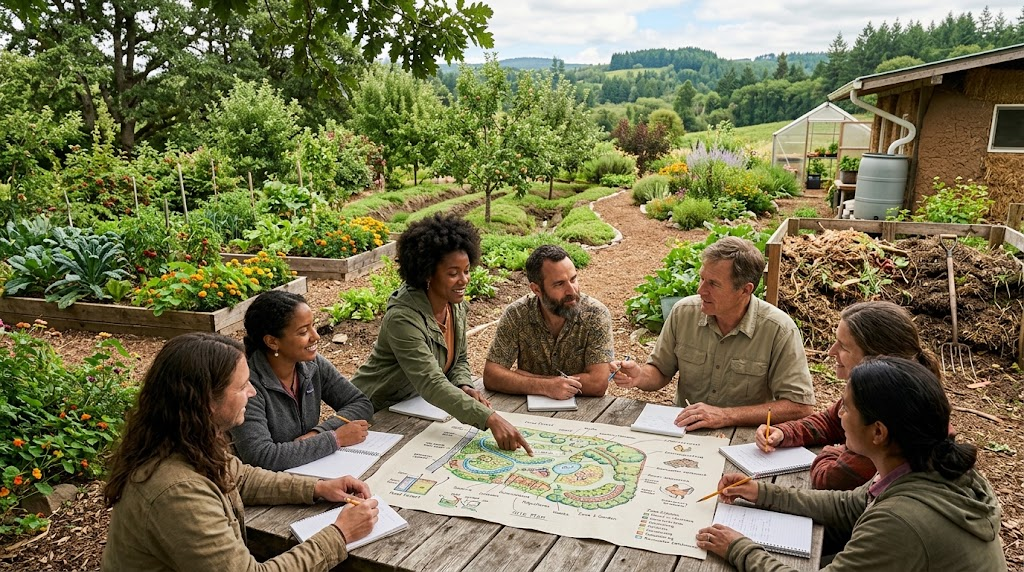
Permaculture has evolved from an approach to sustainable agriculture into a broader framework for designing resilient relationships between people, resources, and the natural world. For anyone considering advanced study in this field, a PDC permaculture design course can provide an important foundation.
PDC stands for Permaculture Design Course. It introduces learners to the ethics, principles, design methods, and practical thinking used in permaculture. Rather than concentrating on a single skill such as gardening or farming, a well-designed PDC encourages students to understand how different parts of a system interact.
For prospective diploma students, this foundation can be particularly valuable. A certificate-level course can help learners develop the vocabulary, design mindset, observation skills, and practical confidence needed to move into more advanced project-based learning.
This guide explains what a PDC permaculture design course is, what you can expect to learn, how to choose a course, and how PDC education can fit into a longer permaculture learning pathway.
What Is a PDC Permaculture Design Course?
A PDC permaculture design course is a structured educational program that teaches the foundations of permaculture design.
The acronym PDC commonly refers to a Permaculture Design Course, while a Permaculture Design Certificate may be awarded after successful completion of a qualifying course. Course structures differ between providers, so prospective students should always examine the curriculum, learning requirements, assessment process, and credentials associated with a specific program.
The central idea behind permaculture education is systems thinking. Instead of treating soil, water, food, energy, buildings, people, and ecosystems as unrelated subjects, students learn to examine their relationships.
This approach encourages questions such as:
- How can available resources be used more efficiently?
- How can different elements of a system support one another?
- What patterns already exist in a particular environment?
- How can waste from one process become a resource for another?
- How can a design meet human needs while supporting ecological health?
- How can systems become more resilient over time?
These questions form the basis for applying permaculture beyond individual gardens and into landscapes, communities, organizations, and other human systems.
Why Take a PDC Permaculture Design Course?
People enter permaculture education for many different reasons. Some want to redesign a garden or homestead. Others are interested in ecological restoration, sustainable agriculture, community development, education, or regenerative entrepreneurship.
For diploma seekers, however, there is an additional consideration: foundational education can provide preparation for deeper project work.
A PDC can help you establish a common conceptual foundation before you begin working on more complex designs. It can also help you determine whether permaculture is the right field for your long-term educational and professional goals.
A good course should not simply give you information. It should encourage you to observe, analyze, design, implement, document, and reflect.
That progression is important because permaculture is fundamentally practical. Understanding a design principle is useful, but being able to apply it to a real situation is a much deeper skill.
What Do You Learn in a PDC?
The curriculum of a PDC varies between educational providers, but several themes commonly appear in permaculture education.
Permaculture Ethics
Ethics provide an important foundation for permaculture thinking.
The three widely recognized ethical principles are:
- Care for the Earth
- Care for People
- Fair Share
These principles help frame decisions about resources, ecosystems, communities, and human needs.
For students, understanding the ethics is important because permaculture is not simply a collection of agricultural techniques. The ethics provide a framework for deciding why and how a design should be developed.
Permaculture Principles
Students also learn design principles that can help them recognize relationships and opportunities within a system.
These principles encourage practices such as:
- Observing before intervening
- Using resources efficiently
- Valuing diversity
- Working with natural patterns
- Creating multiple functions for important elements
- Connecting elements so they support each other
- Designing for resilience and long-term sustainability
The value of these principles lies in their application. Rather than memorizing them as isolated rules, students can learn to use them as questions during the design process.
Systems Thinking
Systems thinking is one of the most transferable skills developed through permaculture education.
A conventional approach might examine a problem in isolation. A systems approach asks what relationships contribute to that problem and what other effects could result from a proposed solution.
For example, a water-management decision can influence soil, vegetation, food production, biodiversity, labor requirements, and maintenance.
By learning to see these connections, students become better equipped to create integrated designs rather than isolated interventions.
Ecological Observation
Observation is central to effective design.
Before making changes, a designer needs to understand the site or system. This can involve examining:
- Climate
- Sun and shade
- Wind
- Water movement
- Soil characteristics
- Existing vegetation
- Wildlife
- Human activity
- Available resources
- Constraints and opportunities
The goal is not simply to collect information. Observation provides the evidence needed to make better design decisions.
Soil and Food Systems
Many PDC programs introduce learners to ecological approaches to food production and soil management.
Topics may include soil health, biodiversity, plant relationships, growing systems, ecological agriculture, and resource cycling.
The emphasis is generally on understanding relationships rather than applying one universal growing method. Conditions vary from one location to another, so observation and context remain essential.
Water Management
Water is another major design consideration.
A permaculture learner may explore how water enters, moves through, is stored within, and leaves a site. Understanding these flows can reveal opportunities for more efficient resource use.
Water design can involve landscape patterns, harvesting concepts, soil-water relationships, and strategies for reducing unnecessary resource loss.
Natural Patterns
Nature contains patterns that can inspire human design.
Students may examine patterns found in landscapes, ecosystems, plant growth, water movement, and other natural processes.
The objective is not to copy nature literally. Instead, natural systems can provide insights into efficiency, diversity, adaptation, feedback, and resilience.
PDC and Practical Design Skills
One of the most important differences between simply reading about permaculture and studying it through a structured course is the opportunity to practice design.
Design work typically involves moving through several stages.
1. Define the Situation
First, clarify what you are designing and why.
This might involve a garden, community project, educational initiative, landscape, food system, or another real-world challenge.
2. Observe
Gather information about the existing conditions.
Good observation can prevent premature decisions and reveal opportunities that are not immediately obvious.
3. Analyze Relationships
Consider how different elements interact.
For example, a design should not treat water, plants, soil, structures, and people as independent components when they influence one another.
4. Develop Possibilities
Generate potential solutions based on the site’s characteristics, available resources, needs, and constraints.
5. Create a Design
Turn ideas into a coherent system.
Depending on the project, this may involve maps, diagrams, written explanations, schedules, implementation plans, or other forms of documentation.
6. Implement and Reflect
Where appropriate, put elements of the design into practice.
Then evaluate what happened. What worked? What did not? What unexpected effects appeared? What should change?
This final stage is especially important for diploma seekers because real-world implementation creates learning that cannot be gained entirely from theory.
Online PDC Permaculture Design Course Options
An online PDC can be particularly attractive to students who need flexibility.
Instead of relocating to a physical campus, learners may be able to combine study with work, community activities, family responsibilities, or ongoing projects.
However, online does not automatically mean better or easier.
When evaluating an online PDC, look beyond the word “online.” Ask what students actually do during the course.
Useful questions include:
- Is the course primarily lectures, or does it include practical assignments?
- Are there opportunities to receive feedback?
- Does the course encourage independent design work?
- Can you apply the material to a real project?
- Is there interaction with instructors or mentors?
- How is student progress evaluated?
- What documentation is expected?
- Does the course provide a pathway toward further study?
The best option depends on your learning goals. A person looking for general knowledge may want a different experience from someone preparing for advanced diploma-level work.
Choosing the Right PDC Permaculture Design Course
If your ultimate goal is a permaculture diploma, it is worth evaluating your PDC strategically.
Examine the Curriculum
Start with the actual course content.
Look for meaningful coverage of ethics, principles, ecological systems, observation, design methodology, and practical application.
A broad curriculum can give you a stronger foundation than a course focused narrowly on a single aspect of permaculture.
Look at the Learning Method
Consider how you learn best.
Some students thrive with self-directed study. Others need regular interaction, mentoring, group discussion, and feedback.
For diploma seekers, the ability to work independently is particularly valuable because advanced programs often require students to take greater responsibility for their projects and learning process.
Consider Practical Application
Permaculture is a design discipline, so practical application matters.
Look for opportunities to work with real situations rather than simply completing quizzes or consuming educational content.
A project can become a bridge between foundational learning and advanced study.
Examine Mentoring and Feedback
Feedback can significantly improve design skills.
A mentor or experienced practitioner can identify assumptions, ask better questions, point out overlooked relationships, and help you improve your documentation.
For learners preparing for diploma-level work, developing the ability to receive and apply constructive feedback is an important part of the learning process.
Think About Your Long-Term Path
Do not evaluate a PDC only by what happens during the course.
Think about what you want to do afterward.
If your objective is a permaculture diploma, investigate whether the educational pathway can help you transition from foundational learning into deeper project work.
PDC Certificate vs. Permaculture Diploma
A PDC certificate and a permaculture diploma should not automatically be treated as the same qualification.
A PDC generally provides foundational education in permaculture design. A diploma can represent a more advanced learning pathway involving deeper investigation, independent projects, documentation, and practical application.
The distinction can be understood broadly like this:
| PDC / Certificate | Permaculture Diploma |
|---|---|
| Foundational learning | Advanced learning |
| Introduces core principles | Applies and develops those principles |
| Builds basic design knowledge | Develops deeper design competence |
| Often structured as a course | May involve extended project work |
| Can be a starting point | Can represent continued specialization |
The exact requirements vary between institutions.
For example, Gaia University describes its International Diploma of Permaculture Design as an advanced program designed for learners who have completed a Permaculture Design Course. Its model combines additional content with hands-on project design, documentation, mentoring, and feedback.
Explore Gaia University’s International Diploma of Permaculture Design
Moving From a PDC Toward Diploma-Level Learning
Completing a PDC can be the beginning rather than the end of your permaculture education.
After foundational study, consider building a portfolio of practical work.
For example, you could document:
- A garden design
- A community project
- A water-management concept
- A food-growing system
- A landscape assessment
- An ecological restoration project
- A social or organizational design
- A regenerative livelihood project
Documentation is valuable because it turns experience into evidence of learning.
Instead of simply saying that you understand permaculture, you can demonstrate how you observed a situation, analyzed it, developed a design, implemented actions, evaluated outcomes, and changed your approach based on what you learned.
Gaia University states that its diploma programs use real projects and ePortfolios to help learners develop and demonstrate competencies. Its program offerings also describe a flexible “learning and doing” model combining online study, hands-on action-learning, and documented self-directed project work.
Learn more about Gaia University’s diploma programs
What Can You Do With Permaculture Design Skills?
Permaculture education can be applied across a wide range of activities.
Potential applications include:
Sustainable Landscape Design
Permaculture principles can inform landscape planning by considering water, soil, plants, biodiversity, human needs, and resource flows as connected components.
Regenerative Agriculture
Permaculture concepts can contribute to approaches that emphasize ecological relationships, soil health, biodiversity, and resource efficiency.
Community Development
Permaculture can also be applied to social systems. Community projects may use design thinking to explore food systems, shared resources, local resilience, education, and cooperation.
Environmental Education
People with permaculture knowledge may use their skills in educational programs, workshops, community initiatives, or other learning environments.
Ecological and Regenerative Projects
Organizations working on sustainability, resilience, restoration, and regenerative development may benefit from people who understand systems thinking and practical design.
A PDC alone does not guarantee employment or professional recognition. Experience, communication skills, project management, local knowledge, and continued education can all contribute to professional development.
How to Get More Value From Your PDC
If you are taking a PDC with the intention of eventually pursuing a diploma, approach the course as a design laboratory rather than simply a qualification to complete.
Keep Detailed Notes
Record questions, observations, design decisions, feedback, and lessons learned.
Over time, these notes can become useful material for future projects.
Choose a Real Project
Whenever possible, connect your coursework to an actual situation.
Real constraints make design work more meaningful. They also force you to test whether your ideas work beyond theory.
Document Your Process
Do not document only the final design.
Record the process that produced it.
Include observations, alternatives you considered, challenges, feedback, and changes made along the way.
Practice Explaining Your Decisions
A strong designer needs to communicate.
Try explaining why you selected a particular strategy, what evidence informed your decision, and what outcomes you expect.
This develops an important professional skill while also exposing weaknesses in your reasoning.
Reflect Regularly
Ask yourself:
- What did I assume?
- What did I observe?
- What surprised me?
- What worked?
- What failed?
- What would I change?
- What additional information do I need?
Reflection turns activity into learning.
Is a PDC Right for Someone Seeking a Permaculture Diploma?
For many diploma seekers, yes—a PDC can be a useful starting point.
It introduces the language and foundational concepts of permaculture while providing an opportunity to determine whether you want to pursue deeper study.
However, choosing the right PDC matters.
If you already know that you want to continue toward advanced permaculture education, prioritize a program that develops more than theoretical knowledge. Look for opportunities to design, practice, document, receive feedback, and work on real problems.
Gaia University’s program structure illustrates one possible progression: its diploma offerings describe foundational online certificate work followed by a mentored, self-directed project phase.
For a learner interested specifically in Gaia University’s pathway, its program offerings provide current information about available diplomas, certificates, study formats, mentoring, and program structures.
View Gaia University’s current program offerings
Frequently Asked Questions About a PDC Permaculture Design Course
What does PDC stand for?
PDC stands for Permaculture Design Course. The term is commonly used for structured courses that teach the foundations of permaculture design.
Is a PDC the same as a permaculture diploma?
No. A PDC generally represents foundational permaculture education, while a diploma can involve more advanced learning and extended project work. Requirements and credentials vary between providers.
Can beginners take a PDC?
Yes. Many PDC programs are designed to introduce learners to permaculture ethics, principles, systems thinking, and design methods.
Is an online PDC worthwhile?
An online PDC can be worthwhile if its learning format matches your goals. For students who need flexibility, online study can make it easier to combine education with existing responsibilities and projects.
The quality of the learning experience depends more on curriculum, practical application, feedback, mentoring, and student engagement than on whether the course is online or in person.
What should I look for in a PDC?
Look for a well-structured curriculum, practical design activities, opportunities for feedback, qualified instructors or mentors, useful documentation requirements, and a learning pathway that aligns with your long-term goals.
Can a PDC help prepare me for a diploma?
Yes. A PDC can establish foundational knowledge and design skills that are useful when progressing into advanced permaculture education. Some diploma pathways specifically build on prior PDC education.
Does completing a PDC make me an experienced permaculture designer?
A PDC provides foundational training, but expertise develops through continued practice.
Working on real projects, receiving feedback, documenting outcomes, and learning from both successes and mistakes are important parts of developing design competence.
Final Thoughts
A PDC permaculture design course can be much more than an introduction to sustainable gardening. At its best, it provides a framework for understanding ecological relationships, human needs, resources, and design decisions as parts of interconnected systems.
For someone seeking a permaculture diploma, the value of a PDC lies in the foundation it creates. It can introduce essential principles while helping you develop observation, systems thinking, design, documentation, and practical problem-solving skills.
The most effective way to approach your PDC is to think beyond the certificate itself. Use the course to begin building a body of practical work. Choose real projects, document your decisions, seek feedback, reflect on results, and continue developing your ability to design in context.
A permaculture diploma can then become a natural next step for learners who want to move beyond foundational knowledge and explore deeper project-based practice.
Ultimately, permaculture education is about learning how to see relationships—and then using that understanding to create thoughtful, regenerative designs that respond to real-world conditions.

Responses