
Permaculture PDC Course: A Complete Guide for Diploma Seekers

Introduction
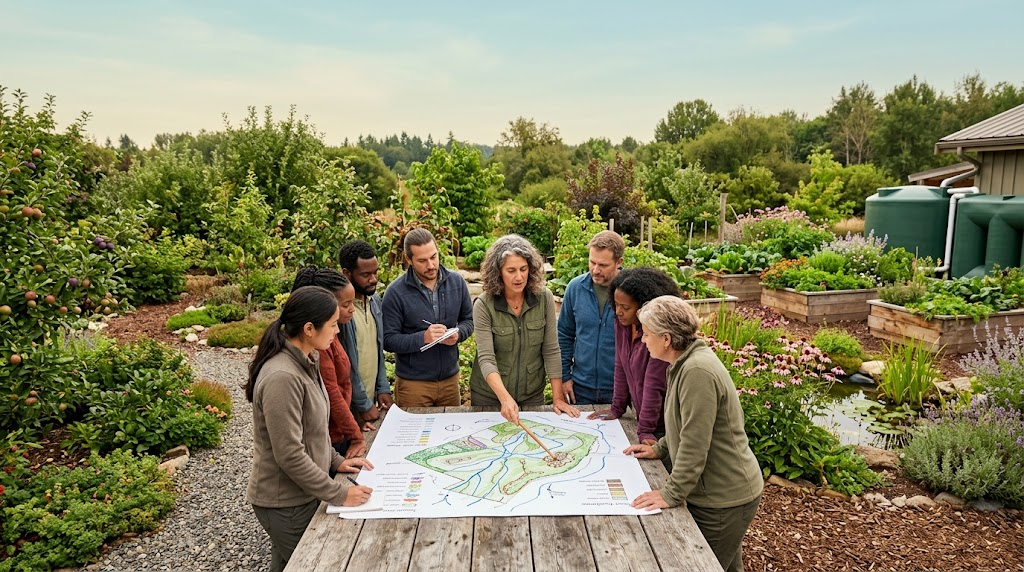
A permaculture PDC course can be an important starting point for anyone who wants to understand ecological design, regenerative systems, and practical approaches to creating resilient human environments. PDC stands for Permaculture Design Course, and these courses generally introduce students to the ethics, principles, observation methods, and design processes that form the foundation of permaculture.
For people considering a permaculture diploma, choosing the right PDC is particularly important. A foundational course should do more than introduce terminology. It should help you develop systems-thinking skills, understand how natural and human systems interact, and begin applying design principles to real situations.
Permaculture education can also take many forms. Some courses are intensive and classroom-based, while others are online, blended, community-based, or designed around practical projects. The right option depends on your learning goals, schedule, experience, and plans for further study.
This guide explains what a permaculture PDC course is, what you can learn, how to evaluate a course, and how PDC education can fit into a longer pathway toward diploma-level learning.
What Is a Permaculture PDC Course?
A permaculture PDC course is a structured educational program focused on the foundations of permaculture design. The abbreviation PDC commonly means Permaculture Design Course, while a Permaculture Design Certificate may be awarded after completing an appropriate course.
The purpose of a PDC is to help learners understand how to observe, analyze, and design systems rather than simply teaching individual gardening or sustainability techniques.
Permaculture approaches a site or project as an interconnected system. Soil, water, plants, animals, buildings, energy, people, infrastructure, economics, and culture can all influence one another. Instead of solving each issue independently, permaculture design looks for relationships and opportunities for multiple functions.
For example, a water-management feature might potentially support irrigation, soil health, biodiversity, and landscape resilience. A food-producing system can also be designed around nutrient cycling, habitat creation, efficient water use, and community needs.
This systems-based perspective is one of the most important concepts introduced in a PDC.
What Does PDC Stand For?
PDC stands for Permaculture Design Course.
The term is widely used for courses that introduce students to the foundations of permaculture design. A course may cover ethics, principles, ecological systems, site assessment, food production, water management, natural building, energy, community systems, and design processes.
However, PDC programs are not identical. Curriculum, teaching methods, assessments, practical requirements, duration, and certification arrangements can differ between providers.
If you are considering a PDC as preparation for a future diploma, review the actual curriculum rather than choosing a course based only on the PDC label.
What Do You Learn in a Permaculture PDC Course?
A well-structured PDC introduces a broad range of subjects. The precise curriculum varies, but several themes are common.
Permaculture Ethics
Ethics provide a foundation for permaculture thinking. Students commonly explore ideas associated with care for the Earth, care for people, and fair and responsible use of resources.
These principles help frame design decisions. A technically efficient design still needs to consider who benefits from it, what resources it requires, and how it affects surrounding ecological and social systems.
Understanding ethics also helps students avoid treating permaculture as simply a collection of techniques.
Permaculture Principles
A PDC introduces principles that can guide observation and decision-making.
Students may explore concepts such as observing and interacting, obtaining useful yields, valuing diversity, using edges and relationships, and responding creatively to change.
The practical value of these principles comes from learning how to apply them rather than simply memorizing them.
For example, observation can encourage a designer to understand seasonal patterns, water movement, sunlight, wind, existing vegetation, human activity, and other site characteristics before proposing interventions.
Systems Thinking
Systems thinking is central to permaculture.
Instead of viewing a garden, farm, household, or community as a collection of isolated components, students learn to consider relationships between components.
Questions might include:
- What inputs does the system require?
- What outputs does it produce?
- Where are resources being wasted?
- Which elements could perform multiple functions?
- Where are feedback loops occurring?
- What relationships could make the system more resilient?
- What changes could create benefits across several parts of the system?
This way of thinking can be applied to land-based projects as well as organizations, communities, livelihoods, and other complex systems.
Site Observation and Assessment
Observation is one of the most practical skills developed through permaculture education.
Before creating a design, students may examine:
- Climate
- Sun exposure
- Wind
- Water movement
- Soil
- Existing vegetation
- Wildlife
- Access
- Buildings
- Infrastructure
- Human activity
- Resource availability
- Existing problems and opportunities
Good observation reduces the risk of designing something that conflicts with the characteristics of a particular site.
Soil and Food Systems
Many PDC programs introduce ecological approaches to soil and food production.
Topics can include soil structure, fertility, composting, mulching, plant relationships, food forests, gardens, agroecological systems, and nutrient cycling.
The broader lesson is that food production can be understood as part of a larger ecological system rather than as an isolated activity.
Water Management
Water is another important part of permaculture design.
Students may examine how rainfall, runoff, storage, infiltration, soil, vegetation, and human water use interact.
Depending on the course, learners may explore strategies for conserving water, reducing unnecessary runoff, improving soil moisture, and integrating water into broader site designs.
Energy and Resource Use
Permaculture also encourages learners to examine how energy and resources move through systems.
A PDC may introduce concepts related to renewable energy, energy efficiency, passive design, resource conservation, appropriate technology, and the relationship between built environments and ecological systems.
The goal is not necessarily to prescribe one technology. Instead, students learn to evaluate resources and design choices within their specific context.
Social and Community Systems
Permaculture is not limited to landscapes.
Human relationships, community organization, education, economics, governance, and livelihoods can also be considered through a systems-design perspective.
For diploma seekers, this broader perspective can be especially useful because advanced permaculture projects may involve organizations, communities, enterprises, research, or social initiatives rather than only physical sites.
Why Take a Permaculture PDC Course?
People choose PDC education for different reasons.
Some want to redesign their home garden. Others are interested in regenerative agriculture, ecological restoration, community resilience, environmental education, sustainable livelihoods, or professional development.
For a prospective diploma student, there is an additional benefit: a PDC can establish a foundation for deeper project-based learning.
A PDC can help you:
- Build foundational permaculture knowledge
- Learn the language of ecological design
- Develop observation skills
- Practice systems thinking
- Understand design processes
- Explore different areas of permaculture
- Identify subjects you want to specialize in
- Begin developing practical project experience
- Prepare for more advanced learning
A good PDC should encourage you to move from learning concepts toward applying concepts.
That transition matters because permaculture competence develops through practice. Reading about design is useful, but designing, testing, documenting, evaluating, and improving a real project provides another level of learning.
PDC Certificate vs. Permaculture Diploma
A PDC certificate and a permaculture diploma are related, but they are not necessarily the same type of qualification.
| PDC / Certificate | Permaculture Diploma |
| Usually foundational | Usually more advanced |
| Introduces core concepts | Develops deeper application |
| Often structured as a course | May involve extended project work |
| Builds initial design knowledge | Can emphasize independent practice |
| May be completed in a defined course period | May involve longer-term learning |
| Can provide preparation for further study | Can focus on demonstrated competencies and projects |
The exact distinction depends on the educational institution.
For example, Gaia University describes its International Diploma of Permaculture Design as an advanced program intended for learners who have completed a Permaculture Design Course. Its pathway combines additional learning with project design, documentation, mentoring, advising, and feedback.
You can explore the International Diploma of Permaculture Design to understand how a PDC can connect with a more advanced learning pathway.
How to Choose the Right Permaculture PDC Course
Choosing a PDC should involve more than comparing course titles.
Review the Curriculum
Start by examining what the course actually teaches.
Look for a broad foundation covering ecological design, ethics, principles, systems thinking, observation, design methods, and practical applications.
If your long-term goal is a diploma, consider whether the course provides the conceptual foundation you will need for more advanced study.
Look at the Learning Format
PDC programs can be delivered in different ways.
An online program may provide flexibility for students who cannot attend a residential course. An intensive program may provide concentrated learning and direct interaction. A blended program can combine online study with practical work.
Consider how you learn most effectively and how much time you can realistically dedicate to study.
Check Practical Application
Permaculture is an applied discipline, so practical learning matters.
Look for opportunities to work with real sites, design scenarios, case studies, projects, or other activities that require you to apply concepts.
A course that encourages students to observe, design, implement, document, and reflect can provide useful preparation for future project-based learning.
Understand Assessment and Completion Requirements
Before enrolling, find out how your learning will be assessed.
Questions worth considering include:
- Are there assignments?
- Is there a design project?
- Are projects reviewed?
- Is there feedback from instructors or mentors?
- What is required to receive the certificate?
- How much independent work is expected?
Clear requirements can help you understand what completing the course will involve.
Consider the Next Step
If your ultimate goal is a permaculture diploma, consider whether your PDC connects naturally with further learning.
Some educational pathways are designed so that foundational certificates lead into more advanced programs. Gaia University, for example, describes its diploma programs as pathways that combine certificate-level learning with later project work and mentoring.
You can review Gaia University’s diploma programs for information about its current learning pathways.
Online vs. In-Person PDC Courses
An online permaculture PDC course can provide flexibility, particularly for learners who have work, family, or geographic commitments.
Online learning can include digital readings, videos, assignments, discussions, live sessions, design exercises, and project work.
However, prospective students should look beyond the word “online.” The quality of an online course depends on its curriculum, interaction, feedback, practical requirements, and learning structure.
An in-person course can provide direct observation and hands-on experiences. An online course can make structured education more accessible across geographic boundaries.
Neither format is automatically suitable for everyone. The important question is whether the learning design supports your objectives.
How to Prepare for Your PDC
You do not necessarily need extensive previous experience to begin a PDC. Many courses introduce learners to permaculture from the foundations.
Still, preparation can make the learning experience more productive.
Start Observing Your Environment
Before beginning the course, practice observing the place where you live.
Notice:
- Where sunlight falls during different parts of the day
- How rainwater moves
- Which plants grow naturally
- Where wind is strongest
- How people move through the space
- Where resources are entering and leaving
- Which problems repeat over time
You do not need to immediately solve these problems. The purpose is to develop the habit of observing before intervening.
Keep a Learning Journal
A journal can help you record questions, observations, ideas, sketches, and reflections.
Over time, these notes can become useful evidence of how your thinking develops.
Choose a Real Project
If possible, identify a manageable project that you can use to practice what you learn.
It could involve a garden, community initiative, landscape, household resource system, educational project, or another appropriate context.
A real project gives abstract concepts somewhere to land.
Moving From PDC Learning to Diploma-Level Practice
Completing a PDC does not have to be the end of your learning journey.
For many diploma seekers, it can become the foundation for a portfolio of increasingly sophisticated projects.
After completing foundational study, you might develop work around:
- Regenerative landscape design
- Food-growing systems
- Water management
- Ecological restoration
- Community resilience
- Sustainable livelihoods
- Education
- Social design
- Organizational development
- Permaculture research
- Regenerative enterprise
The important step is to document the process.
For each project, record what you observed, what you intended to achieve, what you designed, what you implemented, what happened, and what you learned.
This transforms experience into evidence of developing competence.
Gaia University describes its diploma model as combining real-world project work with documentation, mentoring, and feedback, with projects documented through an ePortfolio.
Building a Permaculture Portfolio
A portfolio can become an important part of your development as a permaculture practitioner.
Rather than presenting only a certificate, a portfolio can demonstrate how you think and work.
A project entry might include:
- Context — Describe the site, organization, or challenge.
- Observation — Explain what you discovered.
- Analysis — Identify relationships, constraints, and opportunities.
- Design — Present your proposed approach.
- Implementation — Document what you actually did.
- Evaluation — Examine what worked and what did not.
- Reflection — Explain what you would change next time.
- Next steps — Identify further questions or improvements.
This process encourages continuous learning rather than treating education as something that ends when a certificate is awarded.
What Can You Do After a PDC?
A PDC provides foundational education, but what you do with that knowledge depends on your interests and continued experience.
Possible applications include personal land projects, community initiatives, ecological education, food systems, sustainable agriculture, regenerative development, and further academic or professional learning.
A PDC alone does not automatically establish professional competence in every area of permaculture. Practical experience, project outcomes, communication skills, local knowledge, and continued education can all matter.
This is why diploma seekers should think about their education as a pathway rather than a single credential.
Is a Permaculture PDC Course Worth It for Diploma Seekers?
The answer depends on your goals and the quality of the specific course.
For someone considering advanced permaculture education, a PDC can provide a useful foundation in terminology, ethics, principles, systems thinking, observation, and design.
The most valuable course is not necessarily the one with the longest list of topics. Look for an educational experience that helps you connect ideas, practice design, receive feedback, and understand how foundational knowledge can be applied to real projects.
If your objective is eventually to pursue diploma-level study, investigate the progression between the PDC and the diploma before enrolling.
Gaia University’s current program information describes a learning model built around online study, hands-on action learning, self-directed project work, documentation, and mentoring. Its International Diploma of Permaculture Design is specifically positioned as an advanced pathway following a Permaculture Design Course.
Frequently Asked Questions About Permaculture PDC Courses
What is a permaculture PDC course?
A permaculture PDC course is a Permaculture Design Course that introduces learners to the foundations of permaculture, including ethics, principles, ecological systems, observation, and design methods.
What does PDC stand for?
PDC stands for Permaculture Design Course. The term is commonly used for foundational permaculture education.
Is a PDC the same as a permaculture diploma?
No. A PDC generally provides foundational training, while a permaculture diploma can involve more advanced study, extended project work, documentation, mentoring, and practical application. Requirements vary by institution.
Can beginners take a PDC?
Yes. Many PDC programs are designed to introduce students to permaculture from the beginning, although individual course requirements differ.
Can an online PDC prepare me for a diploma?
It can, depending on the course and the requirements of the diploma pathway. When choosing an online PDC, examine its curriculum, practical components, assessment, and compatibility with your future educational goals.
What should I look for in a PDC?
Look for a clear curriculum, experienced educators, practical application, meaningful feedback, transparent completion requirements, and a learning format that fits your circumstances.
What should I do after completing a PDC?
Continue applying what you have learned. Develop real projects, document your process, seek feedback, build a portfolio, and investigate advanced learning options that match your goals.
Conclusion
A permaculture PDC course can provide much more than an introduction to sustainable gardening. A strong PDC teaches learners to observe systems, understand relationships, think ecologically, and approach design as a process of continuous learning and adaptation.
For aspiring diploma students, the PDC can serve as a foundation for deeper project-based practice. The next stage is to move from understanding principles to applying them: observe real situations, develop designs, test ideas, document results, and reflect on what you learn.
When choosing a course, look beyond the certificate itself. Consider the curriculum, learning format, practical opportunities, assessment process, feedback, and connection to your longer-term goals.
For learners who want to progress toward advanced permaculture study, Gaia University’s current programs provide a pathway that combines foundational learning with self-directed projects, documentation, mentoring, and practical action. The key is to approach your education not simply as a credential to obtain, but as an opportunity to develop the knowledge and capabilities needed to design and contribute to more resilient systems.

Responses