
Self Directed Learning Programs: A Guide to Permaculture Education

Traditional education often follows a predetermined structure. Students attend scheduled classes, complete standardized assignments, and progress through a curriculum designed by someone else. While this approach can provide valuable knowledge, it does not always accommodate the individual interests, practical experiences, and personal goals of adult learners.
For people interested in permaculture, ecological restoration, regenerative agriculture, and sustainable community development, a different educational approach can be particularly valuable. Self directed learning programs offer an opportunity to take responsibility for the learning process, explore subjects in depth, and apply new knowledge to meaningful real-world projects.
Rather than following a fixed sequence of lessons, learners identify their objectives, select appropriate resources, develop practical skills, and evaluate their progress. This makes self-directed education especially relevant to aspiring permaculture designers and practitioners who want to connect theoretical understanding with practical experience.
A Permaculture Diploma can be a natural outcome of this approach. It allows learners to demonstrate their development through completed projects, reflective practice, and evidence of applied design knowledge.
In this article, we explore how self directed learning programs work, their advantages, how they support permaculture education, and how prospective diploma students can use them to build a meaningful learning journey.
What Are Self Directed Learning Programs?
Self directed learning programs are educational approaches that place learners at the center of the learning process. Instead of relying entirely on teachers or institutions to determine what, when, and how learning takes place, participants actively manage their educational development.
Learners establish goals, identify knowledge gaps, select learning materials, organize activities, and assess their achievements.
This does not mean that self-directed learners must work entirely alone. Many programs include mentors, tutors, peer networks, learning communities, and professional guidance. The main difference is that the learner takes primary responsibility for determining the direction and pace of their development.
A self-directed learning process generally includes several important activities:
- Identifying learning needs: Recognizing which knowledge, skills, and competencies need further development.
- Establishing objectives: Creating clear goals connected to personal interests or professional aspirations.
- Selecting resources: Choosing books, courses, workshops, research materials, practical activities, and expert guidance.
- Applying knowledge: Testing ideas through experiments, projects, professional activities, and community initiatives.
- Evaluating progress: Reviewing results, identifying challenges, and adjusting learning strategies.
- Documenting achievements: Collecting evidence of development through portfolios, project reports, and reflective journals.
The process is continuous rather than linear. New experiences often reveal additional questions, encouraging learners to refine their goals and explore unfamiliar subjects.
For permaculture students, this flexibility is particularly useful because ecological design requires an understanding of interconnected systems rather than memorization of isolated facts.
Why Self Directed Learning Is Important for Permaculture Education
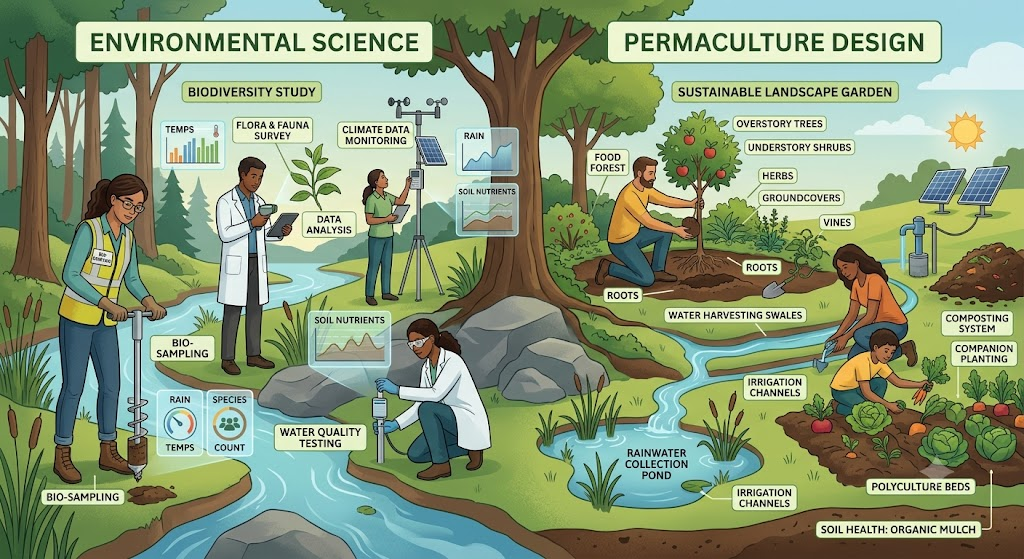
Permaculture is an interdisciplinary design approach that draws on ecology, agriculture, water management, architecture, economics, social systems, and community development.
A successful permaculture practitioner must understand how these elements interact within a particular environment. This knowledge cannot always be developed effectively through classroom instruction alone.
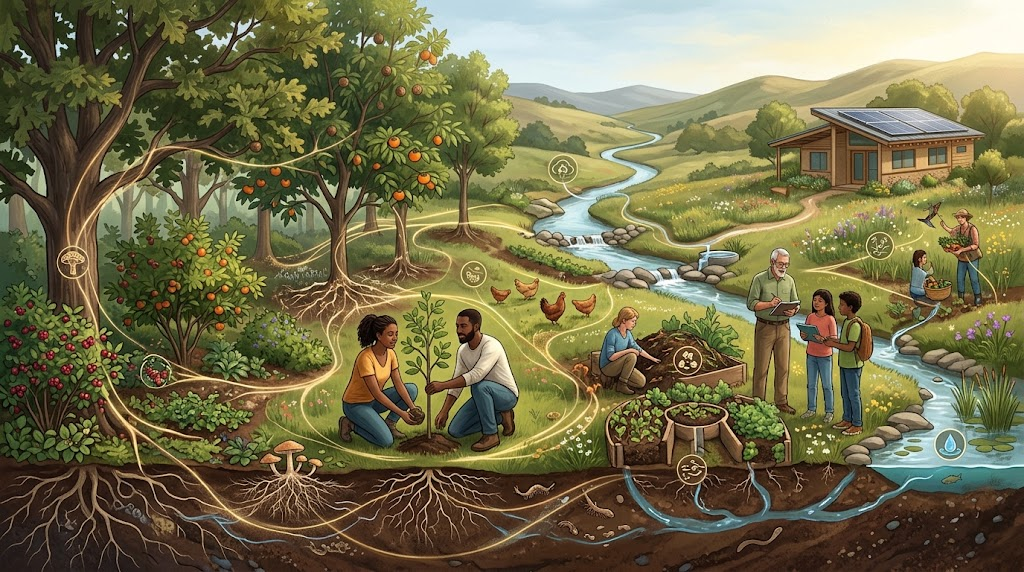
For example, designing a productive food forest requires more than understanding plant selection. A designer must also consider soil conditions, sunlight, water availability, biodiversity, local climate, maintenance requirements, and relationships between different components of the system.
Similarly, developing a regenerative community initiative requires knowledge of communication, collaboration, organizational structures, resource management, and local economic relationships.
Self directed learning programs provide the flexibility to explore these subjects according to the learner’s specific interests and practical circumstances.
Connecting Theory With Real-World Experience
One of the most important characteristics of permaculture education is the relationship between theoretical knowledge and practical application.
A student may study soil ecology, water harvesting, or agroforestry through reading and research. However, a deeper understanding develops when that knowledge is applied to an actual landscape.
Self-directed learning encourages students to move between research, experimentation, observation, and reflection.
For example, a learner interested in regenerative agriculture might:
- Research soil health and ecological farming principles.
- Observe soil conditions in a selected landscape.
- Develop a small-scale soil improvement project.
- Monitor changes over time.
- Evaluate the results and identify opportunities for improvement.
This process develops practical competence while encouraging independent thinking.
Supporting Individual Learning Goals
Every permaculture student begins with a different background.
Some learners have experience in farming or gardening, while others come from education, business, architecture, environmental studies, or community development.
A standardized curriculum may not fully address these differences.
Self directed learning programs allow participants to build on existing knowledge while concentrating on areas that require further development.
For instance, someone with an agricultural background might focus more heavily on social systems and community facilitation. An architect might explore ecological building, natural materials, and landscape integration. A community organizer might concentrate on food systems, local resilience, and participatory design.
This individualized approach makes education more relevant and meaningful.
Key Characteristics of Effective Self Directed Learning Programs
Not every independent learning experience automatically becomes an effective educational program. Successful self-directed education requires structure, reflection, and clear objectives.
Several characteristics help create a productive learning environment.
1. Learner Autonomy
Learner autonomy is the foundation of self-directed education.
Participants have the freedom to identify their interests, establish priorities, and make decisions about their learning activities.
However, autonomy also involves responsibility. Students must remain committed to their objectives, organize their time, and evaluate their development honestly.
In permaculture education, autonomy allows students to explore projects that reflect their ecological interests and local opportunities.
2. Flexible Learning Pathways
Effective programs recognize that learners develop knowledge and practical abilities at different speeds.
Instead of requiring everyone to complete identical activities in the same order, flexible learning pathways accommodate different backgrounds, circumstances, and interests.
A learner might combine independent research with practical workshops, community projects, professional experience, and mentoring.
This flexibility is especially important for adult learners balancing education with employment, family responsibilities, or existing projects.
3. Practical Project-Based Learning
Project-based learning is particularly compatible with self-directed education.
Rather than studying concepts without applying them, learners develop projects that address real challenges.
Permaculture projects might include:
- Designing a regenerative home garden.
- Developing a food forest.
- Improving soil health on agricultural land.
- Creating a rainwater harvesting strategy.
- Designing an ecological education program.
- Supporting a community food initiative.
- Developing a sustainable rural enterprise.
- Planning a landscape restoration project.
Each project becomes an opportunity to research, experiment, apply knowledge, and demonstrate competencies.
4. Reflection and Continuous Improvement
Reflection allows learners to understand what they have achieved and what still needs attention.
In permaculture, this is particularly important because ecological systems are dynamic. Designs often require adjustments as environmental conditions change and new information becomes available.
A reflective learning practice might include documenting:
- The original project objectives.
- The design decisions made.
- Research and resources consulted.
- Challenges encountered.
- Feedback received.
- Results observed.
- Lessons learned.
- Possible improvements.
This documentation creates a valuable record of professional and personal development.
5. Mentorship and Peer Learning
Although self-directed learners manage their own educational journeys, external guidance remains valuable.
Mentors can provide feedback, challenge assumptions, recommend resources, and help learners identify areas that require further development.
Peer learning also creates opportunities to exchange experiences and explore different perspectives.
For permaculture diploma seekers, connecting with experienced practitioners and other learners can strengthen both technical understanding and confidence.
Self Directed Learning Programs and Permaculture Diploma Education
A Permaculture Diploma represents a deeper level of engagement with permaculture principles, design methods, and practical application.
While introductory permaculture education often focuses on foundational concepts, diploma-level development generally involves sustained learning, practical experience, and the ability to demonstrate design competence.
Self directed learning programs provide an effective framework for this type of development because they allow students to build an educational portfolio around their interests and real-world activities.
Rather than simply completing a series of unrelated assignments, learners can develop interconnected projects that demonstrate their growing understanding of ecological and social systems.
Developing a Personal Learning Pathway
A useful starting point is to establish a personal learning plan.
This plan should connect the learner’s long-term objectives with practical activities and measurable outcomes.
For example, someone interested in becoming a professional permaculture designer might organize their learning around the following areas:
Ecological foundations
- Understanding ecological succession.
- Studying biodiversity and ecosystem functions.
- Exploring soil biology and nutrient cycling.
- Learning about climate and landscape patterns.
Permaculture design
- Understanding design principles and ethics.
- Conducting site assessments.
- Developing sector and zone analyses.
- Creating integrated landscape designs.
Practical implementation
- Establishing productive growing systems.
- Improving water management.
- Developing composting systems.
- Monitoring ecological outcomes.
Social and economic systems
- Understanding community resilience.
- Exploring cooperative economic models.
- Developing participatory design processes.
- Learning about regenerative entrepreneurship.
Professional development
- Building a project portfolio.
- Practicing communication and facilitation.
- Documenting design processes.
- Reflecting on professional competencies.
The learning plan can evolve as new interests emerge and practical experience increases.
Building a Permaculture Portfolio
A portfolio is an important way to demonstrate learning and practical development.
It provides evidence that the learner can apply concepts rather than simply explain them.
A strong portfolio might include:
- Site assessment documents.
- Landscape maps and design drawings.
- Project proposals.
- Photographs documenting implementation.
- Research summaries.
- Soil and water observations.
- Project evaluations.
- Reflective essays.
- Community engagement activities.
Each project should explain the context, objectives, design process, implementation activities, and outcomes.
Where possible, learners should also document limitations and lessons learned. Not every experiment will produce the intended results, and understanding why something did not work is an important part of professional development.
For diploma seekers, portfolio development can transform independent study into a coherent demonstration of knowledge and experience.
Benefits of Self Directed Learning Programs for Adult Learners
Self-directed education offers several advantages for adults seeking meaningful professional and personal development.
Greater Flexibility and Independence
Traditional educational programs often require students to follow fixed schedules and attend activities at predetermined times.
Self-directed learning provides more flexibility.
Learners can organize their studies around their existing responsibilities, allowing them to combine education with employment, family commitments, and practical projects.
This is particularly useful for people living in rural areas or communities where specialized permaculture training opportunities may be limited.
Learning Through Personal Interests
People are generally more motivated when their learning connects with subjects they genuinely care about.
Self directed learning programs allow participants to explore topics that have direct relevance to their lives and aspirations.
A learner interested in ecological building can investigate natural construction techniques, while another interested in food security can focus on community gardens and regenerative food production.
Both can develop valuable competencies through different educational pathways.
Development of Independent Thinking
Self-directed education requires learners to identify problems, evaluate information, and make informed decisions.
These abilities are essential for permaculture practitioners, who frequently work in complex situations without simple or universal solutions.
Developing independent thinking also helps learners become more adaptable when dealing with changing environmental, economic, and social conditions.
Improved Practical Competence
Applying knowledge through projects helps learners develop skills that can be transferred into professional and community contexts.
For example, designing and implementing a water management system can develop competencies in observation, technical planning, resource assessment, and project evaluation.
Over time, these experiences can contribute to a portfolio demonstrating practical capabilities.
Lifelong Learning
Permaculture is an evolving field influenced by ecological research, changing environmental conditions, technological developments, and new community practices.
Self-directed education encourages continuous learning beyond formal qualifications.
Instead of viewing education as something completed after receiving a certificate or diploma, learners develop the ability to identify new challenges and acquire relevant knowledge throughout their lives.
How to Create an Effective Self Directed Learning Plan
A well-designed learning plan provides direction without removing the flexibility that makes self-directed education valuable.
The following steps can help prospective Permaculture Diploma students organize their development.
Step 1: Define Your Long-Term Vision
Begin by identifying what you want to achieve.
Consider questions such as:
- Why do you want to study permaculture?
- What ecological or social challenges interest you?
- Which practical skills do you want to develop?
- Do you want to work professionally as a designer?
- Are you interested in developing your own regenerative project?
- How would you like to contribute to your community?
Your answers will help establish a meaningful direction for your education.
Step 2: Assess Your Existing Knowledge and Experience
Before creating a learning schedule, identify your current strengths and knowledge gaps.
You may already have experience in gardening, ecological building, community work, project management, or environmental education.
Recognizing these abilities helps you avoid unnecessary repetition and concentrate on new areas of development.
It also provides an opportunity to identify transferable professional skills.
Step 3: Establish Specific Learning Objectives
General intentions such as learning more about permaculture are difficult to evaluate.
Instead, create objectives connected to specific outcomes.
For example:
- Develop the ability to conduct a comprehensive site assessment.
- Understand the relationship between soil health and ecosystem resilience.
- Design an integrated water management system.
- Create a practical food forest proposal.
- Develop skills in community facilitation.
- Complete a documented regenerative design project.
Specific objectives make progress easier to monitor.
Step 4: Select Appropriate Learning Resources
Self-directed learners can combine multiple educational resources.
These might include:
- Permaculture books and publications.
- Online educational programs.
- Recorded lectures and presentations.
- Practical workshops.
- Research papers.
- Case studies.
- Mentorship sessions.
- Field visits.
- Community projects.
The most effective resources are those that support your objectives and encourage practical application.
It is also important to evaluate the quality of information. Compare different perspectives, consider the context of recommendations, and distinguish established knowledge from untested claims.
Step 5: Apply Knowledge Through Projects
Practical application should be integrated into the learning process from the beginning.
Choose projects that are achievable within your available time and resources.
A small garden transformation, for example, can provide opportunities to explore soil improvement, biodiversity, water management, plant relationships, and ecological observation.
Larger projects can gradually build on the knowledge gained through smaller experiments.
Step 6: Document and Evaluate Progress
Maintain a learning journal or digital portfolio.
Record your activities, research findings, practical experiences, and reflections.
Regular evaluation helps identify areas where additional learning is necessary.
It also provides evidence of development that can support future professional opportunities or diploma assessment.
Step 7: Seek Feedback and Refine Your Approach
Independent learning does not mean avoiding feedback.
Discuss your projects with experienced practitioners, mentors, and peers.
Constructive feedback can reveal overlooked issues and introduce alternative approaches.
Use this information to refine your designs and adjust your learning objectives.
The Role of Project-Based Learning in Permaculture Development
Project-based learning is one of the most effective ways to connect self-directed education with real-world competence.
Permaculture is fundamentally concerned with designing systems that respond to specific environmental and social conditions.
Therefore, learners benefit from working with real landscapes, communities, and resource constraints.
Consider a student developing a regenerative garden.
The project might begin with an assessment of the existing site, including sunlight, water movement, soil characteristics, vegetation, and surrounding infrastructure.
The learner then identifies opportunities to improve productivity and ecological function.
Research and design activities might involve selecting suitable plants, planning water management, improving soil conditions, and considering relationships between different system components.
After developing the design, the student implements selected elements and monitors their performance.
Throughout the process, the learner documents decisions, unexpected outcomes, and possible improvements.
This single project can integrate several areas of learning:
- Ecological observation.
- Landscape analysis.
- Soil management.
- Water conservation.
- Plant selection.
- Design thinking.
- Project planning.
- Resource management.
- Reflective practice.
More importantly, it demonstrates how different competencies work together.
This integrated approach is particularly valuable for people pursuing a Permaculture Diploma because it connects learning outcomes with practical design experience.
Challenges of Self Directed Learning and How to Overcome Them
Although self-directed education offers considerable flexibility, it also requires discipline and careful organization.
Understanding potential challenges can help learners create more sustainable learning habits.
Lack of Structure
Without a fixed timetable, some learners struggle to maintain consistency.
A practical solution is to establish a realistic weekly learning routine.
Set aside dedicated time for reading, research, project development, and reflection.
The schedule should be flexible enough to accommodate changing circumstances while maintaining regular progress.
Information Overload
The availability of online resources can make it difficult to decide what to study.
Learners may spend considerable time collecting information without applying it.
To avoid this problem, connect every learning activity to a specific objective.
Before selecting a resource, ask whether it addresses a current knowledge gap or supports an active project.
Prioritize depth and application over the quantity of information consumed.
Limited Feedback
Independent learners may find it difficult to evaluate their work objectively.
Mentorship, peer discussions, and professional feedback can help address this challenge.
Participating in learning communities also provides opportunities to compare approaches and discuss practical experiences.
Maintaining Motivation
Long-term educational projects require sustained commitment.
Motivation can fluctuate, particularly when results take time to become visible.
Breaking larger objectives into smaller milestones can make progress easier to recognize.
Celebrating completed project stages, reviewing earlier achievements, and maintaining a clear connection with your long-term vision can also help sustain engagement.
Translating Theory Into Practice
Some learners become comfortable studying concepts but hesitate when applying them.
Starting with manageable projects can help bridge this gap.
Practical experimentation provides valuable opportunities to test assumptions, develop confidence, and learn from direct observation.
Choosing a Self Directed Learning Program for a Permaculture Diploma
Not all self-directed learning opportunities provide the same level of support or educational depth.
If you are considering a Permaculture Diploma, it is important to understand how a particular program approaches learning, assessment, mentorship, and practical experience.
Several factors deserve consideration.
Educational Philosophy
Look for a program that recognizes the importance of learner autonomy, practical experience, and continuous development.
Permaculture education benefits from approaches that connect ecological principles with social, cultural, and economic contexts.
A program should encourage learners to think critically and develop their own capacity to solve problems.
Mentorship and Guidance
Although flexibility is important, access to experienced mentors can significantly improve the learning experience.
Consider whether the program provides opportunities for project feedback, learning discussions, and guidance on educational development.
Practical Project Requirements
Investigate how the program connects learning with practical design activities.
A strong educational pathway should encourage learners to develop projects that demonstrate their ability to apply permaculture principles in real situations.
Assessment and Recognition
Understand how learning achievements are evaluated.
Depending on the educational framework, assessment may involve portfolios, project documentation, mentor reviews, presentations, reflective reports, or other forms of evidence.
Prospective students should also clarify the qualification awarded, its assessment requirements, and any relevant accreditation or recognition arrangements.
Learning Community
A supportive learning community can provide valuable opportunities for collaboration and knowledge exchange.
Consider whether the program connects students with other learners, practitioners, mentors, and ecological initiatives.
These relationships can continue to support professional development long after formal studies have ended.
Gaia University’s Approach to Self Directed Learning
For people interested in regenerative education, Gaia University provides an educational context worth exploring.
Its educational philosophy is associated with learner-centered development, action learning, and practical engagement with regenerative projects.
This orientation is relevant to students who want to develop their capabilities through meaningful work rather than relying exclusively on conventional classroom-based instruction.
A self-directed approach can help permaculture students connect personal learning objectives with projects that contribute to ecological and social transformation.
Learning Through Action
Action learning emphasizes the relationship between knowledge, experience, and reflection.
Instead of treating education as the accumulation of information, learners engage with practical challenges and use their experiences as opportunities for development.
For example, a student working on a community food project may need to investigate local ecological conditions, understand community needs, develop a design proposal, coordinate activities, and evaluate outcomes.
Each stage creates opportunities to develop new competencies.
Developing Regenerative Competencies
Regenerative development requires more than technical knowledge.
Practitioners also need abilities related to systems thinking, collaboration, leadership, communication, and long-term planning.
Self-directed educational pathways can support the development of these competencies by encouraging learners to work across different disciplines.
This is especially important for permaculture diploma seekers who want to contribute to broader ecological and social transformation.
Connecting Personal Development With Positive Change
Another important aspect of regenerative education is the relationship between individual development and collective wellbeing.
Learners can use their educational projects to explore ways of improving ecological health, strengthening communities, and developing more resilient systems.
This makes the learning process relevant beyond personal achievement.
It creates opportunities to connect education with meaningful contributions to the world.
Future Opportunities for Self Directed Learning in Regenerative Education
The importance of independent and flexible education is likely to continue growing as societies respond to environmental challenges, technological change, and evolving professional requirements.
Regenerative education provides a particularly relevant context for these developments.
Interdisciplinary Learning
Future permaculture practitioners will increasingly need to connect knowledge from different disciplines.
Ecology, renewable energy, sustainable architecture, food systems, economics, and community development are closely related.
Self-directed learning makes it easier to explore these connections and develop a broader understanding of complex challenges.
Digital Learning Environments
Digital platforms provide access to educational materials, professional networks, online discussions, and remote mentoring.
These tools can support learners who are unable to attend traditional educational institutions.
However, digital resources are most valuable when combined with practical experience, direct observation, and meaningful interaction with people and places.
Community-Based Education
Local projects can become powerful learning environments.
Community gardens, ecological restoration initiatives, cooperative enterprises, and educational projects provide opportunities to learn through collaboration.
These activities also demonstrate how education can contribute directly to local resilience.
Regenerative Entrepreneurship
Self-directed education can support people who want to develop businesses and initiatives based on regenerative principles.
Students can explore sustainable business models, circular economies, social enterprise, ecological services, and community-based economic development.
By combining practical projects with entrepreneurial learning, they can develop the knowledge needed to create initiatives that consider environmental and social outcomes alongside financial sustainability.
Conclusion: Taking Responsibility for Your Permaculture Learning Journey
Self directed learning programs offer an effective educational pathway for people who want to develop meaningful knowledge, practical skills, and professional capabilities.
Their flexibility allows learners to connect education with personal interests, existing experience, and real-world challenges.
For aspiring permaculture diploma students, this approach is particularly valuable because it supports the integration of ecological understanding, design practice, project development, and reflective learning.
Instead of separating theory from experience, self-directed education encourages learners to move continuously between research, observation, experimentation, and application.
A successful learning journey requires more than independence. It also depends on clear objectives, consistent effort, appropriate resources, constructive feedback, and a willingness to learn from experience.
By developing these habits, students can build portfolios that demonstrate their competencies and prepare themselves for meaningful contributions to regenerative projects.
Ultimately, the value of self-directed education extends beyond earning a qualification. It develops the ability to recognize challenges, find relevant knowledge, design practical responses, and continue learning throughout life.
For anyone interested in creating healthier ecosystems and more resilient communities, taking responsibility for the learning process can be an important first step toward becoming an effective permaculture practitioner and regenerative change-maker.

Responses