
Regenerative Systems Thinking: A Guide for Permaculture Practitioners

Introduction: Why Regenerative Systems Thinking Matters
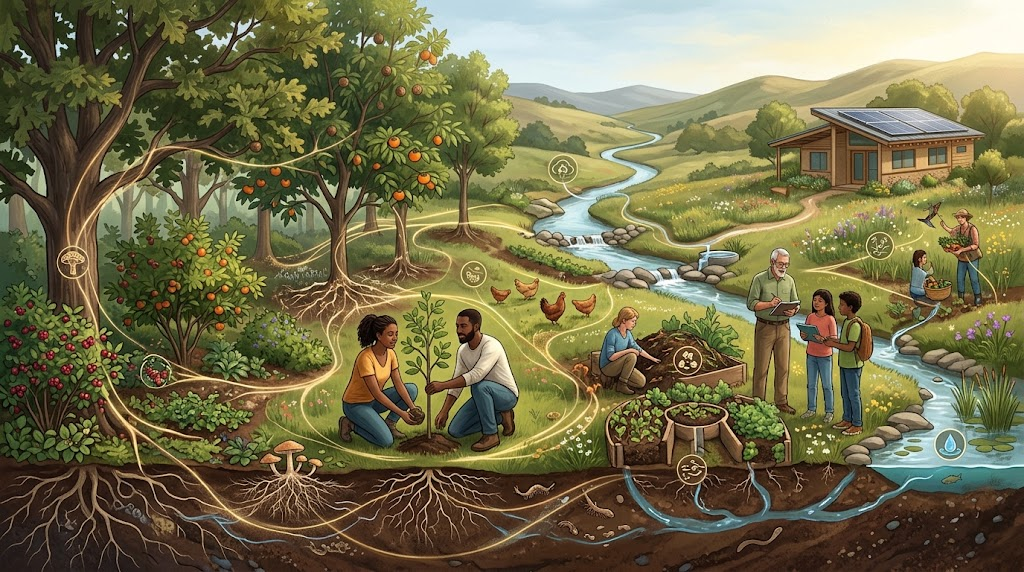
The challenges facing the natural world and human societies are rarely isolated. Soil degradation, biodiversity loss, climate change, water scarcity, economic inequality, and community fragmentation are interconnected problems. Addressing one issue without understanding its relationship to others can create unintended consequences or simply move a problem from one place to another.
This is where regenerative systems thinking becomes essential.
Regenerative systems thinking is an approach to understanding and improving the relationships between living systems, human communities, economies, and the natural environment. Rather than treating individual problems as separate challenges, it examines how different elements interact, influence one another, and contribute to the overall health of a system.
For permaculture practitioners, this perspective is particularly valuable. Permaculture is built around observing natural patterns, understanding relationships, and designing systems that support life. Regenerative systems thinking takes these ideas further by encouraging practitioners to consider entire landscapes, communities, and social structures when developing solutions.
For students pursuing a permaculture diploma, learning to think systemically is an important step toward becoming a capable designer. It helps transform theoretical knowledge into practical solutions that address underlying causes rather than temporary symptoms.
This guide explores the meaning of regenerative systems thinking, its relationship with permaculture, its fundamental principles, and practical ways to apply it in ecological and community-based projects.
1. What Is Regenerative Systems Thinking?
Regenerative systems thinking combines two complementary approaches: systems thinking and regenerative design.
Systems thinking is the practice of understanding how different parts of a system relate to and influence one another. It recognizes that the behavior of a whole system cannot always be understood by examining its individual components.
Regenerative thinking focuses on creating conditions that allow living systems to restore, renew, and improve their capacity to support life.
Together, these approaches encourage people to move beyond reducing environmental damage toward actively improving ecological and social conditions.
For example, consider a farming landscape experiencing declining soil fertility.
A conventional response might involve introducing additional fertilizers to increase crop production. Although this could improve short-term yields, it may not address the underlying causes of soil degradation.
A regenerative systems approach would investigate a wider range of relationships:
- How does rainfall move through the landscape?
- What is happening to soil organic matter?
- Are agricultural practices affecting soil organisms?
- How does vegetation influence water retention?
- Are livestock management practices contributing to soil degradation?
- How do economic pressures influence farmers’ decisions?
- What role does local knowledge play in land management?
By examining these connections, practitioners can develop interventions that address several related challenges simultaneously.
The objective is not simply to improve one agricultural outcome. It is to strengthen the overall capacity of the landscape to function as a living system.
The Difference Between Linear and Systems Thinking
Linear thinking generally follows a straightforward cause-and-effect structure. It assumes that a particular problem can be addressed by identifying a direct cause and applying a solution.
Systems thinking recognizes that real-world problems often involve multiple causes, feedback loops, delays, and unexpected interactions.
Consider the following comparison:
| Linear thinking | Regenerative systems thinking |
|---|---|
| Focuses on individual problems | Examines interconnected challenges |
| Looks for immediate solutions | Considers long-term consequences |
| Treats resources as separate inputs | Understands resources as interconnected flows |
| Measures isolated outcomes | Evaluates whole-system health |
| Often reacts to symptoms | Investigates underlying patterns |
| Favors predictable interventions | Adapts to changing conditions |
Neither approach is automatically appropriate for every situation. However, complex ecological and social challenges generally require a broader perspective.
2. The Foundations of Regenerative Systems Thinking
Several fundamental concepts help explain how regenerative systems thinking works.
Interconnectedness
The first foundation is recognizing that everything within a system exists in relationship with other elements.
In an ecosystem, soil, water, plants, animals, microorganisms, and climate interact continuously. A change in one component can influence many others.
For example, removing trees from a hillside can affect more than the availability of timber. It may also influence:
- Soil stability and erosion.
- Water infiltration and groundwater recharge.
- Local temperatures and microclimates.
- Wildlife habitats and biodiversity.
- Carbon storage.
- Agricultural productivity.
These relationships demonstrate why isolated interventions can produce unexpected results.
Permaculture designers use interconnectedness as a foundation for creating productive landscapes. Instead of assigning every element a single function, they look for opportunities to establish beneficial relationships between multiple elements.
Feedback Loops
Feedback loops describe processes in which the results of an action influence the system that produced them.
There are two broad types of feedback loops.
Reinforcing feedback loops amplify an existing change. They can create either beneficial or harmful outcomes.
For example, increasing vegetation cover can improve soil protection. Better soil conditions may support more plant growth, which further increases vegetation cover.
This creates a reinforcing cycle that supports ecosystem recovery.
Balancing feedback loops counteract changes and help maintain stability.
For example, when plant growth increases, competition for available water and nutrients may also increase. These limiting factors can moderate further growth.
Understanding feedback loops helps permaculture practitioners identify processes that strengthen or weaken ecological resilience.
Emergent Properties
Emergent properties are characteristics that arise from interactions between different parts of a system.
A healthy forest, for example, provides far more than the combined individual functions of its trees, plants, fungi, insects, and animals.
Their interactions create complex ecological processes, including nutrient cycling, habitat formation, water regulation, and soil development.
These outcomes cannot be fully understood by studying each organism independently.
For permaculture diploma students, this concept highlights the importance of designing relationships rather than simply collecting useful elements.
System Boundaries and Context
Every system has boundaries, although these boundaries are often flexible and influenced by the purpose of an investigation.
A farm can be considered a system, but it is also part of a watershed, a local economy, and a wider ecosystem.
The boundaries chosen by a designer influence which relationships become visible.
For example, examining a farm only within its property boundaries may overlook the effects of upstream water management or regional market conditions.
Regenerative systems thinking encourages practitioners to identify the appropriate scale of analysis and remain aware of influences beyond the immediate project.
3. The Relationship Between Permaculture and Regenerative Systems Thinking
Permaculture provides a practical framework for applying systems thinking to land use, food production, settlement design, and community development.
Its ethical foundations are commonly expressed through three central commitments:
- Earth Care: Protecting and restoring the natural systems that support life.
- People Care: Supporting human well-being, relationships, and equitable access to essential resources.
- Fair Share: Recognizing limits and distributing surplus responsibly.
These ethics encourage designers to consider ecological and social consequences together.
Regenerative systems thinking strengthens this approach by helping practitioners understand how decisions in one area influence outcomes elsewhere.
Applying Systems Thinking to Permaculture Design
Imagine designing a small regenerative farm.
A conventional approach might divide the project into separate categories, such as vegetable production, livestock, irrigation, and composting.
A systems-oriented designer instead investigates how these elements can support one another.
For example:
- Vegetable production generates organic residues.
- Organic residues become inputs for composting.
- Compost improves soil structure and fertility.
- Healthy soil supports plant growth and water retention.
- Diverse vegetation provides habitat for beneficial organisms.
- Livestock can contribute manure and help manage vegetation when appropriately integrated.
- Rainwater harvesting supports production during dry periods.
The result is a network of relationships in which different elements perform multiple functions.
This is a fundamental principle of permaculture design: creating productive relationships that reduce waste, improve resource efficiency, and strengthen the resilience of the whole system.
4. Regenerative Systems Thinking and the Permaculture Design Principles
The twelve widely taught permaculture design principles offer useful guidance for applying systems thinking in practical situations.
Several principles have particularly strong connections to regenerative systems approaches.
Observe and Interact
Effective design begins with understanding the existing system.
Observation involves studying ecological patterns, seasonal changes, resource flows, human activities, and environmental conditions before introducing interventions.
For diploma students, this means spending time understanding a site rather than immediately deciding what should be built or planted.
Catch and Store Energy
Energy exists in many forms, including sunlight, water, organic matter, and human knowledge.
Regenerative systems thinking encourages designers to identify where energy enters a system, how it moves, and where it can be stored for future use.
Examples include rainwater harvesting, soil organic matter accumulation, and the preservation of local knowledge.
Obtain a Yield
A regenerative system must provide meaningful outputs while maintaining or improving the conditions that support future production.
Yields can include food, clean water, healthy soil, biodiversity, educational opportunities, and community benefits.
This broader understanding helps practitioners avoid measuring success through production volume alone.
Apply Self-Regulation and Accept Feedback
Every intervention produces consequences.
Designers must monitor these outcomes and adapt their decisions when conditions change.
For example, a newly established food forest may require different management as trees mature and the microclimate develops.
Feedback helps practitioners identify which design assumptions were correct and which require adjustment.
Integrate Rather Than Segregate
This principle is especially relevant to systems thinking.
Instead of placing elements in isolation, designers seek relationships that allow them to support one another.
A well-designed food forest, for example, can integrate fruit trees, shrubs, ground covers, climbing plants, soil organisms, and wildlife habitats.
The strength of the system comes from the relationships between its components.
Use and Value Diversity
Biological, cultural, and economic diversity can help systems respond to changing conditions.
A diverse agricultural system may be better equipped to manage certain pests, environmental stresses, and market fluctuations than one dependent on a single crop or income source.
Diversity also creates opportunities for cooperation and innovation.
5. Understanding Systems Mapping and Ecological Relationships
One practical method for developing regenerative systems thinking is systems mapping.
Systems mapping involves visually representing the components of a system and the relationships between them.
It helps designers understand how different processes interact and where an intervention might create meaningful change.
For permaculture diploma seekers, systems mapping can be used to analyze farms, gardens, watersheds, community food networks, and local economies.
How to Create a Basic Systems Map
Start by defining the system you want to understand.
For example, you might investigate declining soil health on a small farm.
Step 1: Identify the Main Elements
List the important components involved in the system:
- Soil structure.
- Organic matter.
- Rainfall.
- Vegetation.
- Livestock.
- Agricultural practices.
- Farm income.
- Labor availability.
Step 2: Identify Relationships
Determine how these elements influence one another.
For example, vegetation cover influences soil protection, while soil health influences plant growth.
Step 3: Identify Feedback Loops
Look for relationships that reinforce or regulate existing conditions.
Increasing organic matter can improve soil structure, which may support greater plant growth and additional organic matter production.
Step 4: Identify External Influences
Consider factors outside the immediate site, such as climate conditions, market demand, local regulations, and regional water management.
Step 5: Identify Potential Intervention Points
Look for opportunities to improve several connected processes through one well-considered intervention.
For example, introducing appropriate perennial vegetation may support soil protection, habitat creation, water management, and long-term biomass production.
Step 6: Monitor and Update the Map
Systems are dynamic. New information may reveal relationships that were not obvious during the initial assessment.
A systems map should therefore be treated as a working model rather than a permanent representation of reality.
6. Practical Applications of Regenerative Systems Thinking
Regenerative systems thinking can be applied at different scales, from individual gardens to regional development projects.
Understanding how the approach works in different contexts helps permaculture students develop transferable design skills.
Regenerative Agriculture
Agriculture is one of the clearest areas where systems thinking can improve decision-making.
Agricultural landscapes depend on relationships between soil, water, plants, animals, microorganisms, climate, and people.
A regenerative agricultural approach may combine:
- Crop diversity and appropriate rotations.
- Perennial planting systems.
- Ground cover and soil protection.
- Composting and nutrient cycling.
- Integrated livestock management.
- Water conservation.
- Habitat restoration.
These practices should be selected according to local ecological conditions rather than applied as a universal checklist.
The goal is to develop agricultural systems that maintain productive capacity while improving ecological functions.
Water Management and Watershed Restoration
Water management demonstrates why designing within ecological boundaries is important.
Water moves across landscapes through rainfall, infiltration, groundwater, surface runoff, evaporation, and transpiration.
A change in vegetation cover or land management can influence several of these processes.
For example, restoring vegetation in an appropriate part of a catchment can help protect soil, improve infiltration, and create habitat.
However, effective watershed management requires consideration of the entire hydrological context, including upstream and downstream communities.
A project that improves water availability in one location should not create additional problems elsewhere.
Community Resilience
Regenerative systems thinking is equally important in social systems.
Communities depend on networks of relationships involving food, education, health, local businesses, infrastructure, cultural knowledge, and governance.
A community food project, for example, can produce benefits beyond food availability.
It may also:
- Strengthen relationships between residents.
- Create educational opportunities.
- Support local producers.
- Encourage knowledge sharing.
- Improve access to nutritious food.
- Develop local organizational capacity.
These wider benefits become visible when practitioners consider the project as part of a larger social system.
Regenerative Economics
Economic systems influence how natural and human resources are used.
A conventional economic assessment may focus primarily on financial returns while overlooking ecological degradation, social costs, and long-term resource depletion.
Regenerative economic thinking asks how economic activity can contribute to the health and resilience of the systems on which it depends.
Examples include local food networks, cooperative enterprises, repair and reuse initiatives, community-supported agriculture, and locally rooted regenerative businesses.
For permaculture designers, these ideas help connect ecological design with viable livelihoods.
7. Developing Systems Thinking Skills as a Permaculture Diploma Student
Understanding regenerative systems thinking requires more than reading about ecological relationships.
It develops through observation, experimentation, reflection, documentation, and practical design work.
Students pursuing a permaculture diploma can strengthen their systems thinking abilities through several activities.
Practice Whole-System Observation
Choose a site that you can observe regularly.
It might be a garden, farm, community space, woodland, or neighborhood.
Study its ecological and social characteristics.
Pay attention to:
- Seasonal patterns.
- Water movement.
- Soil conditions.
- Vegetation structure.
- Wildlife activity.
- Resource inputs and outputs.
- Human activities.
- Existing relationships between different elements.
Record your observations over time.
Repeated observation helps distinguish temporary conditions from longer-term patterns.
Develop Multiple-Scale Thinking
Practice looking at the same challenge from different perspectives.
For example, a vegetable garden can be examined at several scales:
- The individual plant.
- The garden bed.
- The whole garden.
- The household food system.
- The neighborhood food network.
- The regional agricultural system.
Each scale reveals different relationships and potential interventions.
This ability is particularly useful when designing projects that interact with wider ecological and social processes.
Learn to Identify Root Causes
When investigating a problem, avoid immediately jumping to solutions.
Ask why the problem exists and what processes contribute to it.
For example, poor vegetable production may result from several interconnected factors, including soil compaction, insufficient organic matter, unsuitable plant selection, irregular watering, or limited sunlight.
Identifying the underlying conditions helps prevent unnecessary interventions.
Experiment and Learn From Feedback
Small experiments provide valuable opportunities to test design assumptions.
You might compare different mulching approaches, observe the effects of increased plant diversity, or monitor how a water-management intervention changes soil moisture.
Record what happens and consider why.
Not every experiment will produce the expected outcome. That is part of the learning process.
A regenerative practitioner should be prepared to revise decisions when evidence indicates that a different approach is needed.
Document the Learning Journey
Documentation is an essential part of professional permaculture practice.
Maintain records of:
- Initial site observations.
- Design objectives.
- Systems maps.
- Research findings.
- Design decisions.
- Implementation activities.
- Monitoring results.
- Reflections and lessons learned.
This documentation creates a clear record of how your understanding and design decisions develop over time.
It also helps communicate your work to mentors, collaborators, clients, and other practitioners.
8. Systems Thinking Tools for Regenerative Designers
Several practical tools can support the development of regenerative systems thinking.
Causal Loop Diagrams
Causal loop diagrams illustrate how variables influence one another through feedback relationships.
They are useful for understanding reinforcing and balancing feedback loops.
For example, increased vegetation cover may improve soil protection, which supports better growing conditions and further vegetation development.
A causal loop diagram makes these relationships easier to discuss and investigate.
Resource Flow Analysis
Resource flow analysis examines how materials, water, energy, nutrients, and other resources move through a system.
In a farm, this could involve tracking:
- Water entering and leaving the property.
- Organic materials produced and reused.
- Nutrient inputs and outputs.
- Energy requirements.
- Food production and distribution.
The analysis can reveal opportunities to reduce waste and establish more effective resource cycles.
Stakeholder Mapping
Social systems involve people and organizations with different interests, knowledge, responsibilities, and levels of influence.
Stakeholder mapping helps identify these relationships.
For example, a community food project may involve farmers, residents, schools, local businesses, community organizations, and municipal authorities.
Understanding their perspectives can improve collaboration and reduce the likelihood of designing solutions that overlook important community needs.
Scenario Planning
Scenario planning explores how a system might respond under different future conditions.
A permaculture designer could consider several possibilities:
- A period of prolonged drought.
- Changes in local food demand.
- Reduced availability of external resources.
- Increased community participation.
- Changes in land ownership.
Considering alternative scenarios helps create designs that can adapt rather than depend on one predicted future.
Monitoring and Evaluation
Regenerative projects require appropriate indicators to understand whether conditions are improving.
Depending on the project, these indicators might include:
- Soil organic matter.
- Soil infiltration rates.
- Plant diversity.
- Pollinator activity.
- Water consumption.
- Local food production.
- Community participation.
- Financial viability.
It is important to combine measurable indicators with qualitative observations.
For example, a community project may show improved participation through attendance records, but interviews may reveal additional changes in trust, collaboration, and local knowledge sharing.
9. Common Challenges When Applying Regenerative Systems Thinking
Although systems thinking offers significant opportunities, applying it in real-world projects can be challenging.
Complexity and Information Overload
Living systems contain many interacting variables.
Trying to understand everything at once can make decision-making difficult.
A practical response is to begin with a clearly defined question, identify the most relevant relationships, and gradually expand the analysis as new information becomes available.
The objective is not to create a perfect model of reality. It is to develop a useful understanding that supports better decisions.
Unintended Consequences
An intervention designed to improve one part of a system may create difficulties elsewhere.
For example, introducing a new crop may increase production but also increase water demand or labor requirements.
Before implementing a design, consider possible indirect effects and identify ways to monitor them.
Short-Term and Long-Term Conflicts
Regenerative processes often require time.
Soil development, habitat restoration, community trust, and local economic resilience cannot always be achieved quickly.
Project planning should therefore distinguish immediate outcomes from longer-term changes.
A realistic implementation strategy can combine short-term benefits with activities that strengthen the system over time.
Balancing Different Interests
Ecological, social, and economic priorities do not always align automatically.
A land restoration project may require changes to existing livelihood practices. A community enterprise may face financial pressures that conflict with its ecological objectives.
Systems thinking encourages transparent communication, participation, and consideration of different perspectives.
It does not eliminate conflicts, but it can help practitioners understand their causes and explore more balanced responses.
10. Regenerative Systems Thinking as a Foundation for Professional Permaculture Practice
For permaculture diploma seekers, regenerative systems thinking is more than an academic concept.
It is a practical capability that supports the development of thoughtful, context-sensitive design work.
A competent permaculture designer must be able to observe a site, interpret ecological relationships, understand human needs, identify constraints, and develop solutions that respond to the wider context.
Systems thinking helps connect these responsibilities.
It also supports professional development in several areas.
Becoming a More Effective Designer
Designers who understand interconnectedness are better equipped to recognize opportunities for integration.
Instead of creating separate solutions for water, soil, food, and energy, they can explore how these elements might support one another.
This leads to more coherent design proposals.
Building Collaborative Relationships
Regenerative projects often involve people from different disciplines and backgrounds.
A systems perspective helps practitioners understand how different forms of knowledge contribute to a shared project.
It encourages communication between ecological specialists, farmers, educators, community organizers, and local decision-makers.
Creating Evidence-Based Portfolios
A professional permaculture portfolio should demonstrate more than the ability to produce attractive design drawings.
It should explain the reasoning behind design decisions.
Students can strengthen their portfolios by documenting:
- The original site conditions.
- The system boundaries and context.
- Key relationships and feedback loops.
- The design objectives.
- Selected interventions.
- Implementation processes.
- Monitoring methods.
- Observed outcomes.
- Lessons for future development.
This approach demonstrates the ability to connect theory with practical application.
Developing a Lifelong Learning Practice
Regenerative systems are dynamic. Conditions change, new information becomes available, and interventions produce results that may differ from initial expectations.
Consequently, professional development should remain an ongoing process.
Permaculture practitioners benefit from continuously observing, researching, experimenting, collaborating, and reflecting on their work.
This learning orientation is especially relevant to complex projects where there is no single predetermined solution.
11. Learning Regenerative Systems Thinking Through Action Learning
One effective way to develop systems thinking is through action learning.
Action learning combines practical work with structured reflection. Instead of separating education from real-world application, students use actual projects as opportunities to develop knowledge and skills.
For example, a diploma student might choose to develop a community garden.
The learning process could involve:
- Investigating the ecological and social context.
- Identifying community needs and project objectives.
- Mapping the relationships between resources, people, and ecological processes.
- Developing an integrated permaculture design.
- Implementing selected elements.
- Monitoring outcomes.
- Reflecting on challenges and unexpected results.
- Updating the design based on new knowledge.
This process helps students develop practical experience while building a deeper understanding of systems behavior.
At Gaia University, learning pathways connect regenerative design, practical projects, self-directed learning, and documented action learning.
Students interested in this educational approach can explore the International Diploma of Permaculture Design and other program offerings.
The university’s approach to learning through projects also emphasizes the importance of documenting decisions, reflecting on experience, and sharing knowledge with a wider learning community.
These practices help learners move beyond theoretical understanding toward the practical capabilities required for ecosocial regeneration.
12. A Practical Framework for Applying Regenerative Systems Thinking
Permaculture diploma students can use the following framework when approaching a new design project.
1. Understand the Context
Investigate the ecological, social, cultural, and economic conditions surrounding the project.
2. Define the System
Establish the boundaries of your investigation while recognizing connections to larger systems.
3. Observe Relationships
Identify important elements and examine how they influence one another.
4. Recognize Patterns
Look for recurring processes, resource flows, feedback loops, and limiting factors.
5. Identify Opportunities
Consider where a change could generate multiple positive outcomes.
6. Develop an Integrated Design
Select interventions that respond to the specific context and support the health of the wider system.
7. Implement and Monitor
Introduce changes at an appropriate scale and monitor their effects using relevant indicators.
8. Reflect and Adapt
Evaluate results, identify unintended consequences, and modify the design when necessary.
This framework is not a rigid sequence. In practice, designers often revisit earlier stages as their understanding develops.
The important point is to treat design as an ongoing process of learning and adaptation.
Conclusion: Thinking in Relationships to Create Regenerative Futures
Regenerative systems thinking provides an essential perspective for people working toward ecological restoration, resilient communities, and sustainable livelihoods.
It encourages practitioners to understand the relationships that shape living systems rather than approaching environmental and social challenges as isolated problems.
For permaculture designers, this means looking beyond individual techniques and asking how different elements can work together to improve the health and resilience of an entire system.
Whether applied to regenerative agriculture, watershed restoration, community development, or local economic initiatives, systems thinking helps practitioners identify underlying patterns, understand feedback, anticipate unintended consequences, and develop more integrated solutions.
For permaculture diploma seekers, the most valuable way to develop this capability is through practical experience. Observe real systems, create design maps, experiment with interventions, document outcomes, and continuously reflect on what you learn.
Regeneration is not simply about maintaining existing conditions or reducing environmental damage. It is about developing the relationships, capacities, and conditions that allow ecological and social systems to thrive.
By combining systems thinking with permaculture ethics and practical action learning, future designers can contribute to a more resilient and regenerative world.


Responses