
Permaculture Course Online Free: A Practical Guide for Aspiring Permaculture Diploma Seekers

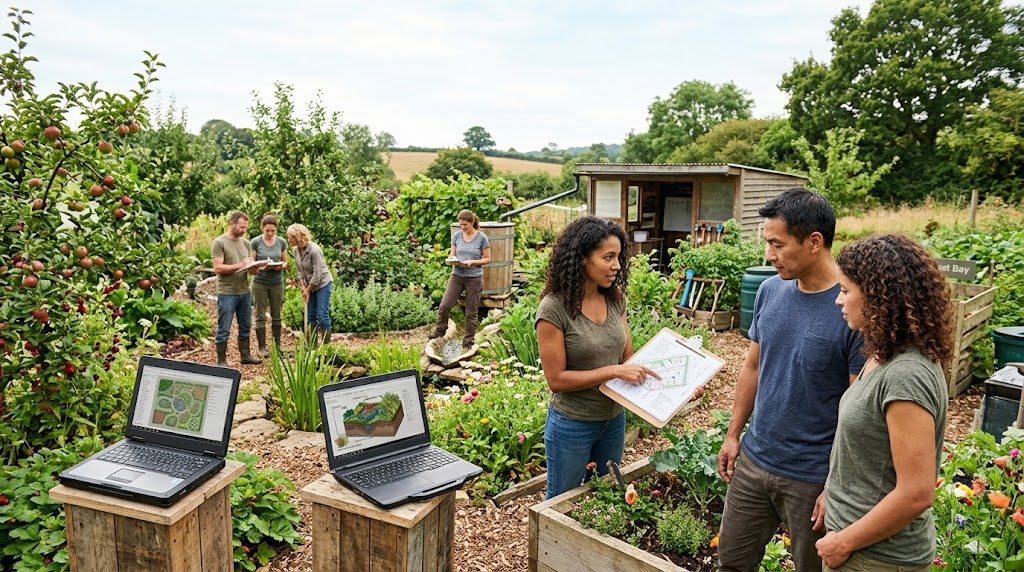
Introduction
Interest in permaculture continues to grow among people who want to understand ecological design, regenerative practices, resilient communities, and more sustainable ways of living. But for many beginners, the first challenge is knowing where to start.
A permaculture course online free can be an accessible starting point. Free online learning allows you to explore permaculture concepts, understand whether the field matches your goals, and begin developing a foundation before committing to a more advanced educational pathway.
For someone planning to pursue a permaculture diploma, however, free learning should be viewed as more than a collection of interesting articles or videos. The real value comes from turning information into skills through observation, design exercises, reflection, documentation, and practical projects.
This guide explains what you can expect from free online permaculture education, how to evaluate a course, what subjects to study, and how free learning can fit into a longer-term pathway toward permaculture design and diploma-level education.
What Is a Permaculture Course Online Free?
A permaculture course online free is an educational resource or course that allows learners to study permaculture concepts without paying tuition for the learning materials or participation.
The format can vary considerably. Some free courses are structured programs with modules and activities, while others provide self-paced readings, introductory lessons, recorded presentations, or guided exercises.
A useful introductory course may cover subjects such as:
- Permaculture ethics
- Permaculture design principles
- Systems thinking
- Ecological observation
- Soil and water management
- Food systems
- Regenerative agriculture
- Community resilience
- Natural patterns
- Sustainable resource use
- Design methodology
- Project planning
The important distinction is between access to information and structured education. A collection of free resources can help you learn, but a well-designed course gives your learning a sequence and purpose.
For diploma seekers, this distinction matters because advanced study generally requires learners to move beyond simply understanding concepts and demonstrate that they can apply them.
Why Study Permaculture Online for Free?
There are several reasons an aspiring permaculture student may begin with free online learning.
1. It Reduces the Barrier to Getting Started
You do not need to make a major educational commitment before discovering whether permaculture is right for you.
A free course can introduce you to the terminology, philosophy, and design approach used in the field. This gives you a better basis for deciding whether further study is worthwhile.
2. You Can Learn at Your Own Pace
Online learning is particularly useful when your schedule does not fit a traditional classroom.
Self-paced resources allow you to:
- Study when convenient
- Revisit difficult concepts
- Take notes gradually
- Combine learning with practical projects
- Develop your own learning routine
This flexibility can be valuable for future diploma seekers who expect to combine education with work, community projects, or other responsibilities.
3. You Can Test Your Interests
Permaculture is a broad field. You may initially be interested in gardening but later discover that your strongest interest is ecological design, community development, regenerative livelihoods, water systems, or social transformation.
Free introductory education gives you an opportunity to explore these areas before selecting a specialization or advanced pathway.
4. It Encourages Independent Learning
Permaculture education is closely connected with observation and experimentation.
Instead of asking only, “What does the textbook say?”, permaculture encourages questions such as:
- What patterns exist in this landscape?
- Where does water naturally move?
- What resources are already available?
- What relationships exist between different elements?
- What problems could be solved by redesigning the system?
- How could one element provide several useful functions?
A free online course can therefore become the beginning of a much broader independent learning process.
What Should You Learn in a Free Permaculture Course?
If your long-term objective is a permaculture diploma, prioritize courses that introduce fundamental concepts rather than focusing narrowly on individual techniques.
Permaculture Ethics
Ethics provide an important foundation for permaculture thinking.
The commonly taught ethical framework includes:
- Care for the Earth
- Care for people
- Fair share
These ideas influence how designers think about resources, communities, ecosystems, and long-term consequences.
Understanding the ethical foundation helps prevent permaculture from becoming simply a collection of gardening techniques.
Permaculture Principles
Permaculture principles provide practical guidance for designing systems.
Rather than memorizing principles as isolated statements, try to understand how they influence decisions.
For example, a designer may consider how one resource can perform multiple functions, how existing natural patterns can be used, or how relationships between elements can reduce waste and increase resilience.
The goal is to develop a design mindset.
Systems Thinking
Systems thinking is one of the most important skills for anyone considering advanced permaculture education.
A garden is not simply a collection of plants. It is connected to soil, water, sunlight, climate, microorganisms, people, energy, materials, and surrounding ecosystems.
Similarly, a community project is connected to social, economic, cultural, and environmental factors.
Systems thinking helps you identify these relationships rather than treating every problem as an isolated issue.
Observation
Good design begins with observation.
Before changing a landscape or system, learners should understand its existing characteristics.
Observation can include:
- Sun and shade patterns
- Wind exposure
- Water movement
- Existing vegetation
- Soil characteristics
- Human activity
- Available resources
- Seasonal changes
- Existing problems and opportunities
This is a skill you can begin practicing without purchasing specialized equipment.
Choose a small area and observe it repeatedly over time. Record what changes. Compare observations and look for patterns.
Ecological Design
Ecological design asks how human systems can function more effectively while respecting natural processes.
You might study relationships among:
- Landscapes
- Food production
- Water
- Energy
- Buildings
- Waste
- Biodiversity
- Human communities
The objective is not to copy nature literally but to learn from ecological relationships and apply those insights appropriately.
Free Learning vs. a Formal Permaculture Certificate
One important consideration for diploma seekers is the difference between free educational content and formal certification.
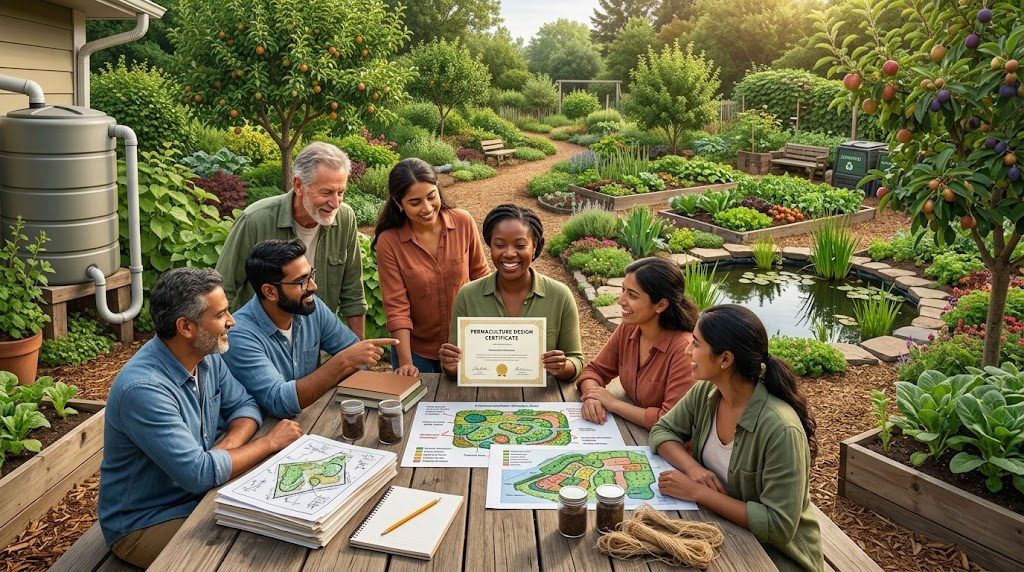
A free resource may teach valuable knowledge without providing an academic or professional credential. A structured Permaculture Design Certificate, commonly called a PDC, generally represents a more organized educational experience with defined learning outcomes.
A certificate pathway can provide:
- A structured curriculum
- Assignments or design activities
- Feedback
- A learning community
- Documentation of completed work
- A clearer progression toward advanced study
This does not make free education unimportant. In fact, free learning can be an excellent preparation step.
The key is to understand what you are receiving.
Before enrolling in any program, ask:
Is this simply free educational content, or does it provide a formal certificate?
Is there instructor feedback?
Are there practical assignments?
Will I create a portfolio of work?
Does the program connect naturally with further study?
These questions help you distinguish between casual introductory learning and a structured educational pathway.
Can a Free Online Course Prepare You for a Permaculture Diploma?
Yes, but preparation is different from qualification.
A free course can help you establish foundational knowledge before entering a diploma program. It can also help you develop the habits required for project-based learning.
However, becoming a capable permaculture designer requires practice.
Gaia University describes its International Diploma of Permaculture Design as an advanced program designed for learners who have completed a Permaculture Design Course. Its approach combines project design, documentation, mentoring, feedback, and practical application.
This illustrates an important progression:
Free learning → foundational study → practical application → documented projects → advanced education
The exact pathway will differ between institutions, but the principle is broadly useful: information becomes more valuable when you apply it.
How to Turn Free Learning Into Practical Experience
One of the biggest mistakes beginners make is consuming large amounts of educational content without applying it.
Instead, create a small personal project.
It could involve observing:
- A garden
- A balcony growing space
- A community area
- A small landscape
- Household resource flows
- A local food system
You do not need to redesign an entire property.
Start by documenting what you see.
Step 1: Observe
Spend several sessions observing the site.
Record sunlight, shade, water movement, vegetation, human use, and other relevant factors.
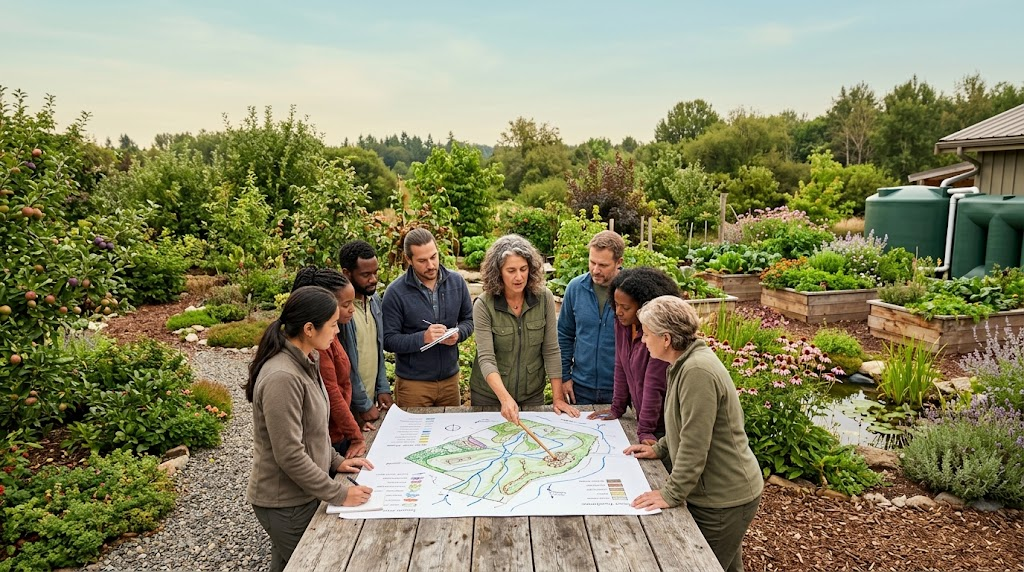
Step 2: Map
Create a simple map showing the major elements.
The map does not need to be professionally produced. Its purpose is to help you visualize relationships.
Step 3: Identify Resources
List resources already available.
These might include:
- Sunlight
- Water
- Existing plants
- Organic material
- Structures
- Human skills
- Available space
- Local knowledge
Step 4: Identify Problems
Write down constraints and challenges.
For example:
- Water is difficult to access
- Certain areas receive excessive shade
- Organic material is being discarded
- Space is underused
- Existing systems require unnecessary maintenance
Step 5: Explore Design Ideas
Develop several possible solutions rather than immediately choosing one.
Compare their benefits, limitations, resource requirements, and potential effects on other parts of the system.
Step 6: Document Your Learning
Keep notes about what you observed, what you designed, what you changed, and what you learned.
This habit is especially valuable for future diploma study because documentation can demonstrate how your thinking develops over time.
What Makes a Good Free Permaculture Course?
Not every free course offers the same educational value.
When evaluating a permaculture course online free, consider these characteristics.
Clear Learning Objectives
A good course should explain what you will understand or be able to do after completing it.
Logical Structure
Look for material that progresses from foundational ideas toward application.
A logical sequence might move from ethics and principles to observation, systems thinking, design methods, and practical exercises.
Practical Activities
Permaculture is fundamentally connected to application.
Courses that include observation exercises, design activities, reflections, or projects can provide greater value than passive content alone.
Opportunities for Reflection
Permaculture design involves decision-making and learning from experience.
Reflection helps you understand not just what you did but why you made particular choices.
Reliable Educational Context
Check who created the course and what educational philosophy informs it.
A clearly identified provider with transparent information about its programs, learning approach, and progression options is generally easier to evaluate.
How Gaia University Fits Into the Learning Pathway
For learners specifically interested in combining permaculture with broader regenerative and ecosocial learning, Gaia University offers both free introductory courses and formal educational programs.
Its program offerings page lists Regenerative Livelihoods by Design as a free, self-paced course that introduces learners to its approach to learning and unlearning. The same page distinguishes its free courses from certificate and diploma programs.
This distinction is useful for diploma seekers.
A free course can help you explore an educational approach without immediately committing to a longer program. If you decide that you want to continue, you can investigate the more structured options.
Gaia University’s diploma information also explains that its diploma pathways use a combination of online learning, practical action, documentation, mentoring, and project work.
For someone searching specifically for a free starting point, the important lesson is to use introductory education strategically rather than treating it as the final destination.
Building a Learning Portfolio
If you are considering a future permaculture diploma, begin documenting your learning from the start.
A simple portfolio might contain:
- Course notes
- Observation journals
- Site maps
- Design sketches
- Project descriptions
- Reflections
- Photographs of project progress
- Challenges encountered
- Lessons learned
- Ideas for future improvements
A portfolio can help transform informal learning into evidence of developing competence.
For example, instead of writing:
“I learned about water management.”
You could document:
“I observed how rainfall moves across the site, mapped the main flow patterns, identified areas of accumulation, and developed several possible approaches for improving water use.”
The second example demonstrates a process of observation, analysis, design, and reflection.
That is much closer to the mindset required for advanced permaculture practice.
Common Mistakes When Taking Free Online Courses
Free education is valuable, but it has limitations.
Mistake 1: Collecting Courses Instead of Practicing
Completing ten introductory courses does not necessarily create more skill than completing one course and applying its concepts carefully.
Prioritize application.
Mistake 2: Expecting a Free Course to Replace Advanced Training
Introductory resources can establish foundations, but advanced design requires deeper practice, feedback, and project experience.
Mistake 3: Focusing Only on Gardening
Permaculture is broader than gardening.
Explore ecological systems, community resilience, resource management, design thinking, and human systems as well.
Mistake 4: Ignoring Local Conditions
Permaculture design is context-dependent.
A technique that works well in one climate, landscape, or community may not be appropriate somewhere else.
Learn the principles behind techniques rather than copying solutions without analysis.
Mistake 5: Not Documenting Your Work
Your learning becomes easier to evaluate and improve when you keep records.
Documentation also becomes increasingly useful if you later pursue formal education.
A Simple Learning Plan for Aspiring Diploma Students
If your goal is eventually to pursue a permaculture diploma, consider the following progression.
Month 1: Foundations
Study:
- Permaculture ethics
- Core principles
- Systems thinking
- Ecological relationships
Create a personal glossary of important terms.
Month 2: Observation
Choose a small site and conduct regular observations.
Document:
- Sun
- Water
- Wind
- Plants
- Soil
- Human activity
- Seasonal changes
Month 3: Design
Create a simple site map.
Identify relationships, resources, challenges, and opportunities.
Develop several possible interventions.
Month 4: Practical Application
Implement a manageable project where appropriate.
Record what happens rather than assuming your original design will work perfectly.
Month 5: Reflection
Review your observations and project results.
Ask:
- What worked?
- What did not work?
- What surprised me?
- What assumptions were incorrect?
- What would I change?
- What did I learn about the system?
Month 6: Explore Formal Study
Once you understand the foundations, compare certificate and diploma pathways.
Look at curriculum, mentoring, project requirements, learning format, expected workload, and progression opportunities.
This approach makes your educational decision much more informed.
Frequently Asked Questions
Is a permaculture course online free suitable for beginners?
Yes. Free online learning can be an effective introduction for beginners who want to understand basic permaculture concepts before pursuing more structured education.
Can I earn a permaculture diploma from a free course?
Generally, a free introductory course should not automatically be assumed to provide a diploma. Check the provider’s specific credential and progression information.
Free learning is best treated as preparation unless the provider explicitly states that the course leads to a recognized qualification.
Is online permaculture education practical?
It can be. The strongest online learning experiences combine digital instruction with observation, projects, design exercises, reflection, and real-world application.
What should I study before pursuing a permaculture diploma?
Begin with permaculture ethics and principles, systems thinking, observation, ecological design, and basic design methodology. Then start applying those concepts through small projects.
Do I need previous experience?
Not necessarily. Introductory permaculture education can be suitable for beginners. What matters most is a willingness to observe carefully, learn continuously, and apply ideas in real situations.
Is free permaculture education enough to become a designer?
Free education can provide useful foundations, but competence comes from continued practice, project experience, feedback, and deeper study.
What should I look for in an advanced program?
For diploma-level study, consider the quality of mentoring, project-based learning, documentation requirements, curriculum, community support, flexibility, and how the program helps you develop demonstrable skills.
Final Thoughts
Searching for a permaculture course online free is a sensible way to begin exploring ecological design without making an immediate financial or educational commitment.
The most effective approach, however, is to think beyond simply completing a course.
Learn the fundamentals. Observe real systems. Create maps. Test ideas. Document your work. Reflect on the results. Gradually move from consuming information to designing and doing.
For aspiring permaculture diploma seekers, this progression is particularly important. A free online course can provide the first layer of knowledge, while structured certificates, practical projects, mentoring, and diploma-level study can help develop that foundation into deeper competence.
The ultimate objective is not simply to collect another course completion. It is to develop the ability to understand interconnected systems and design thoughtful, regenerative responses to real-world challenges.
If you are ready to explore that journey, Gaia University’s free and formal learning pathways provide a useful starting point for comparing introductory courses, certificates, and diploma options.
Responses