
Permaculture Design Course Certificate: A Practical Guide for Future Permaculture Designers

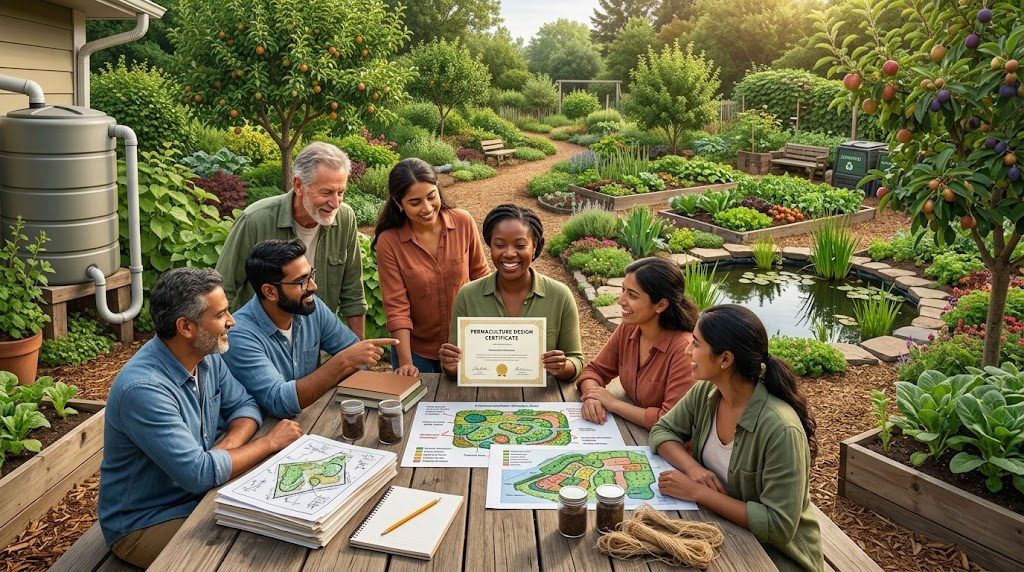
If you want to turn your interest in sustainable living, ecological design, and regenerative systems into practical knowledge, a permaculture design course certificate can be an important step. A well-designed course can introduce you to the principles behind permaculture while helping you develop the skills needed to apply them to gardens, farms, communities, landscapes, and everyday life.
For many aspiring permaculture practitioners, the certificate itself is only one part of the experience. The real value comes from learning how to observe a landscape, understand natural patterns, design integrated systems, and develop solutions that work with rather than against ecological processes.
For prospective Permaculture Diploma Seekers, understanding what a certificate represents, what a course should include, and how it fits into a longer learning pathway can make it easier to choose an educational program that matches your goals.
What Is a Permaculture Design Course Certificate?
A permaculture design course certificate is generally awarded after completing an educational program focused on the foundations and practical application of permaculture design.
Permaculture education can cover topics such as ecological observation, natural systems, soil, water, food production, energy, buildings, community systems, and sustainable resource management. A course may combine theory with practical activities, design exercises, case studies, or project work.
The certificate provides evidence that you completed the requirements of a particular course. However, certificates can differ considerably between educational providers. The title of a certificate does not automatically tell you how comprehensive a program is.
This is why prospective students should look beyond the certificate name and examine the actual curriculum, learning outcomes, teaching approach, assessment methods, project requirements, and opportunities for practical application.
A useful question is not simply, “Will I receive a certificate?”
Instead, ask:
“What will I be able to understand, design, and do after completing this course?”
That question shifts the focus from a credential alone to the knowledge and capabilities you are building.
Why Study Permaculture Design?
Permaculture provides a framework for thinking about relationships between people, landscapes, resources, and natural systems.
Rather than treating individual problems separately, permaculture encourages learners to consider how different elements can support one another. For example, water management can influence soil health, food production, biodiversity, and landscape resilience at the same time.
This systems-thinking approach is one of the reasons people study permaculture for very different purposes.
You might want to:
- Design a productive home garden.
- Develop regenerative agricultural systems.
- Improve water management.
- Restore degraded land.
- Create resilient communities.
- Explore ecological architecture.
- Develop a sustainability-focused career.
- Work on community or educational projects.
- Continue toward more advanced permaculture education.
- Apply ecological design principles to an existing profession.
A permaculture design course certificate can document your completion of foundational studies while giving you a structured framework for developing these interests.
What Should You Learn in a Permaculture Design Course?
When comparing courses, look beyond the course title and investigate the curriculum.
A strong introductory program should provide a broad understanding of permaculture rather than focusing on a single technique.
Permaculture Ethics and Principles
Permaculture education typically begins with its ethical foundations and design principles. These concepts provide a framework for thinking about responsible relationships between people and the environment.
Understanding the principles is more useful than simply memorizing them. A good course should show how they can influence actual design decisions.
Observation and Site Assessment
Observation is central to ecological design.
Before changing a landscape, designers need to understand what is already happening there. This can involve considering sunlight, wind, water movement, soil, vegetation, wildlife, existing structures, human activity, and seasonal changes.
A course should help learners develop the habit of observing first and intervening thoughtfully.
Landscape and System Design
Permaculture design involves connecting different elements into functional systems.
Students may explore concepts such as zones, sectors, patterns, relationships, resource flows, succession, edges, and appropriate placement of elements.
The objective is not simply to create attractive landscapes. It is to design systems in which different components can contribute to overall function and resilience.
Soil and Ecological Health
Healthy soil is fundamental to many land-based systems.
A permaculture course may introduce soil structure, organic matter, nutrient cycling, erosion, composting, mulching, ground cover, and biological activity.
These topics help learners understand why soil should be treated as a living system rather than simply a medium for growing plants.
Water Management
Water is another major design consideration.
Students can explore ways of understanding water movement across a landscape and designing systems that capture, store, distribute, and use water efficiently.
The appropriate approach depends heavily on local climate, terrain, regulations, available resources, and project objectives.
Food Production
Permaculture courses often explore diverse approaches to food production, including gardens, perennial systems, agroforestry, polycultures, seed systems, and ecological growing practices.
The emphasis is generally on relationships between plants, animals, soil, water, people, and other components rather than treating food production as an isolated activity.
Social and Community Systems
Permaculture is not limited to physical landscapes.
Human systems are also important. A comprehensive course can encourage learners to think about cooperation, community resilience, decision-making, education, economics, and social relationships.
This broader perspective can be especially valuable for students who want to apply permaculture principles beyond individual gardens or farms.
How a Certificate Fits Into a Permaculture Learning Path
A certificate does not necessarily represent the end of your education.
For many learners, it is one stage in a broader process that can include introductory learning, practical application, advanced study, professional development, teaching, research, or community projects.
If your long-term goal is a Permaculture Diploma, you should investigate how the course fits into your intended learning pathway before enrolling.
Consider whether the program:
- Provides foundational permaculture knowledge.
- Includes substantial design work.
- Develops practical skills.
- Encourages independent thinking.
- Provides opportunities to create real projects.
- Supports continued study.
- Matches your intended educational goals.
The most useful learning pathway is one that builds progressively. You want each stage to deepen your understanding rather than simply collect certificates.
Online vs. In-Person Permaculture Courses
One of the most important decisions is whether to study online, in person, or through a blended format.
Online Learning
An online permaculture design course can provide flexibility for students who have work, family, travel, or other commitments.
Online study may allow you to review lessons at your own pace and learn from different locations. It can also make ecological design education more accessible to people who do not live near a suitable training center.
However, online learners should actively look for ways to apply concepts to real landscapes. You can use your garden, balcony, community space, local landscape, or another suitable site as an observation and design exercise.
In-Person Learning
In-person courses can provide direct interaction with instructors, classmates, landscapes, and practical activities.
Field-based learning can be particularly useful for developing observation skills because ecological systems are dynamic and cannot always be understood through diagrams or photographs alone.
Blended Learning
A combination of online theory and practical fieldwork can provide another option.
When evaluating a program, consider the learning format in relation to your personal circumstances and learning style. The important question is whether the format enables you to understand concepts and apply them effectively.
How to Choose a Permaculture Design Course Certificate Program
Choosing a program requires more than comparing prices or searching for the word “certificate.”
Start by examining the curriculum.
1. Review the Course Content
Look for a curriculum that covers the major foundations of permaculture design.
Avoid choosing a program solely because it has an appealing title. Read the actual course description and learning outcomes.
2. Check the Learning Outcomes
Ask what you are expected to understand or produce by the end of the course.
Useful learning outcomes should describe skills and knowledge rather than simply listing topics.
For example, learning to analyze a site and develop a design is more meaningful than simply reading about site analysis.
3. Look at Project Requirements
Design projects can turn theoretical learning into practical experience.
If you are considering further permaculture education, having completed meaningful design work can also help you understand whether this field is right for you.
4. Investigate the Teaching Approach
Consider how the course is delivered.
Does it include lectures, demonstrations, discussions, assignments, case studies, design exercises, peer learning, field activities, or instructor feedback?
Different combinations can suit different learners.
5. Consider the Time Commitment
A certificate can represent anything from a short introductory experience to a substantial educational program.
Check the expected study hours, assignment requirements, project work, and course duration.
Do not judge the depth of a program solely by the time required. Instead, consider how much meaningful learning and application is included.
6. Understand the Certificate
Find out exactly what the certificate confirms.
Does it document course completion? Is there an assessment process? Are projects reviewed? What are the completion requirements?
Understanding these details prevents unrealistic expectations.
7. Consider Your Long-Term Goals
Your choice should reflect what you want to do with your knowledge.
Someone interested in transforming a backyard may need a different learning pathway from someone planning to pursue advanced ecological design education or work on larger landscape projects.
What Can You Do After Earning a Permaculture Design Course Certificate?
Completing a certificate course can be a starting point for practical experimentation and further education.
You could begin applying your knowledge to a home landscape, community garden, food-growing project, educational initiative, or ecological restoration effort.
You might also use your new skills to evaluate existing systems and identify opportunities for improvement.
For example, rather than immediately installing a new garden, you could begin by mapping the site, observing sunlight patterns, identifying water flows, analyzing existing vegetation, and documenting seasonal changes.
This design process helps transform abstract principles into practical decision-making.
For students interested in further study, the certificate can also form part of a broader educational journey.
Building a Portfolio Through Permaculture Design Projects
If your goal extends beyond personal learning, consider documenting your projects.
A simple portfolio can include:
- Site observations.
- Base maps.
- Sector analysis.
- Zone analysis.
- Soil observations.
- Water-management concepts.
- Planting plans.
- Design sketches.
- Before-and-after documentation.
- Reflections on design decisions.
- Lessons learned from implementation.
A portfolio demonstrates how you apply knowledge rather than simply showing that you completed a course.
This can be particularly valuable for learners considering future opportunities in ecological design, education, consulting, community development, or related areas.
Common Mistakes When Choosing a Certificate Course
Students sometimes focus too heavily on the credential itself.
One common mistake is assuming that every program with “permaculture” and “certificate” in its title provides the same educational experience.
Another is choosing a course based only on price.
Cost matters, but it should be considered alongside curriculum depth, instructor support, practical work, assessment, flexibility, and learning outcomes.
A third mistake is expecting a certificate to replace practical experience.
Permaculture is fundamentally applied. Reading about ecological design is useful, but observation, experimentation, implementation, and reflection deepen the learning process.
Finally, avoid choosing a course without considering what comes next. If you already know that you want to pursue more advanced permaculture education, investigate whether the introductory course supports that direction.
Is a Permaculture Design Course Certificate Worth It?
The value of a certificate depends largely on your goals and the quality of the education behind it.
If your objective is to develop a stronger understanding of ecological design, a structured course can provide a useful framework and learning sequence.
If your goal is personal application, the course can help you approach your own projects more systematically.
If you intend to pursue a longer educational pathway, the certificate may provide foundational knowledge that prepares you for more advanced study.
The important distinction is between earning a certificate and developing useful capabilities.
A certificate can document learning, but the knowledge, design thinking, practical experience, and projects you develop are what allow you to put permaculture into practice.
Preparing for a Permaculture Diploma
For prospective Permaculture Diploma Seekers, a certificate course can be an opportunity to test and strengthen your interest before committing to more advanced study.
Start by identifying your learning objectives.
Do you want to focus on land design, food systems, community resilience, ecological restoration, sustainable development, or another area?
Then identify the knowledge gaps you need to address.
A useful learning plan might involve:
Step 1: Learn the foundations.
Understand permaculture ethics, principles, observation, systems thinking, and design methodology.
Step 2: Practice observation.
Study real sites and record environmental patterns.
Step 3: Complete design exercises.
Turn observations into maps, analyses, concepts, and practical proposals.
Step 4: Implement small projects.
Apply appropriate ideas in manageable settings.
Step 5: Reflect and document.
Record what worked, what did not, and what you learned.
Step 6: Continue your education.
Explore advanced courses, diploma pathways, specialist subjects, and practical projects.
This approach makes education an ongoing process rather than a one-time credential.
Choosing a Learning Community
Education is also about the people you learn with.
A strong learning environment can expose you to different perspectives, design approaches, landscapes, cultures, and experiences.
For learners interested in continuing their permaculture journey, Gaia University provides an educational environment centered on transformational learning and practical action.
When comparing educational communities, consider whether their philosophy, curriculum, learning model, and expectations align with your own goals.
Questions to Ask Before Enrolling
Before selecting a permaculture design course certificate, create a short checklist.
Ask:
- What are the main learning outcomes?
- What subjects are included?
- How much practical design work is required?
- Is there a final project?
- How are assignments assessed?
- How much instructor support is available?
- Is the course online, in person, or blended?
- How flexible is the schedule?
- How much time should I expect to study each week?
- What does the certificate document?
- How does the course fit into my longer-term goals?
- Will the course help me develop a portfolio?
- What opportunities are available for continued learning?
These questions can reveal important differences between programs that might initially appear similar.
Frequently Asked Questions
What is a permaculture design course certificate?
It is a document awarded after completing the requirements of a particular permaculture design education program. The exact curriculum, assessment, and completion requirements depend on the educational provider.
Is a certificate the same as a permaculture diploma?
Not necessarily. A certificate and diploma can represent different educational pathways, levels, requirements, or program structures. Always review the specific requirements of the institution offering the qualification.
Can I study for a permaculture design course certificate online?
Yes. Online learning can provide flexibility and access to educational resources from different locations. Students should look for opportunities to apply online learning to real-world observation and design projects.
Do I need previous experience to study permaculture design?
Many introductory programs are designed for learners who are new to permaculture. However, requirements vary, so check the entry expectations of the specific course.
What should I look for in a permaculture certificate program?
Look at the curriculum, learning outcomes, practical assignments, design projects, instructor support, assessment methods, course format, time commitment, and how the program fits your longer-term educational goals.
Can a certificate help me pursue further permaculture education?
It can provide foundational knowledge and experience that may support further study. However, admission or progression requirements vary between programs, so prospective students should check the requirements of their intended pathway.
Final Thoughts
A permaculture design course certificate can be much more than a document confirming course completion. The right program can provide a structured introduction to ecological design, systems thinking, observation, practical problem-solving, and regenerative approaches.
For Permaculture Diploma Seekers, the most important consideration is how the course contributes to a broader learning journey.
Look beyond the certificate title. Examine the curriculum, evaluate the learning outcomes, investigate practical projects, and consider how the program fits your future goals.
Most importantly, use what you learn. Observe landscapes, create designs, test appropriate ideas, document your projects, and learn from the results.
Permaculture is a field grounded in relationships, systems, and practical action. A thoughtfully chosen educational program can give you the knowledge and confidence to begin designing those relationships more intentionally—and provide a strong foundation for continuing your development as a permaculture practitioner.

Responses