
Permaculture Design Diploma: A Practical Guide to Choosing the Right Program

Introduction
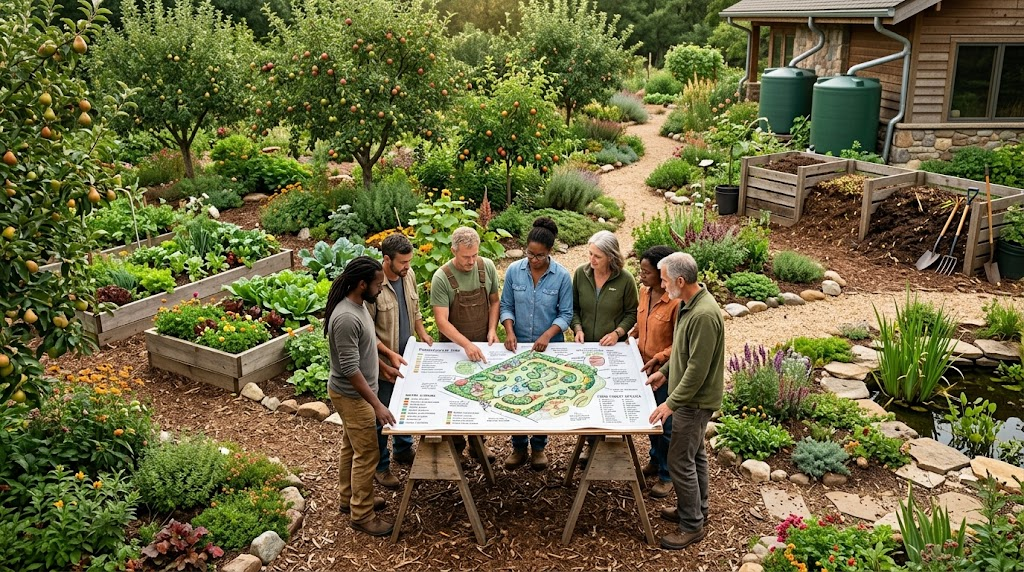
A permaculture design diploma can be a valuable pathway for people who want to move beyond learning individual sustainable practices and develop a deeper understanding of ecological design. Rather than focusing on a single subject such as organic gardening, renewable energy, natural building, or water management, permaculture brings these areas together into a framework for designing systems that work with natural processes.
For prospective students, choosing a diploma program is an important decision. Different programs may vary considerably in their structure, learning methods, assessment requirements, specialization opportunities, and practical components. Some emphasize residential learning and hands-on projects, while others are designed for flexible or online study.
A good program should help you understand permaculture principles while also giving you opportunities to apply them. The goal is not simply to memorize concepts. It is to learn how to observe a site, identify relationships, evaluate resources and limitations, develop design strategies, and create systems that are productive, resilient, and appropriate to their context.
This guide explains what a permaculture design diploma is, what you may learn during your studies, how diploma programs differ from shorter courses, what skills you can develop, and what to consider before enrolling.
What Is a Permaculture Design Diploma?
A permaculture design diploma is an extended educational program focused on applying permaculture principles to the design of sustainable human environments. It generally goes beyond introductory education by giving students more time to study, practice, develop projects, and demonstrate their understanding.
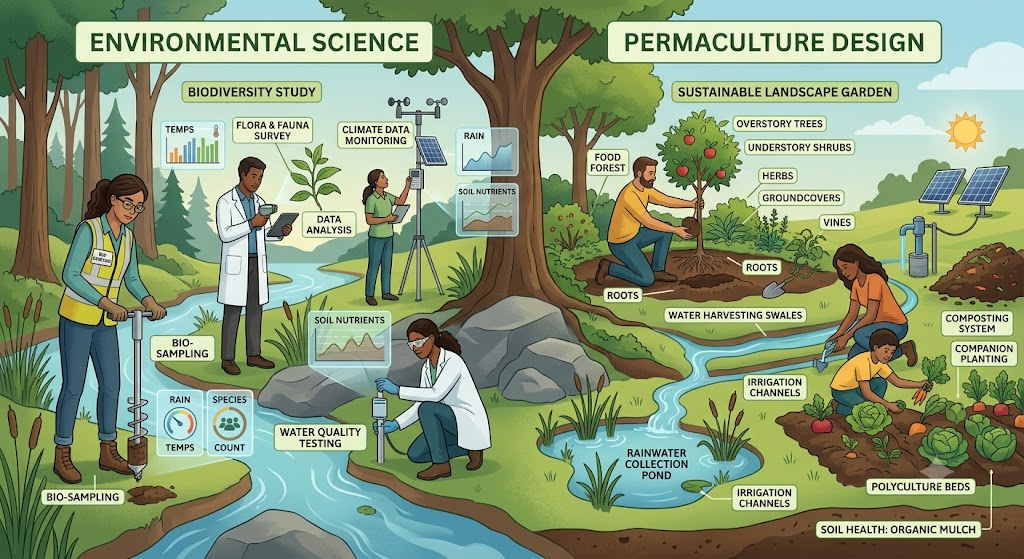
Permaculture itself is based on observing natural systems and applying ecological patterns to human environments. It can be used in gardens, farms, homes, communities, educational projects, landscapes, and broader social systems.
A diploma-level program may therefore cover a wide range of subjects, including:
- Ecological observation and site analysis
- Permaculture ethics and principles
- Landscape and garden design
- Soil health and fertility
- Water management
- Food production
- Agroforestry
- Natural building
- Renewable energy
- Waste reduction and resource management
- Community development
- Sustainable livelihoods
- Ecological restoration
- Climate resilience
- Design methodology
- Project planning and implementation
The exact curriculum depends on the institution and program structure. This is why prospective students should examine the learning outcomes rather than relying only on the word “diploma” in a program title.
Why Study for a Permaculture Design Diploma?
An introductory workshop can provide an excellent foundation, but developing design competence takes time. A longer program allows students to revisit concepts, work on practical applications, receive feedback, and gradually build confidence.
One of the main advantages of diploma-level study is the opportunity to connect individual techniques into larger systems.
For example, learning about rainwater harvesting separately from food production provides useful knowledge. However, a designer needs to understand how water flows across a site, where it can be stored, how it can support plants, how soil affects infiltration, and how infrastructure influences the wider landscape.
The same systems-thinking approach can be applied to energy, buildings, transportation, food, community structures, and economics.
A diploma can therefore be particularly relevant to people who want to develop the ability to design systems rather than simply apply isolated techniques.
What Do You Learn in a Permaculture Design Diploma?
The curriculum varies between institutions, but a comprehensive program generally develops knowledge across several interconnected areas.
Permaculture Ethics and Principles
The foundation of permaculture education is understanding its ethical framework and design principles.
Students typically explore ideas such as caring for the Earth, caring for people, and establishing fair approaches to resource use and distribution. These ideas provide a framework for thinking about ecological and social systems.
Design principles then provide practical ways to translate those values into decisions.
For example, observing before intervening encourages designers to understand a site before making major changes. Another principle may encourage finding multiple functions for important elements of a system.
The purpose is not to apply principles mechanically. Instead, students learn how to interpret them in different contexts.
Site Observation and Analysis
Observation is one of the most important skills developed through permaculture education.
Before designing a garden, farm, community space, or homestead, you need to understand the environment in which the design will operate.
A site analysis may consider:
- Sun and shade
- Wind patterns
- Water movement
- Existing vegetation
- Soil characteristics
- Topography
- Microclimates
- Existing structures
- Access routes
- Human activities
- Wildlife
- Available resources
- Potential constraints
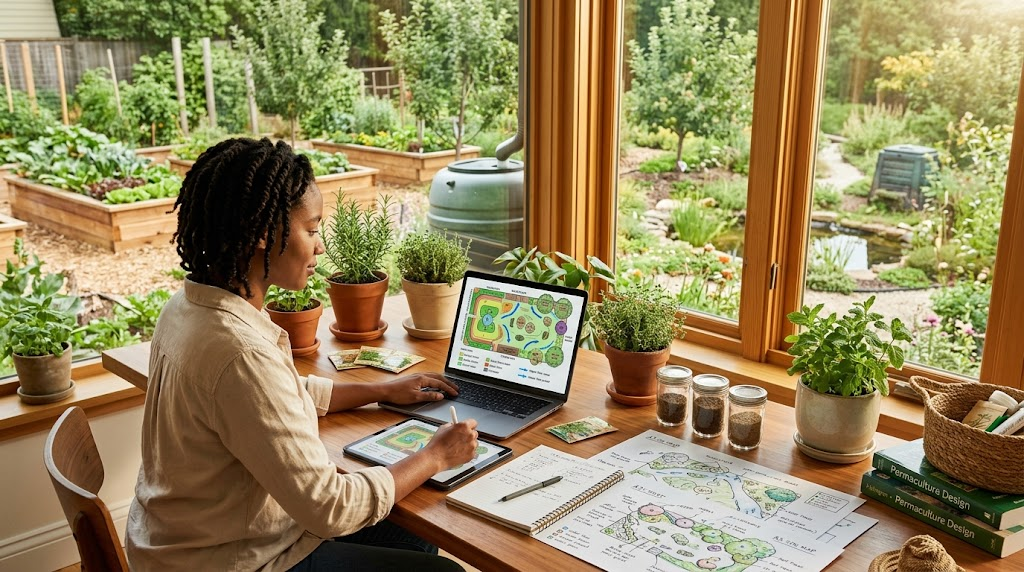
This information can then be organized into maps, diagrams, notes, and other design tools.
Good observation reduces the risk of designing something that conflicts with the natural characteristics of a site.
Ecological Design and Systems Thinking
A central feature of a permaculture design diploma is learning to see relationships.
A conventional approach might treat a vegetable garden, house, water system, and compost area as separate projects. A permaculture designer asks how these components can support one another.
For example, organic household waste can become compost. Compost can improve soil fertility. Healthy soil can support productive plants. Plants can provide food while also contributing organic matter to the system.
This type of relationship is an example of systems thinking.
Students learn to ask questions such as:
- What resources are entering the system?
- What resources are being lost?
- Which elements can perform multiple functions?
- Where are the opportunities to connect components?
- What are the potential unintended consequences?
- How can the design become more resilient?
- What can be learned from natural ecosystems?
These questions are useful far beyond gardening. They can be applied to farms, neighborhoods, businesses, educational programs, and community projects.
Food Production and Permaculture
Food systems are often an important component of permaculture education.
Depending on the program, students may explore:
- Vegetable production
- Perennial crops
- Herb gardens
- Orchard systems
- Seed saving
- Soil regeneration
- Agroforestry
- Polycultures
- Integrated animal systems
- Food forests
- Crop planning
The emphasis is usually not simply on growing food. Instead, students examine how food production can be integrated into wider ecological systems.
For example, plant selection may take into account water requirements, soil conditions, wildlife interactions, seasonal patterns, available labor, and long-term maintenance.
This helps students move from a “what should I grow?” approach toward a broader “how should this system function?” approach.
Water Management
Water is a critical resource in almost every landscape.
Permaculture education can introduce students to ways of observing and managing water through landscape design. Topics may include rainwater collection, infiltration, drainage, storage, irrigation, erosion control, and landscape earthworks.
Understanding water movement is particularly important because poorly planned interventions can create problems such as erosion, waterlogging, or inefficient irrigation.
A permaculture designer therefore considers water as part of the site’s overall system rather than as an isolated resource.
Soil and Regenerative Land Management
Healthy soil supports productive landscapes, but soil can easily be degraded through erosion, compaction, loss of organic matter, and inappropriate land management.
A diploma program may introduce students to soil structure, organic matter, nutrient cycling, biological activity, composting, mulching, and other approaches to improving soil function.
The focus is generally on understanding the relationships between soil, plants, microorganisms, water, and human management.
This knowledge can help students make better decisions about land preparation and long-term maintenance.
Natural Building and Sustainable Infrastructure
Some permaculture programs include sustainable construction and infrastructure.
Possible areas of study include:
- Passive solar design
- Natural building materials
- Thermal performance
- Energy efficiency
- Appropriate technologies
- Renewable energy
- Greywater systems
- Composting systems
- Low-impact infrastructure
Not every diploma covers these areas in the same depth. Prospective students should therefore review the curriculum if sustainable construction or infrastructure is a major interest.
Community and Social Systems
Permaculture is not limited to ecological landscapes.
Human relationships are also systems, and many diploma programs explore community organization, education, economics, communication, and collaborative decision-making.
A productive landscape still depends on people to maintain it. A community project still needs appropriate organizational structures. A sustainable enterprise still needs an economic model.
This is why a comprehensive permaculture education can include both ecological and social design.
Students may examine how to:
- Facilitate collaborative projects
- Communicate design ideas
- Identify community needs
- Develop educational activities
- Build partnerships
- Plan projects
- Consider local economics
- Support community resilience
How Is a Diploma Different From a Permaculture Design Course?
One of the most important questions for prospective students is whether they need a diploma or a shorter course.
A short permaculture design course can be an effective introduction. It may teach fundamental ethics, principles, observation methods, and basic design processes.
A diploma generally provides a longer learning journey.
The difference can often be understood in terms of depth, application, and project development.
A shorter course may answer:
What is permaculture and how does its design process work?
A longer diploma pathway may explore:
How can I apply permaculture design principles to complex real-world situations and develop my own projects?
However, there is no universal curriculum for every institution. The terminology used by educational providers can differ, so students should compare actual learning outcomes, assignments, mentoring, assessment, and project requirements.
What Skills Can You Develop?
A well-structured permaculture design diploma can help students develop both practical and analytical skills.
Observation
You learn to identify patterns and relationships before deciding what interventions may be appropriate.
Design Thinking
You develop processes for moving from observations and problems toward potential solutions.
Systems Thinking
You learn to consider how individual elements interact rather than evaluating them independently.
Research
Permaculture design often requires investigating climate, ecology, materials, plants, water, land use, economics, and social conditions.
Mapping
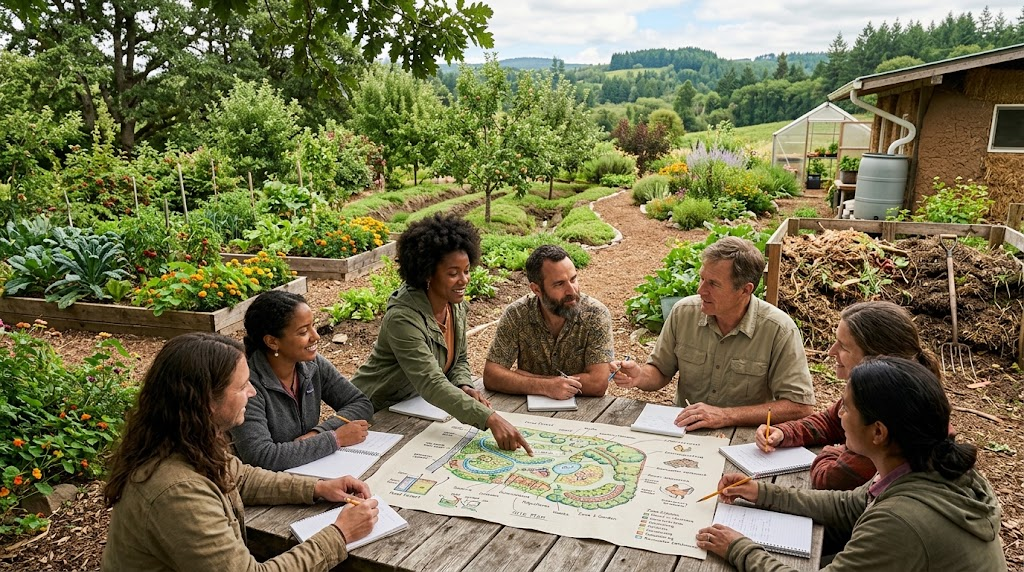
Site mapping can help transform observations into usable design information.
Project Planning
Design ideas must eventually become practical projects. Planning involves resources, time, labor, budgets, priorities, and maintenance.
Communication
A designer needs to explain ideas clearly to clients, communities, collaborators, or project participants.
Adaptation
Real systems rarely behave exactly as expected. Permaculture education can help students develop an iterative approach in which designs are observed, evaluated, and adjusted.
Choosing the Right Permaculture Design Diploma
Not every program will suit every learner. Before enrolling, consider your objectives and compare programs systematically.
1. Review the Curriculum
Look beyond the program title.
Read the curriculum carefully and identify the subjects that matter most to you. If you are interested in ecological farming, look for substantial content on food systems and land management. If you are interested in community projects, investigate the social and organizational components.
2. Check the Learning Format
Consider whether the program is:
- Online
- In person
- Hybrid
- Self-paced
- Mentor-supported
- Cohort-based
- Project-based
The best format depends on how you learn and what you want to accomplish.
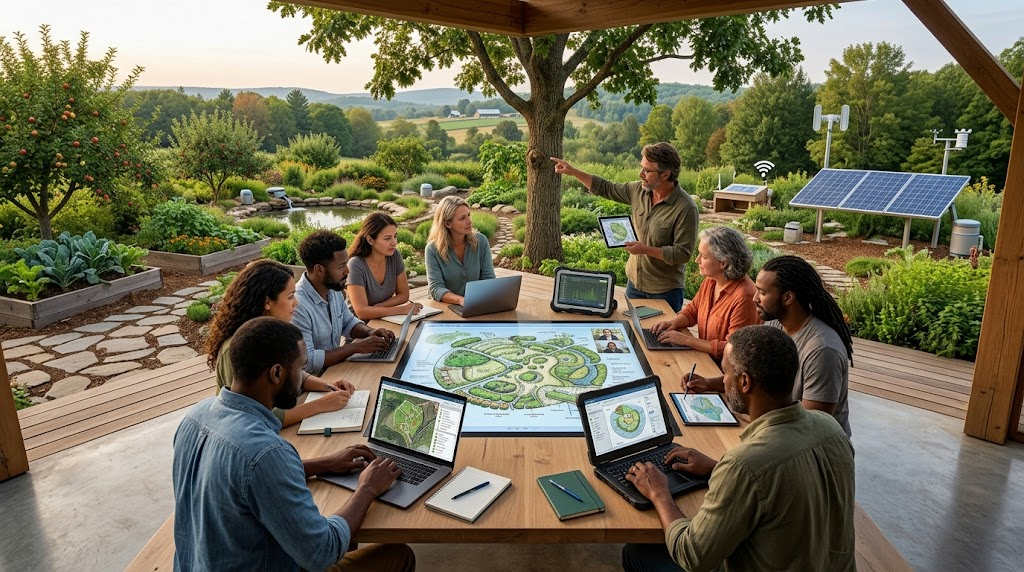
Online education can provide flexibility, particularly for people balancing study with work or other responsibilities. However, students should investigate how practical activities, feedback, and project development are handled.
3. Examine the Project Requirements
Practical design work is particularly important for students who want to develop professional-level skills.
Find out whether the program includes design assignments, case studies, portfolio development, practical projects, or other forms of applied learning.
A program that allows you to build a body of design work can help connect theoretical knowledge with practical application.
4. Investigate Mentoring and Feedback
Independent study can be useful, but feedback can accelerate learning.
Find out how instructors or mentors interact with students. Ask whether assignments are reviewed and whether students can receive guidance when developing complex designs.
5. Consider the Time Commitment
A diploma requires sustained effort.
Before enrolling, consider:
- Weekly study requirements
- Assignment deadlines
- Project expectations
- Duration of the program
- Access to instructors
- Practical requirements
Choose a workload that is realistic for your current circumstances.
6. Understand the Credential
The word “diploma” can mean different things in different educational contexts.
Before enrolling, determine exactly what credential the institution awards, who issues it, what requirements must be completed, and how the program describes its educational status.
This is especially important if you intend to use the credential professionally or for further education.
Who Is a Permaculture Design Diploma For?
A diploma can suit a wide range of learners.
You might consider this pathway if you are:
- Beginning a career in ecological design
- Developing a homestead or sustainable property
- Working in agriculture or horticulture
- Interested in regenerative land management
- Developing community projects
- Working in environmental education
- Exploring ecological entrepreneurship
- Transitioning toward sustainability-related work
- Interested in resilient human settlements
- Looking for a structured way to deepen existing permaculture knowledge
You do not necessarily need to be an experienced farmer, gardener, architect, or environmental professional.
What matters more is your willingness to observe, learn, experiment, document your work, and develop your design thinking.
How to Prepare Before Starting
You can make your diploma experience more productive by preparing before the program begins.
Start by learning the basic vocabulary of permaculture. Become familiar with concepts such as ecological succession, zones, sectors, patterns, edges, feedback loops, energy flows, and systems thinking.
You can also begin observing your immediate environment.
Look at:
- Where sunlight moves during the day
- Where water collects after rain
- Which plants thrive naturally
- Where wind is strongest
- How people move through the space
- Which resources are currently wasted
- Which areas require the most maintenance
Keeping an observation journal can be particularly useful.
You do not need a large farm or rural property to begin developing these skills. Observation can happen in a garden, neighborhood, balcony, schoolyard, urban park, or other everyday environment.
Building a Portfolio During Your Studies
If your goal is to apply permaculture skills professionally, consider documenting your projects throughout your education.
A portfolio might include:
- Site maps
- Base maps
- Sector analysis
- Site observations
- Concept diagrams
- Planting plans
- Water-management plans
- Design reports
- Before-and-after documentation
- Reflections on design decisions
- Project evaluations
Documenting the reasoning behind your decisions is especially valuable.
A finished drawing shows what you designed. A design report can demonstrate why you made those decisions and how you evaluated alternatives.
This distinction can make your portfolio more useful when demonstrating your skills to potential collaborators or clients.
Permaculture Design as a Lifelong Learning Process
Completing a permaculture design diploma is not the end of learning.
Ecological design is context-dependent. A technique that works in one climate, landscape, culture, or economic environment may not work in another.
Experienced designers continue to observe, test, research, and adapt.
This is one of the most important ideas to carry forward from permaculture education: a design is not simply a finished object. It is part of an ongoing relationship between people and living systems.
As your experience grows, you may become increasingly interested in specialized areas such as agroforestry, ecological restoration, urban permaculture, natural building, water systems, community resilience, regenerative agriculture, or ecological education.
Studying Permaculture With Gaia University
For learners looking for a flexible approach to sustainability education, Gaia University offers educational pathways centered on ecological and regenerative approaches.
When evaluating any program, prospective students should look closely at how learning is structured, how projects are developed, what support is available, and how the program connects learning with real-world application.
The right educational pathway should fit your goals rather than simply providing a credential.
Frequently Asked Questions About a Permaculture Design Diploma
Is a permaculture design diploma worth pursuing?
The value depends on your goals, preferred learning style, and the quality and structure of the program. A diploma can provide more time for applied learning and project development than a short introductory course.
Do I need previous permaculture experience?
Not necessarily. Program entry requirements vary, and some programs are designed to accommodate learners who are developing their knowledge from the beginning.
Can I study permaculture online?
Yes. Online and distance-learning programs can make permaculture education accessible to students who cannot attend residential courses. When comparing online programs, examine how practical learning, mentoring, assignments, and project work are handled.
What can I do after completing a permaculture design diploma?
Possible directions include ecological design, land management, education, community projects, sustainable agriculture, regenerative development, consulting, and personal land projects. Career opportunities depend on your existing qualifications, experience, portfolio, location, and the specific requirements of the work you pursue.
Is a diploma the same as a Permaculture Design Certificate?
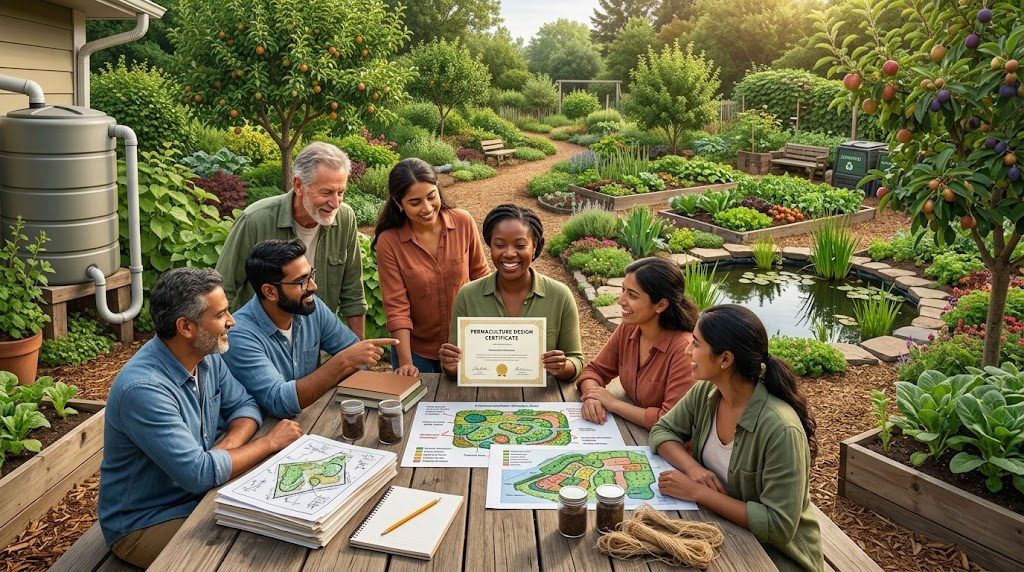
No. The terms generally describe different educational pathways, although terminology varies between providers. A certificate course is often shorter and more introductory, while a diploma program typically involves longer-term study and deeper project work. Always check the specific requirements of the institution offering the credential.
How long does a permaculture design diploma take?
There is no universal duration. Programs can differ substantially in study format, workload, project requirements, and completion timelines. Review the official program structure before enrolling.
Can permaculture skills be useful without owning land?
Absolutely. Permaculture principles can be applied to many scales, from balconies and community gardens to farms, homes, organizations, and urban neighborhoods. Learning to observe relationships and design systems does not require ownership of a large property.
Conclusion
A permaculture design diploma can provide a structured pathway for people who want to develop deeper ecological design knowledge and learn how to apply systems thinking to real-world challenges.
The most useful programs go beyond teaching terminology. They help students observe landscapes, understand ecological relationships, analyze problems, develop designs, communicate ideas, and evaluate their results.
When comparing programs, focus on the curriculum, learning format, practical projects, mentoring, assessment methods, time commitment, and nature of the credential. Think carefully about what you want to do with your education and choose a pathway that supports those objectives.
Permaculture design is ultimately about relationships: between people and landscapes, resources and needs, problems and opportunities, and individual elements within larger systems. A strong educational foundation can help you understand those relationships and turn them into thoughtful, practical designs.
For prospective permaculture diploma seekers, the next step is to identify your learning goals, compare suitable programs, and consider how you can begin applying ecological design principles in the environment around you. The learning process can start long before the diploma is completed—and continue throughout your work, projects, and future designs.
Responses