
Online Master’s in Climate Change and Sustainable Development: A Guide for Permaculture Diploma Seekers

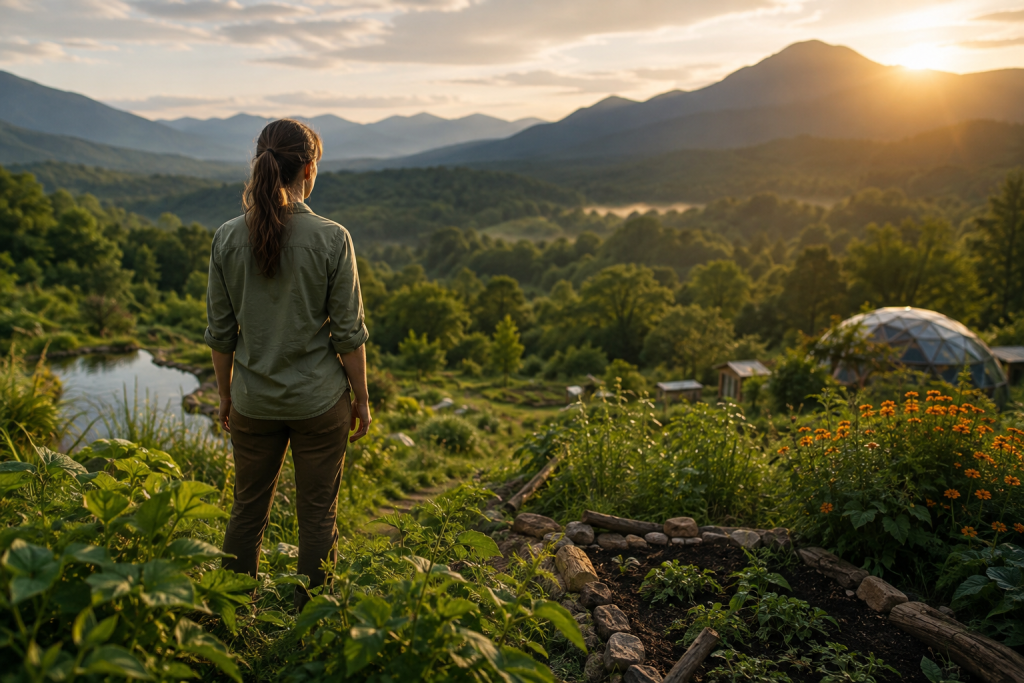
Climate change and sustainability have become defining challenges of the 21st century. As communities seek resilient solutions, professionals with expertise in ecological restoration, regenerative agriculture, community development, and sustainable systems are increasingly valuable.
For permaculture diploma seekers, pursuing an online master’s in climate change and sustainable development can be a natural progression. It builds on ecological design principles while expanding knowledge in environmental policy, systems thinking, climate resilience, regenerative economies, and social innovation.
Unlike traditional academic programs that focus primarily on theory, many learners are looking for educational experiences that connect academic study with meaningful action. The most suitable programs often integrate real-world projects, interdisciplinary learning, and community engagement alongside rigorous academic research.
Why Study Climate Change and Sustainable Development?
Climate change affects nearly every aspect of modern society, including:
- Agriculture
- Water security
- Biodiversity
- Energy systems
- Public health
- Food systems
- Local economies
- Community resilience
Understanding these interconnected challenges requires more than studying environmental science alone. Sustainable development combines ecological, economic, cultural, and social perspectives to create long-term solutions.
Graduates often develop skills in:
- Climate adaptation
- Regenerative development
- Ecological restoration
- Sustainable agriculture
- Systems thinking
- Project leadership
- Community facilitation
- Environmental planning
- Circular economy principles
These competencies are increasingly relevant across nonprofit organizations, education, regenerative enterprises, local government, consulting, and international development.
Why Online Learning Appeals to Permaculture Students
Many permaculture practitioners already learn through hands-on projects, observation, experimentation, and community engagement.
Online master’s programs can complement this approach by allowing students to:
- Continue working while studying
- Apply coursework directly to existing projects
- Learn from diverse international communities
- Study without relocating
- Integrate local ecological knowledge into academic work
- Balance family, professional, and educational commitments
Flexibility is particularly valuable for practitioners managing farms, community gardens, ecological restoration projects, or regenerative businesses.
How Permaculture Connects with Climate Change Education
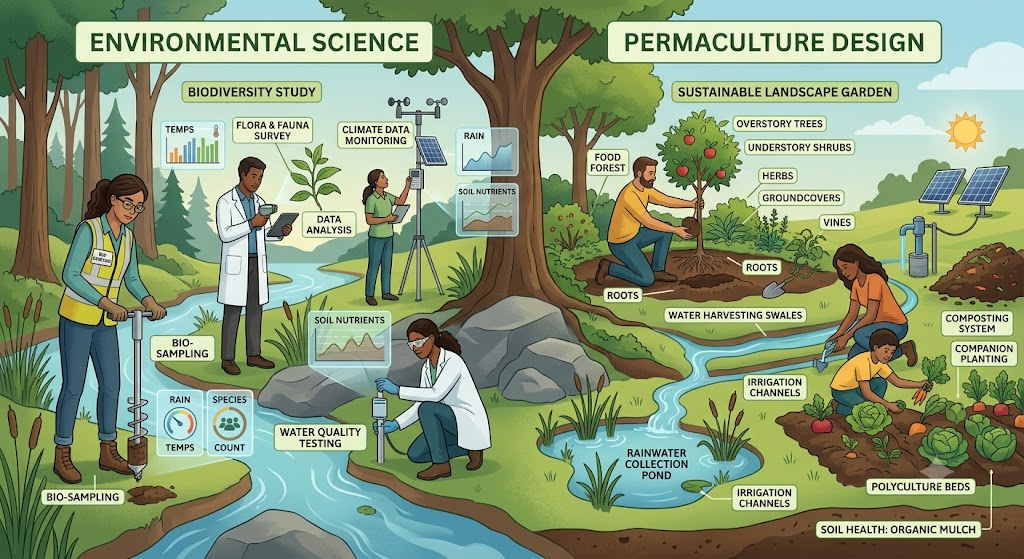
Permaculture extends beyond sustainable gardening. It offers a comprehensive design framework based on observing natural systems and creating resilient human habitats.
Climate change education naturally aligns with many permaculture principles, including:
| Permaculture Principle | Climate Change Application |
| Observe and interact | Climate adaptation planning |
| Catch and store energy | Renewable energy systems |
| Produce no waste | Circular economy strategies |
| Integrate rather than segregate | Systems-based sustainability |
| Use diversity | Ecosystem resilience |
| Small and slow solutions | Community-led adaptation |
Students who already understand permaculture often find it easier to grasp complex sustainability concepts because they are accustomed to thinking in interconnected systems.
What to Look for in an Online Master’s Program
Not every sustainability program offers the same educational experience.
When evaluating an online master’s in climate change and sustainable development, consider whether it includes:
Systems Thinking
Climate challenges rarely exist in isolation. Strong programs teach students to understand interactions among ecological, economic, cultural, and political systems.
Project-Based Learning
Applying theory to real situations deepens understanding and develops practical leadership skills.
Interdisciplinary Curriculum
Climate solutions require knowledge from multiple disciplines, including:
- Ecology
- Agriculture
- Economics
- Sociology
- Environmental governance
- Education
- Design
- Community development
Global Perspective
Climate impacts vary across regions. Learning from diverse ecological and cultural contexts broadens problem-solving abilities.
Local Application
While sustainability is global, implementation is always local. Effective programs encourage students to work within their own communities.
Skills Developed During a Sustainability Master’s
An online master’s focused on climate change and sustainable development often strengthens both technical and interpersonal competencies.
Common areas of development include:
Environmental Analysis
Students learn to evaluate ecosystems, climate risks, and resource management strategies.
Research Skills
Graduate-level education emphasizes critical thinking, literature review, evidence-based decision-making, and independent inquiry.
Leadership
Climate solutions depend on collaboration. Students often develop facilitation, communication, and conflict resolution skills.
Regenerative Design
Rather than simply reducing environmental harm, regenerative approaches aim to restore ecosystems and strengthen communities.
Strategic Planning
Graduates learn how to develop long-term sustainability initiatives for organizations, communities, and landscapes.
Career Opportunities
Graduates may pursue careers in:
- Sustainability consulting
- Environmental education
- Regenerative agriculture
- Ecological restoration
- Community development
- Climate adaptation planning
- Nonprofit leadership
- Corporate sustainability
- Environmental policy
- International development
- Sustainable business
- Research
Many also launch their own regenerative enterprises or expand existing permaculture-based initiatives.
The Importance of Experiential Learning
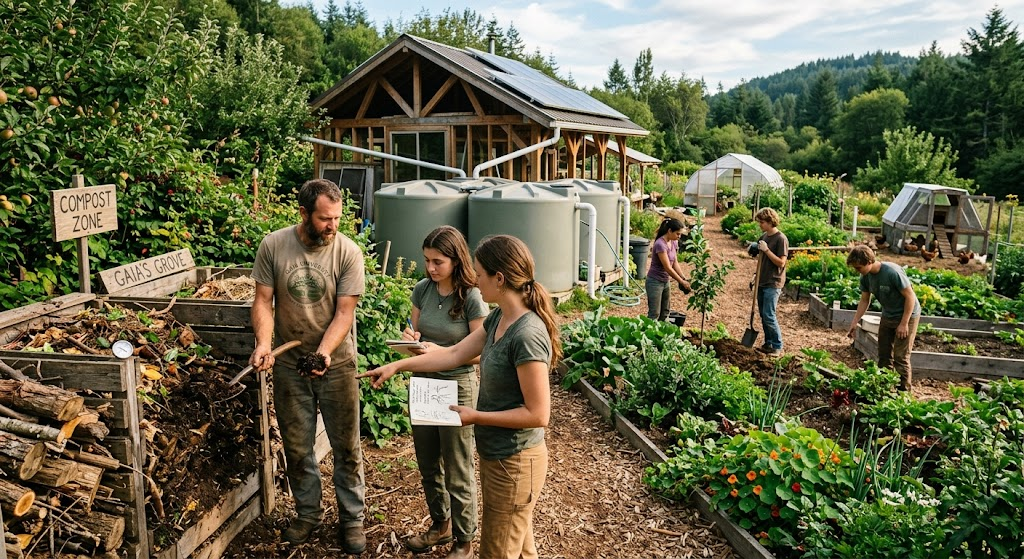
One characteristic increasingly valued in sustainability education is experiential learning.
Rather than separating coursework from practice, experiential learning encourages students to:
- Work on real projects
- Document outcomes
- Reflect on lessons learned
- Collaborate with communities
- Improve ongoing initiatives
This approach mirrors how many experienced permaculture practitioners already develop expertise.
Integrating Regenerative Development into Graduate Education
Regenerative development extends beyond sustainability.
While sustainability often focuses on minimizing harm, regenerative approaches seek to improve ecological and social systems over time.
Graduate study may explore topics such as:
- Watershed restoration
- Food sovereignty
- Agroforestry
- Community resilience
- Indigenous knowledge systems
- Ecosystem regeneration
- Landscape restoration
- Participatory design
- Ecological economics
These themes align closely with advanced permaculture practice.
Gaia University and Regenerative Higher Education
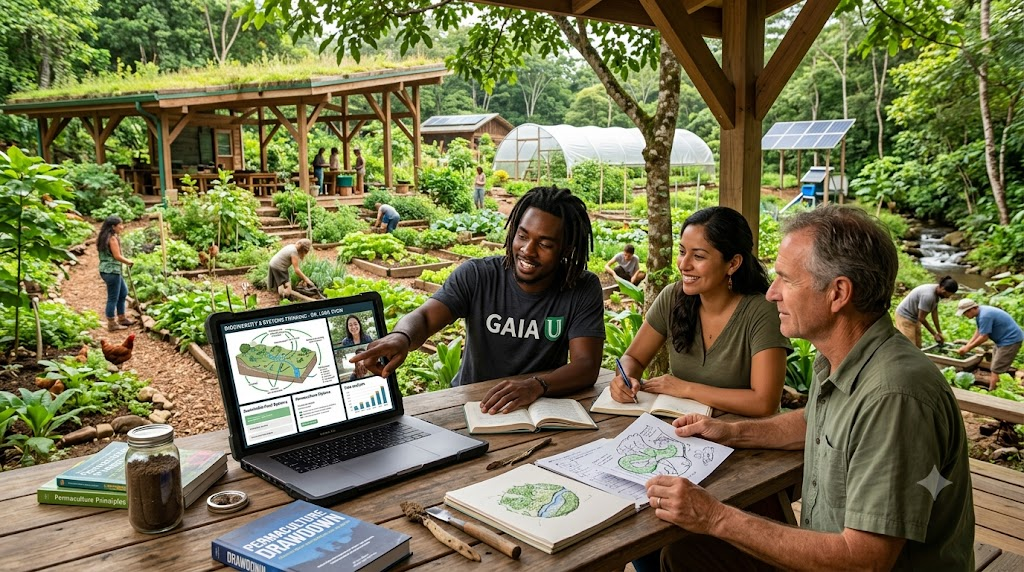
For learners seeking a project-based approach, Gaia University emphasizes self-directed, community-based learning centered on real-world regenerative projects.
Its educational model encourages learners to develop competencies while working on meaningful initiatives related to ecological restoration, regenerative livelihoods, community resilience, and sustainable development.
Prospective students interested in learning more about the university’s educational philosophy can explore the About section.
Information about academic pathways is also available through the university’s academic programs:
https://gaiauniversity.org/
Students interested in admissions and enrollment details can learn more here.
Is an Online Master’s Right for Permaculture Diploma Seekers?
An online master’s can be an excellent next step for learners who want to expand their knowledge beyond introductory permaculture concepts.
It may be particularly suitable for those who wish to:
- Strengthen research capabilities
- Improve project leadership
- Explore systems thinking
- Connect ecological theory with practical implementation
- Develop international perspectives
- Advance regenerative careers
The best educational path depends on individual goals, learning preferences, and the type of impact a student hopes to create.
Frequently Asked Questions
What is an online master’s in climate change and sustainable development?
It is a graduate-level program that explores climate science, sustainability, regenerative development, environmental leadership, and interdisciplinary approaches to addressing environmental challenges through flexible online learning.
Is this type of degree suitable for permaculture practitioners?
Yes. Many concepts taught in climate change and sustainable development complement permaculture principles, particularly systems thinking, ecological restoration, regenerative agriculture, and community resilience.
Can I study while managing a farm or ecological project?
Many online programs are designed for working professionals, allowing students to balance study with ongoing environmental or community projects.
What careers can graduates pursue?
Graduates may work in sustainability consulting, regenerative agriculture, nonprofit leadership, environmental education, ecological restoration, climate adaptation, research, policy, and community development.
Why is systems thinking important?
Climate change involves interconnected environmental, economic, and social issues. Systems thinking helps learners understand relationships between these factors and develop more effective long-term solutions.
How does regenerative development differ from sustainability?
Sustainability often emphasizes maintaining existing systems while reducing environmental impact. Regenerative development goes further by seeking to restore ecosystems, strengthen communities, and improve ecological health over time.
Conclusion
Choosing an online master’s in climate change and sustainable development is about more than earning an academic credential. It represents an opportunity to deepen understanding of ecological systems, develop practical leadership skills, and contribute to resilient communities facing complex environmental challenges.
For permaculture diploma seekers, graduate education can provide a framework for integrating ecological design, climate resilience, systems thinking, and regenerative development into meaningful, real-world practice. By selecting a program that values experiential learning, interdisciplinary collaboration, and community engagement, learners can continue building the knowledge and capabilities needed to support lasting environmental and social regeneration.

Responses