
Permaculture Design Course Online Free: A Practical Guide for Aspiring Permaculture Designers

Introduction
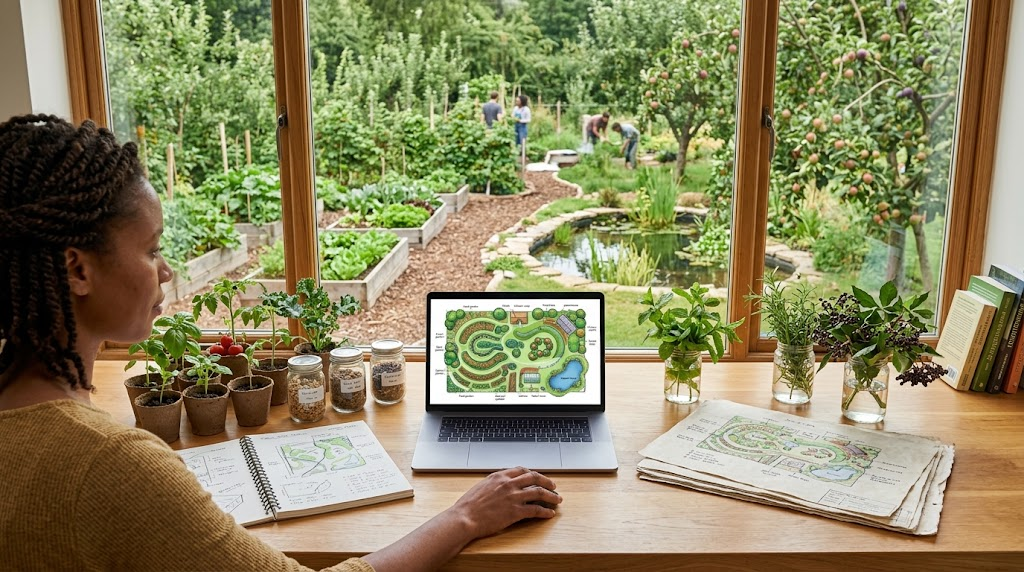
Interest in sustainable living, ecological restoration, food production, and resilient communities is growing. As more people look for practical ways to work with nature rather than against it, permaculture has become an increasingly valuable framework for understanding how human systems can be designed more thoughtfully.
For people who want to explore this field without making a large financial commitment at the beginning, searching for a permaculture design course online free can be an excellent starting point. Free online learning can help you understand fundamental permaculture concepts, discover whether the subject matches your goals, and begin developing the vocabulary and systems-thinking skills needed for more advanced study.
However, there is an important distinction between learning about permaculture for free and completing a structured qualification. A collection of free videos or articles may introduce useful ideas, but a serious permaculture education usually requires deeper study, design practice, feedback, and the ability to apply principles to real situations.
This guide explains what you can realistically expect from free online permaculture education, what subjects you should study, how to evaluate courses, and how free learning can fit into a longer path toward professional or diploma-level permaculture education.
What Is a Permaculture Design Course Online Free?
A permaculture design course online free is an educational resource or course that allows learners to study permaculture principles and design concepts without paying a course fee.
The format can vary significantly. Some free resources are short introductory courses, while others may provide lessons, lectures, reading materials, exercises, or community discussions. The quality and depth of these resources can also differ.
A useful introductory course should help you understand the foundations of permaculture rather than simply provide inspirational information. Ideally, it introduces topics such as:
- Permaculture ethics
- Design principles
- Systems thinking
- Observation and site analysis
- Soil and water management
- Food systems
- Ecological relationships
- Natural patterns
- Renewable resources
- Energy efficiency
- Social systems
- Resilience
- Regenerative design
For someone considering a future permaculture diploma, free study can therefore function as a foundation. It allows you to develop basic knowledge before committing to a more comprehensive educational program.
Why Study Permaculture Online?
Online learning has changed how people can access environmental and design education. You no longer necessarily need to live near a permaculture school or travel to a specific location to begin learning.
A permaculture design course online free can be particularly useful for learners who want flexibility.
Flexible Learning
Online materials can often be studied around work, school, family responsibilities, or other commitments. You can divide lessons into manageable sessions instead of following a fixed classroom timetable.
This is especially useful when learning complex concepts. Permaculture is not simply a list of techniques. It involves learning how different parts of a system interact. Having time to pause, review, and observe examples can make the learning process more effective.
Accessible Introduction
Free learning removes one common barrier: the initial cost.
If you are unfamiliar with permaculture, you may not yet know whether you want to pursue a certificate, diploma, or professional career in the field. Free educational materials give you an opportunity to explore the subject before making a larger commitment.
Learning From Different Environments
Permaculture principles can be applied in many contexts. Online education can expose learners to examples from gardens, farms, homes, communities, urban environments, and restoration projects.
Comparing these examples helps demonstrate that permaculture is not a single gardening method. It is a design approach that can be adapted to different places and circumstances.
What Should You Learn in a Free Permaculture Course?
Not every free course covers the same material. If your ultimate goal is diploma-level study, it is useful to look for resources that introduce the major areas of permaculture design.
1. Permaculture Ethics
Ethics provide an important foundation for permaculture.
The commonly taught ethical framework includes:
- Earth care
- People care
- Fair share or return of surplus
These ideas encourage learners to consider ecological health, human wellbeing, and responsible resource distribution when designing systems.
Understanding the ethics is important because permaculture is about more than producing food efficiently. It asks learners to consider the wider consequences of design decisions.
2. Permaculture Principles
Permaculture principles provide practical guidance for turning ethical ideas into design decisions.
Examples include observing and interacting, catching and storing energy, obtaining a yield, using renewable resources, valuing diversity, and integrating rather than separating elements.
A strong permaculture design course online free should explain not only what these principles are but also how they can influence actual design choices.
For example, observation can help a designer understand sunlight, wind, water movement, soil conditions, human activity, and existing vegetation before introducing new elements.
3. Systems Thinking
Systems thinking is one of the most important skills for aspiring permaculture designers.
A garden, farm, home, or community is not made up of isolated parts. Water influences plants. Plants influence soil. Soil influences productivity. People influence resource flows. Buildings influence energy use and microclimates.
Systems thinking encourages you to ask questions such as:
- What inputs does this system require?
- What outputs does it produce?
- Where are resources being wasted?
- Which elements can support one another?
- What happens when one part changes?
- How can one function be supported by multiple elements?
This way of thinking becomes increasingly important as your designs become more complex.
Site Observation: The Foundation of Good Design
One of the most useful skills you can begin practicing while studying online is observation.
Permaculture design starts with understanding what already exists.
Before designing a garden, for example, you might observe:
- Sun exposure
- Wind direction
- Existing vegetation
- Water movement
- Soil conditions
- Slopes and contours
- Buildings
- Access routes
- Human activity
- Wildlife
- Existing resources
- Seasonal changes
Online lessons can explain these concepts, but observation becomes meaningful when you practice it yourself.
You can begin by choosing a small area near your home and documenting how it changes throughout the day and across different weather conditions.
This turns passive learning into active design practice.
Understanding Water in Permaculture Design
Water is another fundamental subject for permaculture learners.
A permaculture approach does not simply ask how much water a landscape needs. It also considers how rainfall enters, moves through, is stored within, and leaves a site.
A beginner-level course may introduce concepts such as:
- Rainwater harvesting
- Water conservation
- Swales and earthworks
- Contour observation
- Storage
- Irrigation efficiency
- Wetland systems
- Soil moisture
- Landscape hydrology
The objective is not to apply every technique everywhere. Instead, learners should understand why a particular strategy might be appropriate in one context and inappropriate in another.
This is a central principle of design education: context matters.
Soil and Regenerative Growing Systems
Healthy soil is fundamental to productive and resilient ecosystems.
A free online permaculture course may introduce:
- Soil structure
- Organic matter
- Compost
- Mulching
- Soil organisms
- Nutrient cycling
- Ground cover
- Erosion prevention
- No-dig approaches
- Plant-soil relationships
The broader goal is to understand soil as a living system rather than simply a medium in which plants grow.
This perspective can influence decisions about cultivation, fertility, water management, plant selection, and landscape design.
Food Production and Permaculture
Food production is one of the most recognizable applications of permaculture.
However, permaculture gardening is not simply about growing as much food as possible. It involves designing productive systems that consider ecological relationships, available resources, labor, water, soil, biodiversity, and long-term maintenance.
A beginner may encounter topics such as:
- Polycultures
- Perennial crops
- Annual vegetables
- Food forests
- Companion planting
- Seed saving
- Agroforestry
- Integrated animal systems
- Garden design
- Harvest planning
A good learning resource should encourage observation and experimentation rather than suggesting that one technique is universally appropriate.
Natural Patterns and Design
Nature provides countless examples of efficient relationships and patterns.
Permaculture designers often study patterns found in landscapes, plants, water movement, ecosystems, and biological relationships.
Learning to recognize patterns can help you move from copying individual techniques toward understanding why systems work.
For example, a designer might study how water naturally moves across a landscape rather than immediately deciding where to install a particular water-management feature.
This is an important distinction between technique-focused learning and design-focused learning.
How to Evaluate a Free Online Permaculture Course
Because online resources vary widely, it is worth evaluating a course carefully before investing your time.
Look at the Curriculum
Start by examining what the course actually teaches.
Does it cover design principles, ethics, observation, ecology, soil, water, food systems, and social considerations?
A course that focuses entirely on gardening may be useful, but it may not provide a broad introduction to permaculture design.
Look for Practical Assignments
Learning becomes more valuable when you have opportunities to apply concepts.
Look for activities such as:
- Site observation
- Mapping
- Pattern analysis
- Design exercises
- Resource-flow analysis
- Garden planning
- Case-study analysis
Even simple assignments can help you develop the habits needed for more advanced design work.
Check the Course Structure
A structured course is generally easier to follow than a collection of unrelated videos.
Look for a logical progression from foundational concepts to practical applications.
For example:
- Introduction to permaculture
- Ethics and principles
- Observation
- Site analysis
- Systems thinking
- Natural patterns
- Water
- Soil
- Plants and food systems
- Design methods
- Practical design project
A clear progression makes it easier to build knowledge systematically.
Is a Free Course Enough to Become a Permaculture Designer?
Usually, free introductory education should be viewed as a starting point rather than the complete journey.
Reading about permaculture and watching lessons can build knowledge, but design competence requires practice.
A designer needs to develop the ability to:
- Observe a site
- Identify relationships
- Gather relevant information
- Define goals
- Analyze resources
- Identify constraints
- Develop design strategies
- Select appropriate techniques
- Explain design decisions
- Evaluate outcomes
These skills develop through repeated application.
For learners interested in a professional pathway, structured education can provide additional depth, feedback, project work, and a framework for developing a portfolio.
Free Learning vs. Formal Permaculture Education
Understanding the difference between free learning and formal study can help you choose the right educational path.
| Free Online Learning | Formal Permaculture Education |
| Usually introductory | Usually more comprehensive |
| Often self-paced | May follow a structured curriculum |
| Limited or no assessment | May include assignments and assessment |
| Usually low financial commitment | Requires an educational investment |
| Useful for exploration | Designed for deeper competency |
| Practical support varies | Often includes structured guidance |
| May not provide credentials | May provide a certificate or diploma |
Neither approach has to replace the other.
Free learning can be the first step. Formal education can then build on that foundation.
How a Free Course Can Prepare You for Diploma-Level Study
If you are considering becoming a permaculture diploma student, use free education strategically.
Rather than trying to collect as many courses as possible, focus on developing a strong foundation.
Build Your Vocabulary
Learn the terminology used in ecological design.
Understanding concepts such as zones, sectors, succession, edge, stacking functions, energy flows, ecological niches, and regenerative systems will make more advanced material easier to understand.
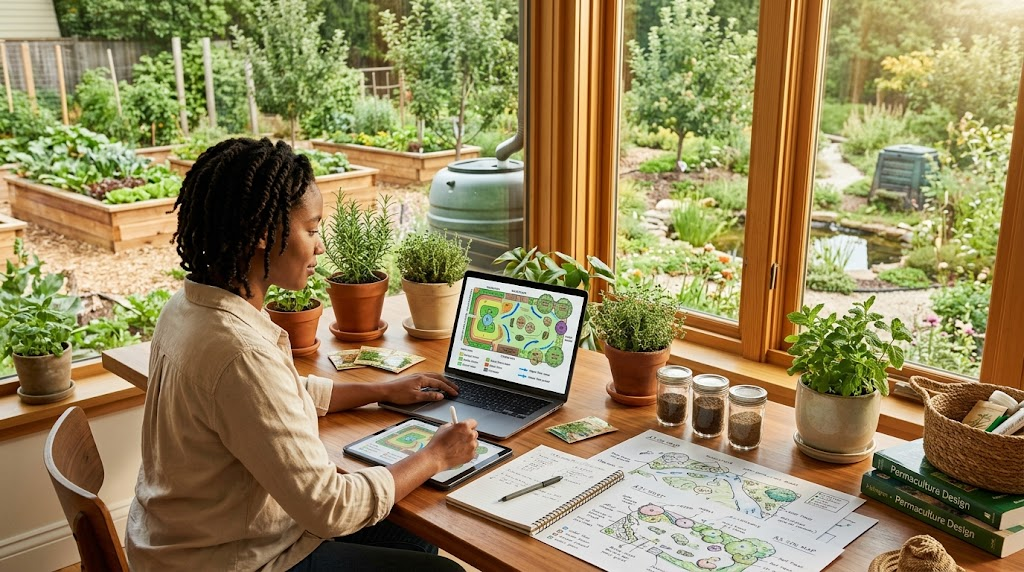
Start a Design Journal
Create a dedicated notebook or digital document.
Record:
- Observations
- Questions
- Site sketches
- Weather patterns
- Plant observations
- Water movement
- Design ideas
- Problems you notice
- Possible solutions
Over time, this becomes evidence of your developing design thinking.
Practice Small Designs
You do not need a large farm to practice.
Choose a balcony, backyard, community space, garden bed, or another suitable area and create a simple design.
Begin with observation rather than immediately drawing solutions.
Study Existing Systems
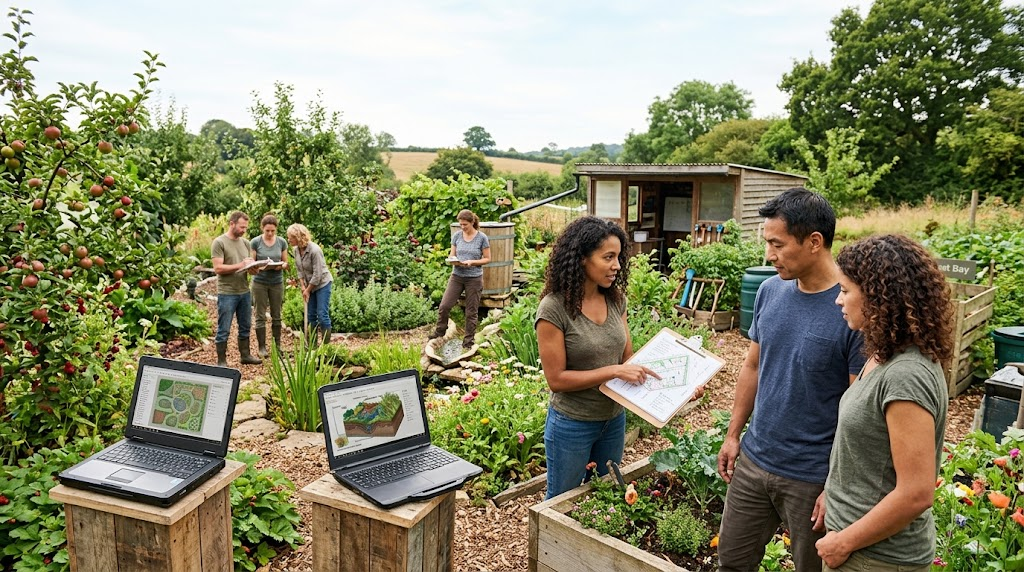
Visit gardens, farms, parks, forests, or other appropriate landscapes and observe how different elements interact.
Ask yourself:
- Where does water go?
- Where does energy enter?
- Where does waste go?
- Which organisms interact?
- What resources are abundant?
- What resources are limited?
- How much human labor is required?
These questions help develop the mindset of a designer.
Creating Your Own Permaculture Learning Path
Searching for a permaculture design course online free can sometimes lead to too many resources.
More information does not necessarily mean better learning.
Instead, create a simple learning pathway.
Stage 1: Foundations
Learn:
- Permaculture ethics
- Core principles
- Systems thinking
- Ecological relationships
- Observation
Stage 2: Site Analysis
Study:
- Climate
- Landform
- Sun
- Wind
- Water
- Soil
- Existing vegetation
- Access
- Human use
Stage 3: Design
Learn how to transform observations into design decisions.
Practice mapping, zoning, sector analysis, pattern analysis, and resource-flow assessment.
Stage 4: Application
Create small designs and test your assumptions.
Document what works and what does not.
Stage 5: Deeper Education
Once you understand the foundations, consider structured permaculture education that offers deeper design practice and a more comprehensive curriculum.
For learners interested in a broader educational pathway, Gaia University provides opportunities to explore learning centered on regenerative and ecological approaches.
Common Mistakes When Learning Permaculture Online
Online learning offers flexibility, but it also creates several potential problems.
Consuming Information Without Practicing
Watching dozens of lessons does not automatically develop design skills.
Set aside time to apply what you learn.
Focusing Only on Techniques
Permaculture contains many interesting techniques, but techniques should serve design goals.
Instead of asking, “Which technique should I use?” ask, “What function needs to be achieved, and what options could fulfill that function?”
Ignoring Local Conditions
A technique that works well in one climate may not be suitable elsewhere.
Always consider local climate, ecology, resources, regulations, culture, and available labor.
Designing Too Quickly
Beginners sometimes start drawing gardens before completing adequate observation.
Slow down.
Good design begins with understanding.
Trying to Change Everything at Once
A small experiment can teach you more than an enormous plan that never gets implemented.
Start with manageable projects and expand your knowledge progressively.
How to Make Free Online Learning More Effective
You can improve the value of a free course by combining study with practical activities.
For every lesson, try to answer three questions:
What did I learn?
Identify the central concept.
Where can I observe it?
Find an example in your environment.
How could I apply it?
Consider a practical design situation.
This simple process turns theoretical information into applied knowledge.
You can also create a weekly learning routine. For example, spend one session studying theory, another observing a site, and another documenting your design ideas.
Consistency is more valuable than trying to complete a large amount of material in a short period.
What to Look for in a More Advanced Permaculture Program
After completing introductory study, you may decide that you want more structured education.
When comparing programs, consider:
- Curriculum depth
- Design methodology
- Practical projects
- Mentorship
- Feedback
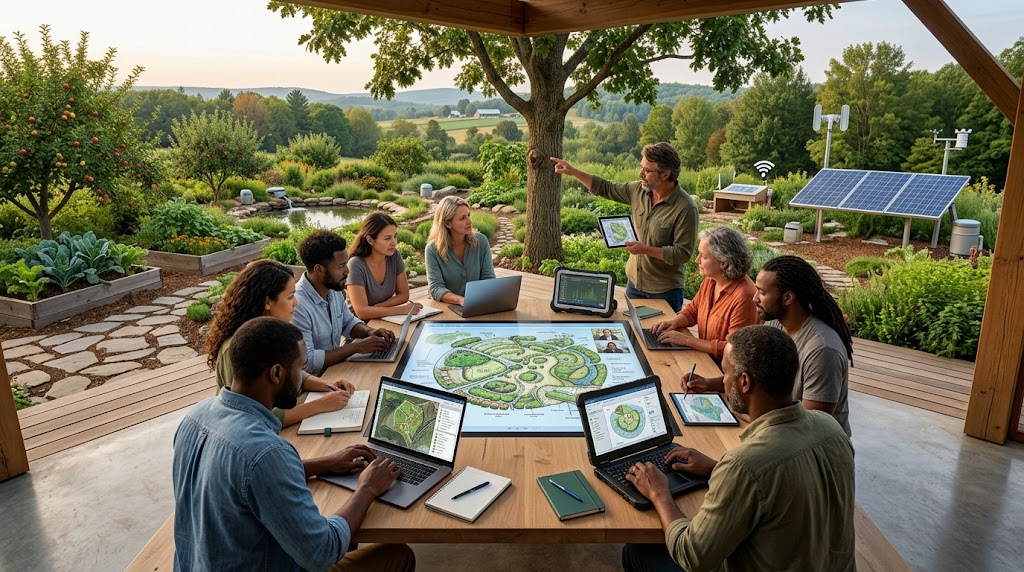
- Community
- Assessment
- Flexibility
- Learning outcomes
- Certificate or diploma structure
- Opportunities to develop a design portfolio
The right choice depends on your goals.
Someone who wants to improve a home garden may need a different educational pathway from someone who wants to develop professional ecological design skills.
Why a Permaculture Diploma Can Be the Next Step
A diploma-level pathway can provide an opportunity to move beyond introductory knowledge.
Instead of simply learning individual principles, students can work toward integrating ecological, social, economic, and design considerations into larger projects.
For a serious Permaculture Diploma Seeker, this shift is important.
The goal is not just to know what permaculture principles are. It is to learn how to use design thinking to address real-world challenges.
A more advanced learning experience can also help students develop a body of work that demonstrates their understanding.
Frequently Asked Questions
Is there a completely free permaculture design course online?
Free permaculture educational resources are available, although the depth, structure, and credentials associated with them vary. Some provide introductory lessons, while more comprehensive programs may require tuition.
Can I learn permaculture without paying for a course?
Yes. You can learn many foundational concepts through free educational materials, books, community resources, practical observation, and experimentation. However, structured education may provide deeper guidance, feedback, and assessment.
Is a free online course enough for a permaculture diploma?
Usually, a free introductory course should be considered preparation rather than a substitute for a comprehensive diploma program. Diploma-level study generally requires more extensive design work and practical application.
What should I learn first in permaculture?
Start with ethics, principles, observation, systems thinking, and ecological relationships. These foundations make it easier to understand more specific topics such as water management, soil, food production, and landscape design.
Can I study permaculture completely online?
Many aspects of permaculture theory and design can be studied online. However, practical observation and hands-on experience remain valuable because permaculture is strongly connected to real landscapes, communities, resources, and ecological processes.
How long does it take to learn permaculture?
There is no single timeframe. You can learn basic concepts relatively quickly, but developing strong design skills requires continued study, observation, practice, and project experience.
Does a free permaculture course provide a certificate?
Not necessarily. Free resources may not offer formal credentials. If certification or a diploma is important to your goals, check the program’s stated qualification and assessment requirements before enrolling.
Conclusion
A permaculture design course online free can be an effective way to begin exploring ecological design without a significant initial financial commitment. It can introduce you to permaculture ethics, design principles, systems thinking, soil, water, food systems, observation, and regenerative approaches.
The most important step, however, is to move beyond passive learning.
Observe your surroundings. Map systems. Keep a design journal. Study natural patterns. Experiment with small projects. Ask why systems work rather than simply copying individual techniques.
Free education can provide a valuable foundation, especially if you are still deciding whether permaculture should become a serious area of study. For those who want to progress toward diploma-level education, it can also help establish the vocabulary, curiosity, and systems-thinking skills needed for more advanced learning.
Ultimately, permaculture is learned not only through information but through observation, design, application, reflection, and continuous improvement. Use free online education as a starting point, then build your knowledge through increasingly practical and structured experiences.
Responses