Benefits of a Free Permaculture Course for Permaculture Diploma Seekers

Introduction to Free Permaculture Learning
A free permaculture course can be one of the most valuable starting points for individuals who aspire to earn a Permaculture Diploma and develop expertise in regenerative design. Whether you are just discovering permaculture or already practicing sustainable living principles, free educational opportunities provide an accessible pathway into a rich and expanding field.
For diploma seekers, the journey toward advanced permaculture education often begins with foundational learning. Free courses allow learners to explore core concepts, test their interests, and develop practical skills before committing to longer-term educational programs. This approach can significantly improve readiness for more advanced studies and professional practice.
As regenerative agriculture, ecosystem restoration, and sustainable community development become increasingly important worldwide, the demand for skilled permaculture practitioners continues to grow. A strong educational foundation can help learners position themselves for leadership roles in these emerging fields.
Understanding Permaculture Education Pathways
What Is Permaculture?
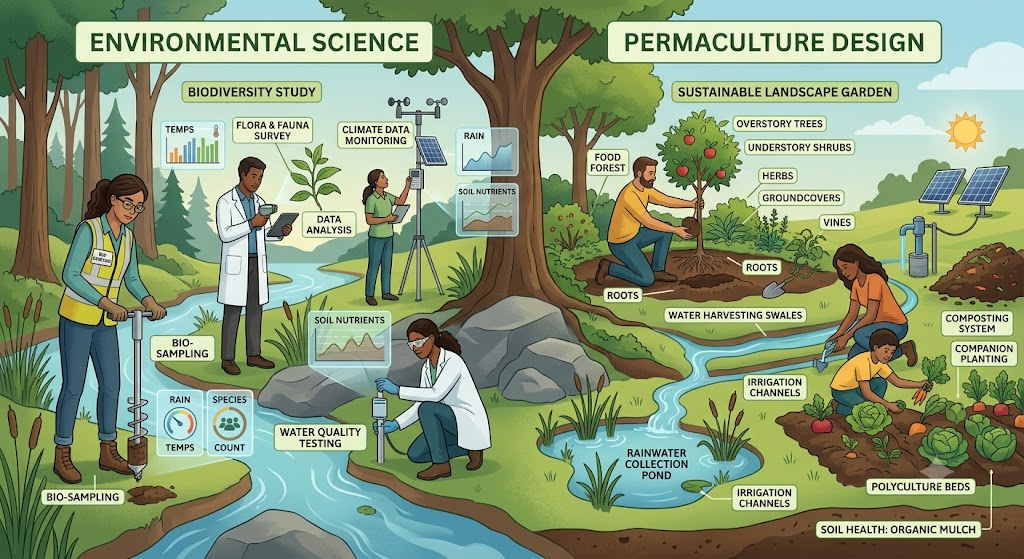
Permaculture is a design system that seeks to create sustainable and regenerative human environments by working with natural systems rather than against them. It integrates knowledge from ecology, agriculture, community development, economics, and systems thinking.
The core ethics of permaculture include:
- Earth Care
- People Care
- Fair Share
These ethics guide decision-making and influence how practitioners design landscapes, businesses, communities, and learning systems.
Why Structured Learning Matters
Many people begin learning permaculture through books, videos, and practical experimentation. While self-study is valuable, structured education provides:
- Clear progression
- Organized curriculum
- Guided reflection
- Feedback opportunities
- Practical application frameworks
These elements become increasingly important for learners seeking diploma-level competency.
Why Start with a Free Permaculture Course
Accessibility for New Learners
One of the greatest advantages of a free permaculture course is accessibility. Financial barriers often prevent talented learners from pursuing educational opportunities.
Free learning options allow students to:
- Explore permaculture concepts risk-free
- Identify areas of interest
- Build confidence
- Assess long-term educational goals
This democratization of education aligns strongly with permaculture values.
Building Foundational Knowledge
Foundational understanding is essential before pursuing advanced credentials.
A quality introductory course often introduces:
| Learning Area | Key Concepts |
| Ecology | Natural systems and relationships |
| Soil Health | Soil biology and fertility |
| Water Systems | Harvesting and conservation |
| Design Principles | Observation and planning |
| Community Systems | Collaboration and resilience |
These concepts become the building blocks for more sophisticated design work later in a diploma pathway.
The Relationship Between Free Learning and Diploma Programs
Preparing for Advanced Studies
Many learners discover that a free permaculture course helps them determine whether advanced study aligns with their goals.
Students entering diploma programs often benefit from prior exposure to:
- Design thinking
- Systems analysis
- Reflective learning
- Project planning
- Documentation practices
Such preparation can make the transition into advanced programs smoother and more productive.
Developing a Learning Portfolio
One overlooked advantage of free education is the opportunity to begin documenting learning experiences.
Portfolio development may include:
- Garden projects
- Community initiatives
- Design sketches
- Reflection journals
- Case studies
These records often become valuable evidence of growth and competency over time.
Essential Skills Gained from a Free Permaculture Course
Ecological Design Thinking
Permaculture emphasizes designing with nature.
Learners begin developing the ability to:
- Observe patterns
- Recognize relationships
- Anticipate consequences
- Design for resilience
These skills extend beyond agriculture and apply to organizations, communities, and personal development.
Systems Analysis
Permaculture practitioners learn to view challenges as interconnected systems.
Instead of addressing symptoms, students learn to identify:
- Root causes
- Feedback loops
- Leverage points
- Long-term solutions
This system’s perspective is highly valued in advanced educational programs.
Regenerative Livelihood Design
Modern permaculture increasingly focuses on creating livelihoods that contribute positively to ecological and social systems.
Learners often explore:
- Purpose-driven work
- Ethical entrepreneurship
- Community resilience
- Resource stewardship
These themes are strongly aligned with advanced learning opportunities available through Gaia University. According to Gaia University’s educational framework, regenerative livelihood design forms a key component of learner development and supports long-term personal and professional growth.
Benefits for Future Diploma Candidates
Confidence Building
Confidence develops through action.
A free permaculture course often encourages learners to:
- Conduct observations
- Implement small projects
- Reflect on outcomes
- Share insights with peers
These experiences reduce uncertainty and build momentum for future studies.
Project Documentation Skills
Advanced diploma pathways frequently emphasize documenting real-world learning.
Students who begin documenting projects early gain advantages such as:
- Better reflection habits
- Improved communication skills
- Clear evidence of competency
- Stronger portfolios
Community Engagement
Permaculture is rarely practiced in isolation.
Many educational experiences encourage:
- Peer learning
- Mentorship
- Community projects
- Collaborative design
Community engagement helps learners expand both knowledge and opportunities.
How Gaia University Supports Advanced Learners
International Diploma of Permaculture Design
For learners seeking a structured progression beyond introductory education, the International Diploma of Permaculture Design provides an advanced pathway focused on applied learning, project work, mentoring, and portfolio development. The program is designed to help learners deepen practical experience while receiving structured support and feedback.
Those interested in learning more can explore the official Gaia University diploma pathway here:
International Diploma of Permaculture Design
Mentoring and Action Learning
A distinguishing feature of Gaia University’s approach is its emphasis on Transformative Action Learning. Learners engage in real-world projects, document outcomes, receive feedback, and continuously refine their understanding through practical application.
Additionally, Gaia University offers a free introductory learning opportunity that introduces learners to regenerative livelihood design and its educational philosophy.
Free Online Course: Regenerative Livelihoods by Design
Creating a Self-Directed Learning Plan
Goal Setting
Successful diploma candidates typically establish clear goals.
Examples include:
- Designing a food forest
- Launching a regenerative enterprise
- Improving community resilience
- Teaching sustainability concepts
Clear objectives help maintain motivation and focus.
Tracking Progress
Effective learners regularly monitor progress through:
- Learning journals
- Project reports
- Reflection exercises
- Peer feedback
Tracking growth creates valuable evidence of competency development.
Common Challenges and Solutions
| Challenge | Solution |
| Information overload | Follow a structured curriculum |
| Lack of practical experience | Start small projects immediately |
| Limited mentorship | Participate in learning communities |
| Difficulty documenting work | Create a regular journaling habit |
| Maintaining motivation | Set measurable milestones |
Many experienced permaculture practitioners emphasize that hands-on implementation is essential for meaningful learning and skill development. Community discussions consistently highlight the value of combining study with practical experimentation and observation.
Frequently Asked Questions
1. Can a free permaculture course prepare me for diploma studies?
Yes. A free permaculture course can provide foundational knowledge, practical skills, and learning habits that support future diploma-level education.
2. What should I learn first in permaculture?
Begin with ecology, observation skills, soil health, water management, and design principles.
3. Do I need land to study permaculture?
No. Many learners begin by observing local ecosystems, participating in community projects, or experimenting with small-scale growing systems.
4. How important is project documentation?
Documentation is extremely valuable because it demonstrates learning, supports reflection, and creates evidence of competency.
5. What makes diploma-level permaculture learning different?
Diploma pathways typically emphasize real-world projects, mentorship, portfolio development, advanced design skills, and reflective practice.
6. Is mentoring important in permaculture education?
Yes. Mentoring helps learners receive feedback, overcome challenges, and accelerate skill development.
Conclusion
A free permaculture course is far more than an introduction to sustainable design. For aspiring diploma candidates, it serves as a foundation for developing ecological literacy, systems thinking, project management skills, and regenerative leadership capabilities.
By combining structured learning, practical application, and reflective practice, learners can build a strong platform for advanced education and professional growth. Those who continue into diploma pathways gain opportunities to deepen their expertise through mentoring, action learning, and real-world project development.
For learners ready to explore advanced pathways in regenerative education, Gaia University offers diploma programs and introductory learning opportunities designed to support meaningful personal and professional transformation.