
Sustainable Living Education: Learn Skills for a Regenerative Future

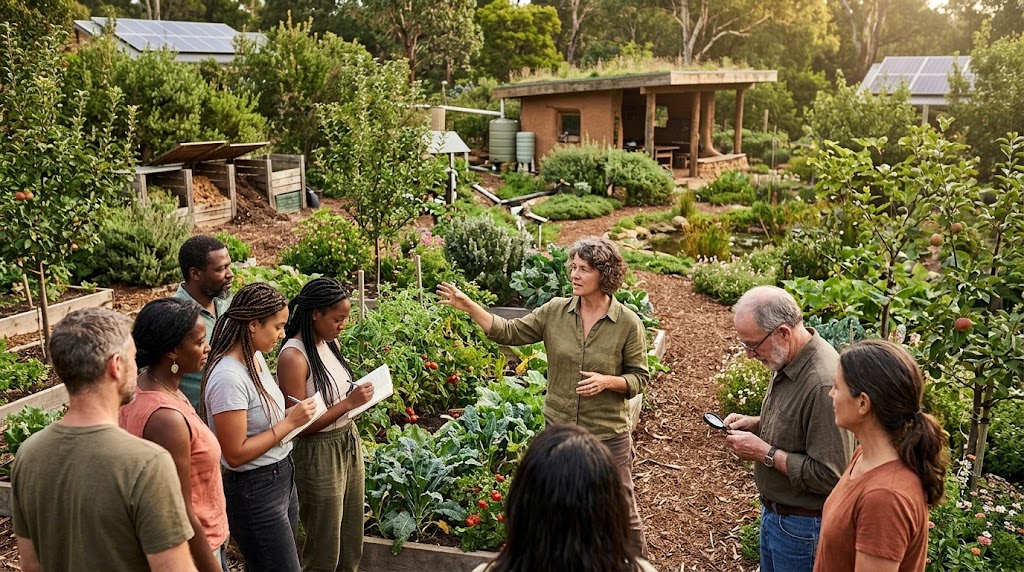
Sustainable living is no longer simply a personal lifestyle choice. It is an essential approach to addressing environmental challenges, strengthening communities, and creating a more balanced relationship between people and the natural world. As concerns about climate change, biodiversity loss, resource depletion, and food security continue to grow, more people are looking for practical ways to contribute to positive environmental change. This growing interest has made sustainable living education an increasingly valuable pathway for individuals who want to understand sustainability and apply its principles in everyday life.
For aspiring permaculture designers, environmental educators, community organizers, and sustainability professionals, education provides the foundation for meaningful action. It offers opportunities to understand ecological systems, develop practical competencies, and explore how human activities can support rather than undermine natural processes.
However, sustainable living education involves much more than learning how to recycle, conserve water, or reduce household waste. It encourages a deeper understanding of the connections between ecosystems, food production, energy use, economics, communities, and personal decision-making.
Through approaches such as permaculture, regenerative design, ecological restoration, and community-based learning, students can develop the knowledge and confidence needed to create lasting improvements in their surroundings.
Whether you are interested in designing productive landscapes, developing sustainable communities, establishing a regenerative enterprise, or pursuing a Permaculture Diploma, understanding the principles of sustainable living can help you turn environmental awareness into practical experience.
What Is Sustainable Living Education?
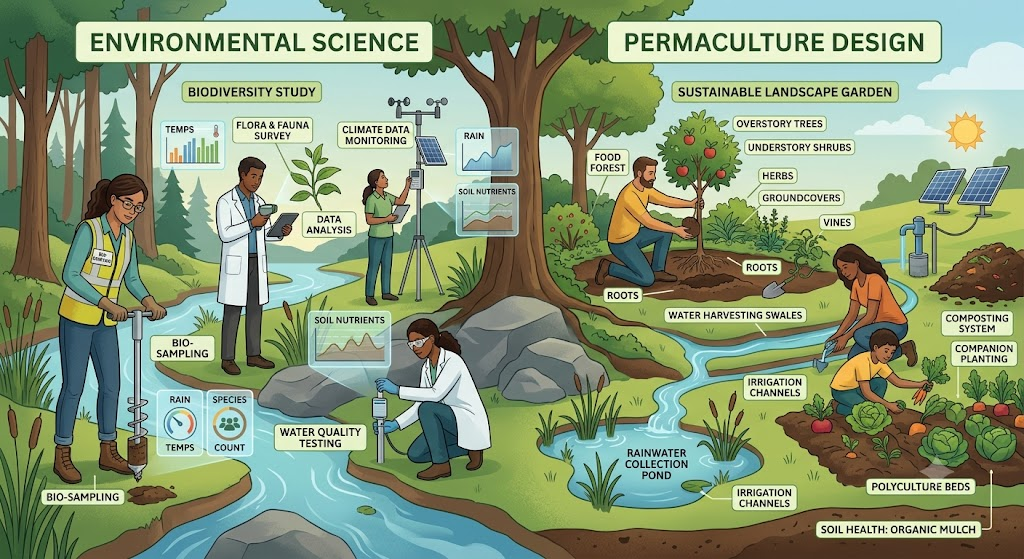
Sustainable living education is a learning approach that helps individuals understand how human lifestyles, communities, and economic activities interact with the natural environment.
It combines environmental knowledge with practical skills, critical thinking, and responsible decision-making. Its purpose is to help people identify more sustainable ways of meeting human needs while protecting ecological systems and supporting future generations.
Traditional environmental education often focuses on understanding environmental problems. Sustainable living education takes this knowledge further by exploring possible solutions and helping learners put them into practice.
Students may investigate subjects such as:
- Sustainable food production and agriculture.
- Permaculture ethics and design principles.
- Soil health and ecological regeneration.
- Renewable energy and energy efficiency.
- Water conservation and responsible management.
- Waste reduction and resource recovery.
- Sustainable construction and natural materials.
- Biodiversity conservation and habitat restoration.
- Community resilience and local economies.
- Ecological entrepreneurship and regenerative livelihoods.
These subjects are interconnected. For example, sustainable food production depends on healthy soil, appropriate water management, biodiversity, and effective resource planning.
Understanding these relationships helps learners move beyond isolated environmental actions and begin thinking about complete systems.
The ultimate goal is to develop people who can recognize ecological challenges, evaluate possible solutions, and design practical approaches that benefit both communities and the environment.
Why Is Sustainable Living Education Important?
Modern societies depend on complex systems that influence natural resources, ecosystems, and human well-being. Many conventional approaches to production and consumption create environmental pressures that cannot be addressed through individual actions alone.
Education helps people understand the causes of these challenges and identify opportunities for positive change.
1. Developing Environmental Awareness
One of the most important benefits of sustainable living education is developing a deeper understanding of ecological processes.
Learners explore how ecosystems function, how resources circulate, and how different environmental factors influence one another.
For example, soil degradation is not simply an agricultural problem. It can affect water retention, biodiversity, food production, carbon storage, and the resilience of entire landscapes.
By understanding these connections, students become better equipped to recognize the broader consequences of human activities.
Environmental awareness also encourages more thoughtful decisions about consumption, transportation, food choices, construction, and resource use.
2. Building Practical Sustainability Skills
Knowledge becomes particularly valuable when it can be translated into action.
Sustainable living education introduces practical competencies that learners can apply in their homes, workplaces, communities, and professional projects.
Depending on the learning pathway, these may include:
- Planning productive gardens.
- Understanding composting and soil improvement.
- Designing water-efficient landscapes.
- Reducing household resource consumption.
- Exploring renewable energy options.
- Applying ecological design methods.
- Developing community sustainability initiatives.
- Evaluating the environmental impact of projects.
These skills help individuals become active participants in sustainability rather than simply observers of environmental problems.
3. Supporting Community Resilience
Sustainable communities need more than environmentally responsible infrastructure. They also depend on strong social relationships, local knowledge, accessible resources, and effective collaboration.
Education can help people understand how communities respond to environmental, economic, and social challenges.
For example, community food gardens can strengthen local food awareness while creating opportunities for cooperation and knowledge sharing.
Similarly, local repair initiatives, educational programs, and shared resource systems can encourage more resilient patterns of community development.
Learning how to facilitate these initiatives is an important part of developing a broader sustainability skill set.
4. Encouraging Regenerative Thinking
Sustainability is often associated with reducing negative environmental impacts. Regenerative thinking expands this perspective by asking how human activities can actively improve ecological and social conditions.
Rather than simply minimizing resource consumption, regenerative approaches consider how land, communities, and economic systems can become healthier over time.
This distinction is particularly important for permaculture students because permaculture emphasizes designing systems that work with natural processes.
Sustainable living education introduces learners to this broader perspective and encourages them to consider the long-term effects of their decisions.
The Connection Between Sustainable Living Education and Permaculture
Permaculture is one of the most comprehensive approaches to sustainable living because it combines ecological observation, design thinking, and practical application.
It draws inspiration from natural ecosystems and applies ecological patterns to human environments.
Rather than treating gardening, housing, water, energy, and community development as unrelated subjects, permaculture explores how these elements can function together.
This makes it particularly relevant for people pursuing advanced sustainability education or a Permaculture Diploma.
Understanding the Three Ethics of Permaculture
Permaculture education is traditionally guided by three interconnected ethical foundations:
Earth Care
Earth Care focuses on protecting and regenerating the natural systems that support life. It encourages responsible land management, biodiversity conservation, soil improvement, and the protection of natural resources.
People Care
People Care recognizes that sustainable systems must also support human needs and well-being. It emphasizes cooperation, appropriate living conditions, education, and access to essential resources.
Fair Share
Fair Share encourages responsible resource distribution and the recognition of ecological limits. It promotes the thoughtful use of surplus resources and supports systems that consider the needs of others.
Together, these ethics provide a framework for evaluating decisions and developing designs that consider both environmental and social consequences.
Applying Permaculture Principles to Everyday Life
Permaculture principles can be applied in many different settings, including urban homes, rural properties, educational environments, community organizations, and commercial projects.
For example:
- Observe and interact: Understand the conditions of a place before making changes.
- Catch and store energy: Make better use of available natural resources.
- Obtain a yield: Design systems that provide useful and meaningful outcomes.
- Apply self-regulation and accept feedback: Learn from results and adjust approaches.
- Produce no waste: Find opportunities to reuse resources and close material cycles.
- Integrate rather than segregate: Develop beneficial relationships between different elements.
- Use and value diversity: Recognize the importance of biological and social diversity.
These principles help students develop a design-oriented mindset that can be applied to challenges beyond traditional agriculture.
Key Subjects Covered in Sustainable Living Education
A comprehensive sustainable living education program may include several interconnected areas of study.
Understanding these subjects can help prospective Permaculture Diploma students identify their interests and develop a meaningful learning pathway.
1. Sustainable Agriculture and Food Systems
Food production is a central component of sustainable living.
Conventional agricultural systems can create challenges involving soil degradation, biodiversity loss, water consumption, and dependence on external inputs.
Sustainable agriculture explores alternative approaches that work with ecological processes.
Students may investigate:
- Organic and regenerative growing methods.
- Permaculture food forests.
- Agroforestry systems.
- Crop diversity and companion planting.
- Soil fertility and composting.
- Seed saving and plant propagation.
- Local food networks.
- Seasonal food production.
An important objective is understanding how food systems can become more productive while maintaining ecological health.
For aspiring permaculture designers, these subjects provide useful foundations for developing gardens, farms, and community food projects.
2. Water Conservation and Management
Water is essential to every living system, yet its availability and quality vary considerably between locations.
Sustainable living education explores how water can be managed responsibly at household, agricultural, and landscape levels.
Relevant subjects include rainwater harvesting concepts, water-efficient gardening, watershed awareness, water conservation, and landscape-based water planning.
Students also learn why understanding local climate, soil characteristics, topography, and vegetation is important when developing water management strategies.
The broader objective is to design systems that make responsible use of available water resources while protecting surrounding ecosystems.
3. Renewable Energy and Resource Efficiency
Energy consumption is closely connected to environmental sustainability.
Educational programs may introduce learners to renewable energy technologies, passive design concepts, energy efficiency, and responsible resource use.
Students can explore how buildings, transportation systems, agricultural operations, and communities can reduce unnecessary energy demand.
Understanding the relationship between energy production, consumption, and environmental impact also supports more informed decision-making when planning sustainable projects.
4. Sustainable Construction and Natural Materials
The built environment has a significant influence on resource consumption and environmental quality.
Sustainable construction explores how buildings and infrastructure can be designed with greater consideration for local climates, available materials, energy requirements, and long-term environmental impacts.
Possible learning areas include:
- Passive solar design.
- Natural building materials.
- Building orientation and ventilation.
- Energy-efficient construction.
- Appropriate technologies.
- Low-impact infrastructure.
- Sustainable landscape integration.
These subjects demonstrate how ecological design can influence the places where people live and work.
5. Waste Management and Circular Systems
Sustainable living education also examines how resources move through production and consumption systems.
Many conventional systems follow a linear model in which materials are extracted, manufactured, consumed, and discarded.
Circular approaches seek to reduce waste by extending the useful life of materials and recovering resources wherever possible.
Students may explore composting, material reuse, repair initiatives, recycling systems, and resource-efficient production.
In permaculture, this connects with the principle of producing no waste and identifying opportunities to create useful relationships between different elements of a system.
6. Community Development and Social Sustainability
Environmental sustainability cannot be separated from social conditions.
Communities need effective communication, shared decision-making, cooperation, and access to opportunities if they are to develop long-term resilience.
Sustainable living education may therefore include community facilitation, collaborative project development, local economic systems, environmental education, and participatory design.
These competencies are particularly valuable for learners who want to work with community organizations, educational institutions, local enterprises, or environmental initiatives.
How Sustainable Living Education Develops Real-World Competencies
One of the most important differences between theoretical environmental learning and applied sustainability education is the opportunity to practice what you learn.
Reading about ecological systems provides useful background knowledge. However, designing and developing projects helps learners understand how different ideas work under real conditions.
A strong learning pathway should therefore combine research, observation, experimentation, reflection, and practical application.
Project-Based Learning
Project-based learning gives students opportunities to apply knowledge to specific challenges.
A learner interested in sustainable food systems might develop a community garden design. Someone interested in ecological restoration might study a degraded landscape and explore appropriate regeneration strategies.
Other possible projects include:
- Developing a small-scale permaculture garden.
- Creating an educational sustainability program.
- Designing a community composting initiative.
- Researching local food distribution systems.
- Exploring regenerative business opportunities.
- Developing a sustainable household resource plan.
- Creating a biodiversity improvement project.
These projects help students develop practical experience while building a portfolio that demonstrates their learning.
Documentation and Reflection
Documentation is another important component of applied sustainability education.
Keeping records of observations, decisions, research, project activities, and outcomes helps learners understand their progress.
It also creates an opportunity to evaluate what worked, what did not work, and what could be improved.
Reflection encourages students to recognize the difference between theoretical assumptions and actual results.
For prospective professionals, documented project experience can also help communicate their competencies to potential collaborators, clients, and employers.
Collaboration and Mentoring
Sustainability challenges rarely have simple solutions.
They often require knowledge from multiple disciplines and the participation of people with different experiences.
Working with mentors, peers, and project partners can help students develop new perspectives and improve their decision-making abilities.
Feedback is especially valuable when evaluating design proposals, testing ideas, and adapting projects to local conditions.
A supportive learning environment can therefore make a significant difference in the development of practical sustainability competencies.
Sustainable Living Education for Permaculture Diploma Seekers
For people considering a Permaculture Diploma, sustainable living education can provide a broader foundation for understanding ecological design and regenerative development.
A diploma-level learning pathway offers an opportunity to move beyond introductory concepts and explore how permaculture principles can be applied through sustained project work.
This is particularly useful for learners who have already completed a Permaculture Design Certificate (PDC) and want to deepen their understanding.
A PDC generally introduces foundational permaculture concepts, ethics, principles, and design methods. Further study can provide opportunities to develop more advanced competencies, investigate specialized subjects, and build experience through practical projects.
Moving Beyond the Permaculture Design Course
Completing a PDC is an important starting point, but applying permaculture principles in real environments involves additional challenges.
Designers need to understand how to interpret site conditions, evaluate resources, communicate proposals, and adapt their work as circumstances change.
Advanced learning can help develop these capabilities.
For example, a student might begin with an interest in food forest design and gradually expand their work into community food systems, ecological entrepreneurship, or regenerative land management.
This broader perspective is valuable because successful sustainability projects often involve more than technical design knowledge.
They also require project management, communication, collaboration, research, and the ability to learn from experience.
Exploring Gaia University’s Permaculture Education Pathway
For learners interested in flexible, applied, and self-directed sustainability education, Gaia University offers learning pathways focused on ecological design, regenerative livelihoods, and transformative action learning.
Its International Diploma of Permaculture Design is an advanced permaculture program intended for learners who have completed a Permaculture Design Course and want to continue developing their design practice.
The program combines advanced learning content, practical project design, documentation, mentoring, and feedback.
An important feature of this pathway is its emphasis on applying knowledge through self-chosen projects.
Students can explore different areas of interest, including research, land-based designs, social and cultural projects, businesses, volunteer activities, and professional work.
The learning structure also incorporates online certificate programs before transitioning into a mentored project and documentation phase.
You can explore the International Diploma of Permaculture Design to understand its structure and learning approach.
Why Self-Directed Learning Matters
Every sustainability learner has different interests, experiences, and professional goals.
Some may want to focus on regenerative agriculture, while others are more interested in ecological education, community development, sustainable enterprises, or landscape design.
Self-directed learning creates space for students to develop their own areas of focus.
Rather than following a single professional pathway, learners can explore how their interests connect with broader sustainability challenges.
This approach encourages independence, initiative, and the ability to identify learning opportunities throughout a professional journey.
For permaculture practitioners, these are valuable competencies because ecological design requires continuous observation, experimentation, and adaptation.
How to Choose the Right Sustainable Living Education Program
With increasing interest in sustainability, prospective students can find many educational opportunities. However, programs vary in their content, structure, learning methods, and practical requirements.
Choosing an appropriate program requires looking beyond its title or advertised benefits.
Consider the following factors before enrolling.
1. Examine the Curriculum
Look for a curriculum that reflects your interests and learning objectives.
If you want to pursue permaculture design, investigate whether the program includes ecological observation, design methodology, practical applications, and advanced project development.
If your interests involve community resilience, look for opportunities to explore social systems, collaboration, and community-based initiatives.
A well-structured curriculum should provide relevant knowledge while encouraging connections between different subjects.
2. Evaluate the Learning Methodology
Consider how the program delivers education.
Some courses emphasize recorded lessons and independent reading. Others incorporate interactive sessions, assignments, group discussions, mentoring, and practical projects.
For students interested in applied sustainability, opportunities to work on real-world challenges can be particularly valuable.
3. Look for Mentoring and Feedback
Mentoring can help learners identify weaknesses, refine their ideas, and develop stronger project outcomes.
Find out whether the program includes individual guidance, peer interaction, or opportunities to receive feedback from experienced practitioners.
4. Consider Flexibility
Many people interested in sustainability education are already working, volunteering, developing projects, or managing personal responsibilities.
An online or flexible program can make continued learning more accessible.
However, flexibility should not mean a lack of structure. Look for a learning environment that provides clear expectations, useful resources, and appropriate support.
5. Understand the Qualification
Different educational institutions use different accreditation and assessment models.
Before enrolling, understand what qualification is awarded, how learning is assessed, and what the credential represents.
Also consider whether the program provides documented project experience that can demonstrate your competencies beyond the qualification itself.
For an overview of available learning pathways, you can explore Gaia University’s program offerings.
Practical Ways to Apply Sustainable Living Education in Everyday Life
Sustainable living education becomes most valuable when its lessons influence everyday decisions and practical activities.
You do not need to begin with a large project. Small experiments can provide useful learning opportunities and help develop confidence.
Here are several ways to start applying sustainability principles.
Begin With Observation
Observe your surroundings before deciding what needs to change.
Look at how resources are used, where waste is generated, how sunlight moves through a space, and how water interacts with the landscape.
In permaculture, observation helps reveal relationships that might otherwise be overlooked.
Develop a Small Food-Growing Project
Growing food can introduce important concepts related to soil, water, biodiversity, seasonal patterns, and resource management.
A small garden or container-growing project can provide an opportunity to practice observation and ecological thinking.
Pay attention to plant health, growing conditions, and the relationships between different elements.
Improve Resource Awareness
Examine how resources are consumed in your home or workplace.
Consider opportunities to reduce unnecessary consumption, improve material reuse, and make more informed purchasing decisions.
Understanding resource flows is an important foundation for developing more sustainable systems.
Participate in Community Initiatives
Community projects provide opportunities to learn from others and understand local environmental challenges.
Consider participating in educational activities, local growing projects, ecological restoration initiatives, or community sustainability discussions.
Collaboration can help turn individual knowledge into shared practical experience.
Document Your Learning
Keep a record of your activities, observations, and project development.
Include photographs, diagrams, research notes, decisions, and reflections.
Over time, this documentation can become a useful learning portfolio that demonstrates your development and supports future professional opportunities.
Career and Professional Opportunities in Sustainable Living
Sustainable living education can support different professional and entrepreneurial directions.
The opportunities available depend on a learner’s experience, additional qualifications, practical competencies, and local employment conditions.
Potential areas of interest include:
Permaculture Design: Developing ecological designs for gardens, farms, properties, and community spaces.
Sustainable Agriculture: Supporting food production systems that prioritize soil health, biodiversity, and responsible resource management.
Environmental Education: Helping individuals and communities understand ecological processes and sustainable practices.
Community Development: Supporting initiatives that strengthen local resilience, collaboration, and access to resources.
Regenerative Entrepreneurship: Developing enterprises that consider environmental and social outcomes alongside economic objectives.
Ecological Restoration: Contributing to projects focused on improving degraded landscapes and supporting biodiversity.
Sustainability Consulting: Helping organizations understand sustainability challenges and identify appropriate improvement opportunities.
Education alone does not guarantee professional employment or business success. However, combining theoretical knowledge with practical experience, project documentation, and relevant professional development can create a stronger foundation for future opportunities.
The Future of Sustainable Living Education
The importance of sustainability education is likely to continue growing as communities, organizations, and individuals respond to environmental and social challenges.
Future learning approaches will need to address increasingly interconnected issues.
Climate adaptation, food security, biodiversity protection, resource efficiency, and community resilience cannot be treated as completely separate subjects.
They require people who can think across disciplines, understand complex systems, and collaborate on practical solutions.
This makes systems thinking an increasingly important part of sustainable living education.
Students need to understand not only how individual interventions work, but also how they influence the wider systems in which they operate.
Digital learning environments can also expand access to sustainability knowledge, allowing people in different geographical locations to exchange experiences and collaborate.
However, technology should complement rather than replace direct engagement with real environments and communities.
The strongest educational approaches will combine accessible knowledge, practical experience, reflective learning, and opportunities to develop meaningful projects.
For permaculture learners, this represents an opportunity to develop skills that remain relevant across different professional contexts and environmental conditions.
Frequently Asked Questions About Sustainable Living Education
What is the main purpose of sustainable living education?
The main purpose is to help people understand the relationship between human activities and ecological systems while developing practical skills for making more responsible decisions. It combines environmental awareness, systems thinking, and applied learning to support sustainable communities and lifestyles.
Is sustainable living education the same as environmental education?
They are closely related, but their emphasis can differ. Environmental education often focuses on understanding ecosystems and environmental challenges. Sustainable living education places additional emphasis on applying that knowledge to everyday activities, resource management, community development, and practical solutions.
How does permaculture contribute to sustainable living education?
Permaculture provides a framework for understanding ecological relationships and designing human systems that work with natural processes. It connects subjects such as food production, water management, soil health, biodiversity, energy, and community development through a common set of ethics and design principles.
Can I study sustainable living education online?
Yes. Online programs can provide access to sustainability knowledge, interactive learning, educational resources, mentoring, and project-based activities. Some programs also allow students to develop practical projects in their own communities while receiving guidance and feedback remotely.
What can I learn through a Permaculture Diploma?
A Permaculture Diploma can provide opportunities to deepen your understanding of ecological design, develop practical project experience, and strengthen competencies in areas such as research, documentation, project development, and regenerative systems thinking. The specific learning outcomes depend on the institution and program.
Do I need previous experience to study sustainable living?
Entry requirements vary between programs. Some introductory courses are suitable for beginners, while advanced diploma pathways may require previous permaculture education, such as a Permaculture Design Certificate.
What is the difference between sustainable and regenerative living?
Sustainable living generally focuses on meeting human needs while reducing environmental harm and maintaining ecological resources. Regenerative living goes further by emphasizing the restoration and improvement of ecological and social systems.
Both approaches are important for developing more responsible and resilient ways of living.
How can I begin applying sustainable living principles?
Start by observing your surroundings, understanding how resources are used, and identifying opportunities for improvement. You can explore food growing, composting concepts, resource efficiency, community activities, and ecological design. Documenting your experiences can help turn these activities into a structured learning process.
Conclusion: Education as a Foundation for a Regenerative Future
Sustainable living education provides more than information about environmental responsibility. It develops the knowledge, practical competencies, and systems thinking needed to create meaningful improvements in the way people interact with the natural world.
Through subjects such as permaculture, regenerative agriculture, renewable energy, water management, community development, and ecological design, learners can explore practical approaches to building more resilient lifestyles and communities.
For aspiring permaculture designers, this education also creates opportunities to move beyond introductory knowledge and develop the capabilities required to design, implement, and evaluate real-world projects.
The most valuable learning experiences connect theory with practice. They encourage observation, experimentation, collaboration, documentation, and continuous improvement.
Whether your goal is to develop a productive landscape, support a community initiative, establish a regenerative enterprise, or pursue a professional pathway in ecological design, investing in sustainable living education can help you take meaningful steps toward that vision.
Ultimately, creating a regenerative future depends on people who are willing not only to understand environmental challenges but also to learn, adapt, and contribute to practical solutions. Education provides the foundation for that transformation.
Responses