
Regenerative Design Principles: A Practical Guide for Permaculture Diploma Seekers

Introduction: Moving Beyond Sustainability
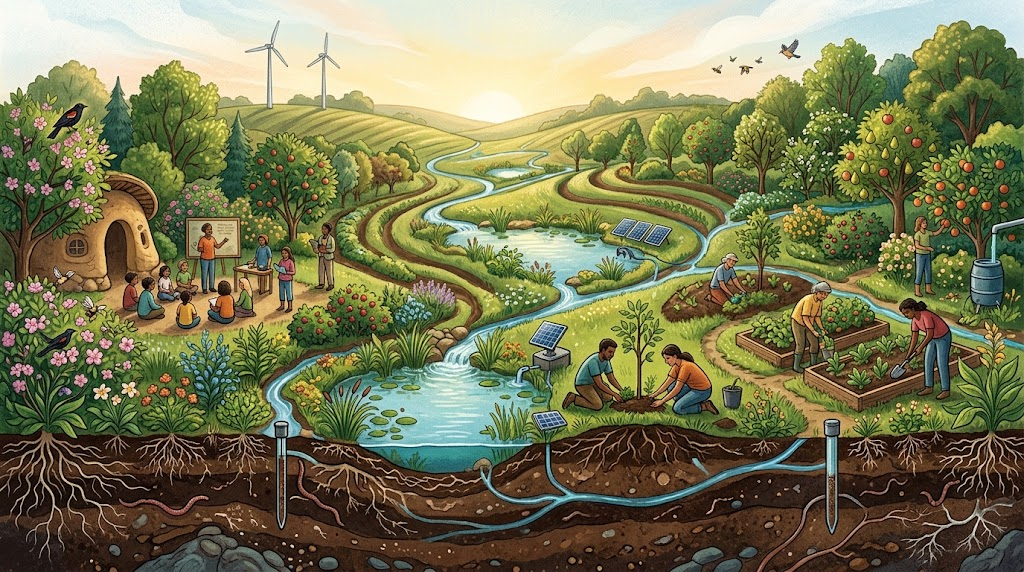
Many environmental approaches focus on reducing harm. That is an important starting point, but regenerative design asks a broader question: How can our designs actively improve the systems they are part of?
This shift is at the heart of regenerative thinking. Instead of simply using fewer resources, regenerative design seeks to restore ecological function, strengthen communities, improve soil and water systems, and create conditions in which life can continue to thrive.
For students pursuing a permaculture education, understanding regenerative design principles can provide a valuable framework for applying permaculture ethics and design methods to larger and more complex challenges. A garden, farm, building, neighborhood, business, or educational project can all be considered as interconnected systems rather than isolated parts.
Regenerative design does not have one universal formula. It is better understood as a way of thinking and designing that considers relationships, feedback, place, time, and the capacity of living systems to renew themselves.
This guide explores the key principles of regenerative design, how they relate to permaculture, and how aspiring designers can use them in practical projects.
What Are Regenerative Design Principles?
Regenerative design principles are guidelines for creating systems that can restore, renew, and strengthen ecological and social relationships rather than simply minimizing negative impacts.
Traditional design often asks:
- How can we make this more efficient?
- How can we reduce waste?
- How can we consume fewer resources?
- How can we lower environmental damage?
Regenerative design adds another level of inquiry:
- How can this system become healthier over time?
- What ecological functions could be restored?
- How can the project increase biodiversity?
- How can people and nature benefit together?
- What resources can be regenerated rather than merely consumed?
- How can the design strengthen the capacity of the wider system?
This distinction is important for permaculture diploma seekers because permaculture already encourages designers to work with natural patterns, cycles, relationships, and ecological processes.
Regenerative design expands this mindset by focusing strongly on positive ecological and social change.
Regenerative Design and Permaculture
Permaculture and regenerative design overlap in many areas, although they are not identical concepts.
Permaculture provides an ethical and design framework for creating sustainable human habitats. Its well-known ethical foundations include care for the Earth, care for people, and fair sharing of resources and opportunities.
Regenerative design can complement these ethics by asking what conditions allow ecosystems and communities to continually renew themselves.
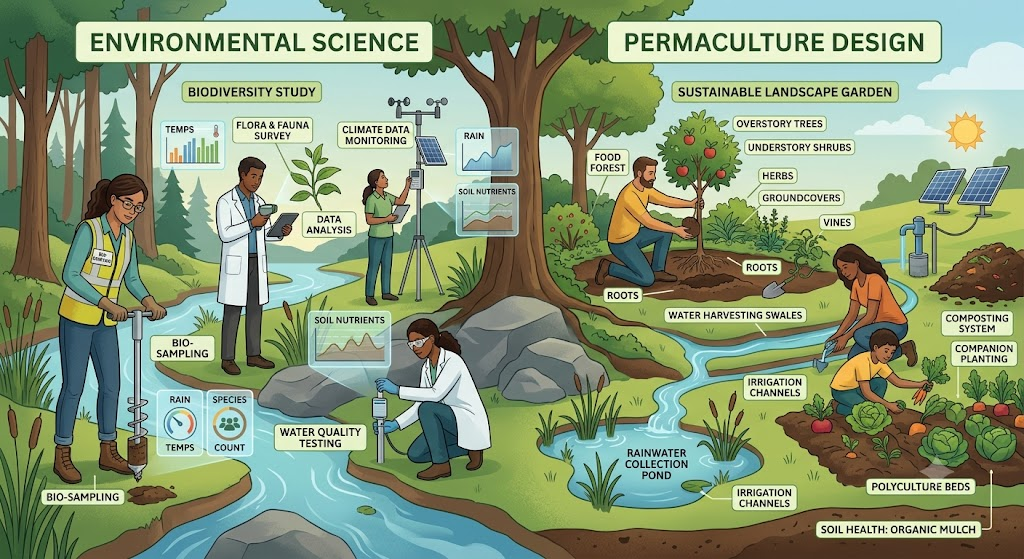
For example, a permaculture garden might be designed to:
- Improve soil fertility
- Capture and infiltrate rainwater
- Produce food
- Support pollinators
- Reduce external inputs
- Create habitat
- Provide learning opportunities
A regenerative approach may go further by asking how the garden can improve the ecological condition of the site over time and how its benefits can extend into the surrounding community.
The emphasis therefore moves from creating a functioning system toward creating a system with the capacity to increase health, resilience, and vitality.
Students exploring a permaculture education pathway can use regenerative design as an additional lens for evaluating the outcomes of their designs.
1. Design for the Health of the Whole System
One of the most important regenerative design principles is to consider the whole system.
A single design decision can affect many connected elements. Changing how water moves across a landscape, for example, can influence soil moisture, plant growth, erosion, habitat, food production, and downstream water quality.
A narrow approach might focus only on the original problem. A systems approach considers the relationships surrounding it.
When designing, ask:
- What systems are connected to this project?
- What resources enter the system?
- What resources leave it?
- Where are the major feedback loops?
- Which relationships are currently weak?
- Which relationships could become stronger?
- What could happen several years after implementation?
This approach prevents designers from treating environmental problems as isolated technical issues.
For a permaculture student, this principle can be applied through site observation, sector analysis, zoning, mapping, pattern recognition, and careful consideration of flows such as water, energy, materials, people, and information.
2. Work With Living Systems
Regenerative design recognizes that ecosystems are dynamic and constantly changing.
A forest is not a static collection of trees. A healthy soil is not simply a container for plant roots. A community is not merely a collection of individuals.
These systems interact, adapt, compete, cooperate, and evolve.
Instead of forcing a landscape into a fixed condition, regenerative designers can work with natural processes.
For example, rather than attempting to eliminate every spontaneous plant from a landscape, a designer might investigate what those plants reveal about soil conditions, disturbance, moisture, or succession.
Similarly, rather than completely controlling water movement, a landscape design might slow, spread, and infiltrate rainfall in ways that cooperate with the site’s natural hydrology.
Working with living systems requires observation and flexibility. A successful design may change as conditions change.
3. Restore Ecological Functions
Regenerative design places strong emphasis on restoring ecological functions.
An ecosystem provides many functions that humans depend upon, including:
- Water infiltration
- Nutrient cycling
- Soil formation
- Carbon storage
- Pollination
- Seed dispersal
- Habitat creation
- Temperature regulation
- Decomposition
- Biodiversity support
A landscape can be productive while still losing ecological function. For example, a heavily managed agricultural system may produce crops but experience declining soil health, reduced biodiversity, erosion, or dependence on external inputs.
A regenerative approach asks how production and ecological restoration can occur together.
In a permaculture project, this could mean integrating perennial plants, improving soil organic matter, creating habitat, retaining water, reducing unnecessary disturbance, and designing relationships between different elements.
The goal is not simply to preserve what remains. It is to create conditions that allow ecological processes to recover and strengthen.
4. Design for Long-Term Resilience
Resilience refers to the ability of a system to respond to change, disturbance, or stress while maintaining essential functions.
Climate variability, economic disruption, resource shortages, extreme weather, changing social needs, and ecological disturbances can all challenge human systems.
Regenerative design therefore considers not only how well something performs under normal conditions but also how it responds when circumstances change.
A resilient design may include:
- Diverse species
- Multiple sources of food
- Local resource cycles
- Water storage and infiltration
- Renewable energy
- Community knowledge
- Redundant functions
- Flexible infrastructure
- Local skills
- Strong social relationships
This connects closely with permaculture’s emphasis on diversity, redundancy, appropriate scale, and designing for resilience.
For diploma seekers, resilience is particularly useful as a design evaluation question: What happens if one important component fails?
If the entire system depends on one input, supplier, crop, technology, or individual, its resilience may be limited.
5. Learn From Natural Patterns
Nature contains patterns that can inform design.
Spirals, branching structures, networks, edges, succession, clustering, layering, and cycles appear repeatedly throughout natural systems.
Regenerative designers do not simply copy natural forms because they look attractive. Instead, they investigate the functions behind those patterns.
For example, branching patterns can distribute water, nutrients, energy, or information efficiently. Network structures can create multiple connections between different parts of a system.
Permaculture uses pattern thinking as an important design strategy. Designers can observe how natural systems solve problems and then adapt those principles to human contexts.
The key word is adapt. Regenerative design does not mean copying nature literally. It means learning from ecological relationships and processes.
6. Design With Place in Mind
A regenerative design should respond to its specific place.
There is no single design that works equally well everywhere. Climate, geology, soils, hydrology, biodiversity, culture, economy, history, and community priorities all influence what is appropriate.
This makes site observation essential.
Before developing a design, investigate:
- Climate patterns
- Seasonal changes
- Sun and wind
- Water movement
- Soil conditions
- Existing vegetation
- Wildlife
- Existing infrastructure
- Local materials
- Cultural history
- Community needs
- Existing economic activities
Place-based design helps prevent the application of generic solutions to highly specific problems.
For a permaculture diploma project, site analysis can become a foundation for making design decisions that are appropriate rather than simply fashionable.
7. Value Diversity and Interconnection
Diversity is one of the strongest sources of resilience in natural systems.
A diverse ecosystem contains multiple species performing different and sometimes overlapping functions. If one component changes or disappears, other components may continue supporting the system.
The same idea can be applied socially and economically.
A regenerative community might develop:
- Diverse food sources
- Multiple livelihoods
- Different forms of knowledge
- Local enterprises
- Community networks
- Different types of habitat
- A range of skills
Interconnection is equally important. Diversity without relationships may not produce a functional system.
The designer’s role is therefore not simply to add more components but to create beneficial relationships between them.
8. Close Resource Loops
Many conventional systems follow a linear pattern:
Extract → Produce → Consume → Discard
Regenerative systems aim to move toward cycles:
Use → Transform → Reuse → Regenerate
In ecological systems, waste from one organism often becomes a resource for another.
This principle can be applied to human systems through composting, water reuse, material recovery, nutrient cycling, local production, repair, and reuse.
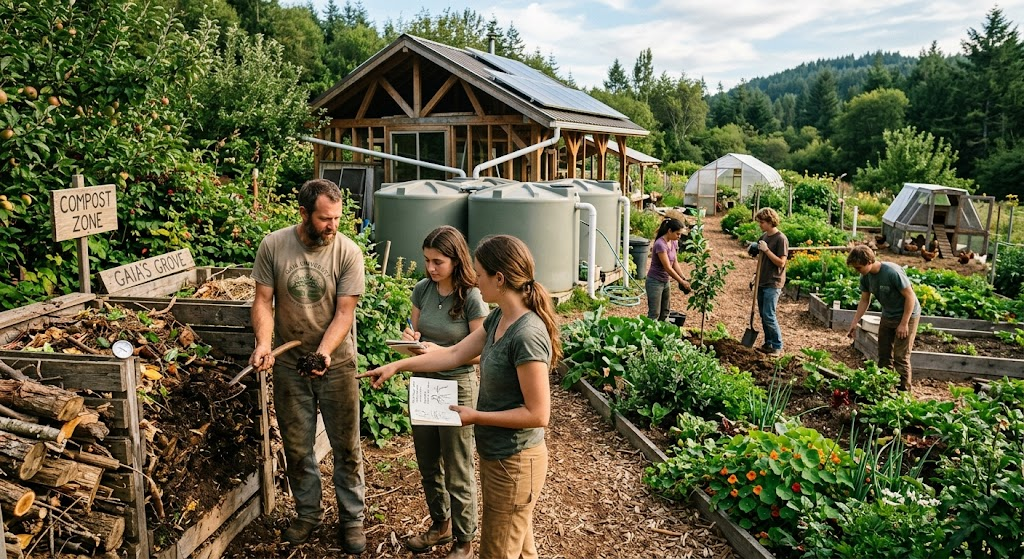
In a permaculture garden, kitchen scraps can become compost. Organic matter can return nutrients to soil. Rainwater can be captured and infiltrated. Plant residues can become mulch.
The objective is to look for resources currently leaving the system and ask whether they could support another function.
9. Design for Positive Feedback
Feedback loops can either strengthen or weaken a system.
A regenerative designer looks for opportunities to create positive relationships between processes.
For example:
Healthy soil can support stronger plant growth. Stronger plant growth can produce more organic matter. Organic matter can improve soil structure. Better soil structure can improve water retention and support further plant growth.
This creates a reinforcing cycle.
Designers can search for similar loops in social systems. A community garden might produce food, provide learning opportunities, bring people together, build skills, and encourage further participation.
The design becomes more powerful when one intervention supports several additional outcomes.
10. Put People Inside the System
Regenerative design is not exclusively about landscapes and ecology.
People are part of ecological systems. A technically impressive environmental project can fail if it does not reflect the needs, knowledge, values, or capabilities of the people involved.
Regenerative design therefore considers social relationships as part of the system.
Important questions include:
- Who uses the system?
- Who makes decisions?
- Who benefits?
- Who carries the workload?
- What knowledge already exists?
- What skills can be developed?
- How can participation increase?
- How can the project create meaningful relationships?
This approach is particularly relevant to permaculture because permaculture design includes both ecological and human dimensions.
A food-growing project, for example, can be evaluated not only by yield but also by whether it strengthens food knowledge, community connections, confidence, and local capacity.
11. Design for Multiple Functions
A regenerative system can become more effective when individual elements serve multiple purposes.
A tree might:
- Produce food
- Provide shade
- Create habitat
- Protect soil
- Capture carbon
- Slow wind
- Produce mulch
- Support pollinators
A pond might:
- Store water
- Support biodiversity
- Moderate microclimate
- Provide irrigation
- Create educational opportunities
Multiple-function design reduces the need for separate infrastructure while increasing relationships between system components.
This is closely aligned with classic permaculture thinking and provides a practical way for students to evaluate whether their designs are making efficient use of available resources.
12. Prioritize Regeneration Over Extraction
Many human systems are built around extracting resources faster than they can naturally recover.
Regenerative design changes the question from:
How much can we obtain from this resource?
to:
How can we use this resource while improving its capacity to renew itself?
This principle can apply to soil, water, forests, fisheries, communities, and even knowledge.
For example, soil should not simply be viewed as a medium for producing crops. It is a living system with biological, chemical, and physical relationships.
A regenerative soil strategy may emphasize organic matter, biological activity, reduced disturbance, plant diversity, ground cover, and appropriate water management.
The wider principle is simple: use resources in ways that maintain or improve their future capacity.
13. Observe, Test, Learn, and Adapt
No design plan can predict every future condition.
Regenerative design therefore depends on continuous learning.
A useful cycle is:
Observe → Design → Implement → Monitor → Reflect → Adapt
This makes the design process iterative rather than final.
Suppose a water-management feature is installed on a landscape. After heavy rainfall, observation may reveal unexpected water movement. Instead of treating this as a failure, the designer can use the information to modify the system.
This mindset is especially useful for permaculture students because design is rarely finished when the plan is drawn. Real-world implementation produces new information.
Documenting observations can also help students develop stronger design portfolios and communicate why particular changes were made.
14. Consider Multiple Timescales
Regenerative design considers both immediate and long-term effects.
A project may produce a short-term benefit while creating long-term problems. Conversely, some regenerative interventions require time before their benefits become visible.
A young food forest, for example, will not provide the same functions as an established system. Soil restoration may also take time.
Designers should therefore ask:
- What happens immediately?
- What happens after one year?
- What happens after five years?
- What happens after several decades?
- What maintenance will be required?
- How might the system evolve without intervention?
Thinking across multiple timescales helps avoid designs optimized only for immediate results.
Applying Regenerative Design Principles to a Permaculture Project
The principles become more useful when translated into a practical process.
Step 1: Observe the Site
Spend time understanding the landscape before deciding what to install.
Record water movement, sun exposure, wind, vegetation, soil conditions, wildlife, existing infrastructure, human activity, and seasonal changes.
Step 2: Identify Existing Strengths
Do not begin by looking only for problems.
Identify what is already working.
Existing mature trees, healthy soil patches, natural water flows, local skills, community relationships, productive plants, and existing infrastructure can all become assets.
Step 3: Identify Degraded Functions
Next, consider what ecological or social functions are missing or declining.
Perhaps water is leaving the site too quickly. Perhaps soil is exposed. Perhaps biodiversity is limited. Perhaps local food knowledge is disappearing.
These observations can help define meaningful design objectives.
Step 4: Map Relationships
Look at how different elements interact.
Instead of designing a vegetable garden, compost system, pond, orchard, and home as separate projects, consider how they can support one another.
For example:
- Kitchen waste → compost
- Compost → soil fertility
- Healthy soil → plant growth
- Plant growth → food and organic matter
- Organic matter → mulch and soil improvement
Step 5: Design for Multiple Benefits
Choose interventions that address several objectives simultaneously.
A carefully placed tree can contribute to food production, shade, biodiversity, soil protection, and microclimate regulation.
Step 6: Implement Gradually
Regenerative design does not always require transforming an entire site at once.
Small experiments can provide valuable information before larger investments are made.
Step 7: Monitor and Adapt
Define indicators that help you understand whether the system is improving.
Possible indicators include:
- Soil condition
- Plant diversity
- Water infiltration
- Wildlife presence
- Food production
- Resource consumption
- Community participation
- Maintenance requirements
The appropriate indicators depend on the project.
Regenerative Design in Different Contexts
The principles of regenerative design can be applied beyond farms and gardens.
Regenerative Agriculture
Agricultural applications may focus on rebuilding soil health, increasing biodiversity, improving water cycles, integrating perennial systems, and strengthening relationships between crops, animals, people, and landscapes.
Regenerative Landscapes
Landscape projects can combine ecological restoration with human use. Parks, community spaces, institutional grounds, and residential landscapes can all be designed to provide habitat, manage water, produce food, and create social benefits.
Regenerative Communities
At the community scale, regenerative design can address food systems, local economies, education, housing, transportation, energy, social relationships, and ecological restoration.
Regenerative Buildings
Buildings can be considered as components of larger ecological systems. Designers can examine materials, energy, water, indoor environments, surrounding landscapes, and the building’s relationship with its users and wider community.
The principle remains consistent: design should contribute to the health and capacity of the larger system rather than operate independently from it.
Regenerative Design vs. Sustainable Design
Sustainability and regeneration are closely related, but they emphasize different outcomes.
Sustainable design generally focuses on maintaining resources and reducing negative environmental impacts. Regenerative design focuses more explicitly on restoring and improving ecological and social systems.
A simplified distinction is:
Sustainable: How can we reduce harm and maintain resources?
Regenerative: How can our actions contribute to renewal and improvement?
This does not mean sustainability is irrelevant. Reducing consumption, waste, emissions, and ecological damage remains important.
Regenerative thinking adds another layer: beyond reducing negative impacts, designers can seek opportunities to create positive feedback and restore system functions.
Common Challenges in Regenerative Design
Regenerative projects can be highly rewarding, but they also present challenges.
Complexity
Living systems are complex. One intervention can create unexpected consequences.
The solution is not to eliminate complexity but to develop strong observation and feedback processes.
Measuring Regeneration
Some benefits are difficult to measure immediately.
Biodiversity, soil health, community capacity, and ecological resilience can develop over long periods.
A combination of quantitative and qualitative indicators can provide a more complete picture.
Short-Term Pressures
Economic and social pressures can encourage decisions that prioritize immediate results.
Regenerative designers need to consider how long-term benefits can be integrated with realistic short-term needs.
Context Matters
A regenerative strategy that works in one climate, community, or landscape may not work somewhere else.
Designers should avoid treating regenerative practices as universal recipes.
How Permaculture Diploma Seekers Can Develop Regenerative Design Skills
Students can develop regenerative design skills by combining theory with observation and practical experimentation.
Start by learning to see systems rather than individual objects. When you encounter a problem, investigate its relationships and underlying causes.
Practice mapping flows:
- Where does water come from?
- Where does it go?
- Where does organic matter accumulate?
- Where does energy enter and leave?
- Where do people move?
- Where does waste go?
- Which resources are currently underused?
Then practice identifying opportunities to connect these flows.
A strong regenerative designer also develops the ability to listen. Local residents, farmers, Indigenous communities, gardeners, tradespeople, scientists, and other practitioners may possess valuable place-based knowledge.
Formal study can provide frameworks, while direct observation and collaboration develop practical judgment.
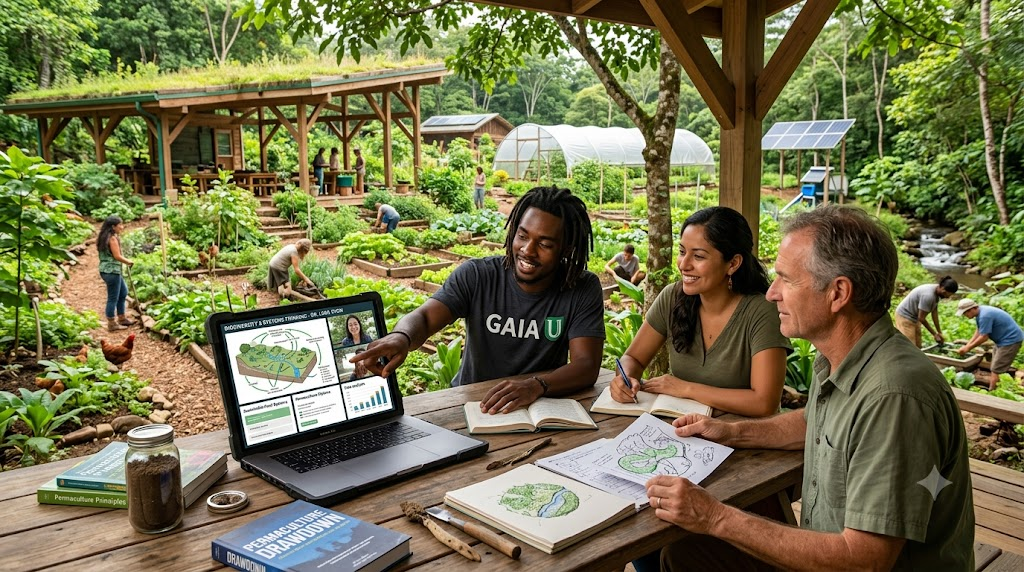
For learners interested in applying these ideas through structured permaculture education, Gaia University offers an educational context for exploring ecological design and regenerative approaches.
Questions to Ask During a Regenerative Design Process
When evaluating a project, use questions that reveal relationships and long-term effects.
Ecological Questions
- Does the design improve soil?
- Does it support biodiversity?
- Does it improve water management?
- Does it restore ecological functions?
- Does it reduce dependence on external inputs?
Social Questions
- Does the project strengthen community capacity?
- Who participates?
- Who benefits?
- What knowledge and skills are developed?
- Does the design support meaningful relationships?
Resource Questions
- What enters the system?
- What leaves the system?
- Can waste become a resource?
- Can resources be cycled locally?
- Are renewable resources being replenished?
Long-Term Questions
- Will the system become stronger over time?
- What happens if conditions change?
- Can the system adapt?
- What maintenance will it require?
- What happens if human intervention decreases?
These questions can help turn regenerative design principles into practical decision-making tools.
Conclusion: Designing for Renewal
Regenerative design principles provide a way to think beyond minimizing environmental harm and toward creating systems capable of renewal.
For permaculture diploma seekers, this perspective strengthens the connection between ecological observation, ethical decision-making, systems thinking, and practical design. The central idea is not that every project must become perfectly self-sufficient or completely independent from external resources. Rather, the aim is to create relationships that improve the health, resilience, and capacity of the larger system.
A regenerative project might restore soil, improve water cycles, increase biodiversity, produce food, strengthen communities, and create opportunities for learning at the same time.
The most important skill is learning to recognize these relationships.
Instead of asking only whether a design works today, ask whether it creates conditions for greater health tomorrow. Instead of seeing waste as an inevitable output, look for opportunities to create cycles. Instead of treating nature and people as separate considerations, design for their relationships.
Ultimately, regenerative design is about creating systems that do more than endure. They learn, adapt, renew, and contribute to the vitality of the places and communities in which they exist.
Responses