
Permaculture Design Course Online: A Practical Guide to Learning Permaculture from Anywhere

Introduction: Why Choose a Permaculture Design Course Online?
Permaculture is more than a way to grow food. It is a design approach for creating resilient systems that work with nature rather than against it. From regenerative agriculture and water management to community development, ecological building, and sustainable livelihoods, permaculture provides a framework for understanding how different parts of a system can support one another.
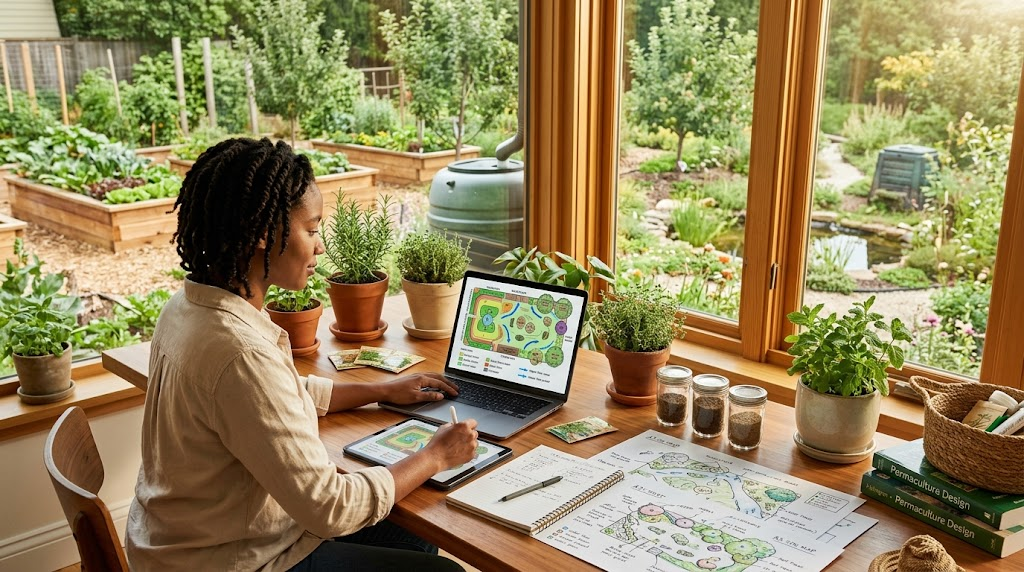
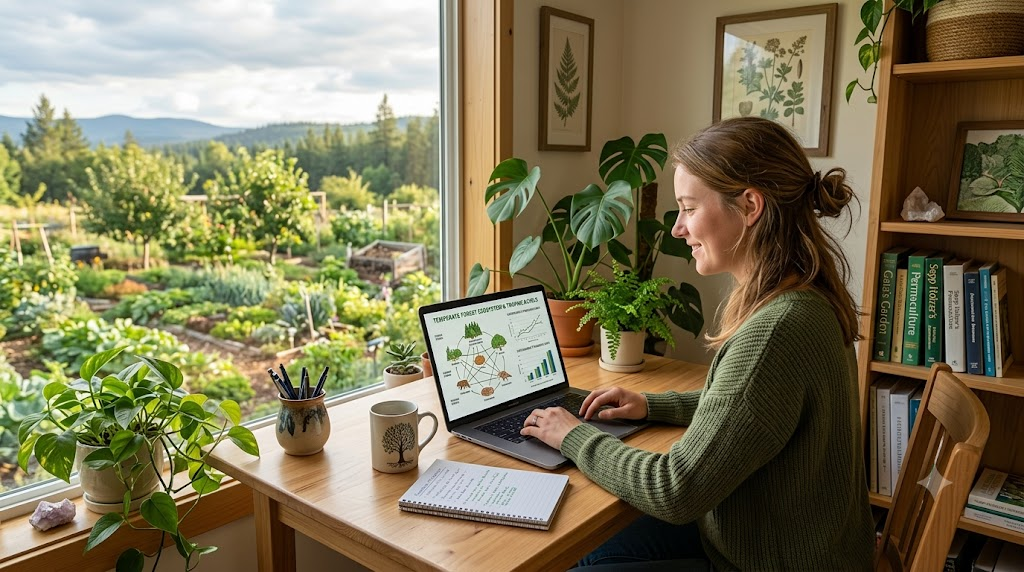
For people interested in developing these skills, an online permaculture design course can provide a flexible way to study without relocating or putting work and other responsibilities on hold. Online learning can connect students with instructors, resources, projects, and communities while allowing them to apply what they learn in their own environment.
For aspiring permaculture diploma students, choosing the right course involves more than finding an online program with an attractive title. It is important to understand what the curriculum covers, how practical assignments are structured, whether the program emphasizes design thinking, and how the learning experience supports your long-term goals.
This guide explains what to expect from a permaculture design course online, what you can learn, how to evaluate different programs, and how to turn online study into practical experience.
What Is a Permaculture Design Course Online?
A permaculture design course online is a structured educational program that teaches the principles, ethics, methods, and practical applications of permaculture through digital learning.
Traditional permaculture education may take place through workshops, residential programs, farms, or community projects. An online course delivers some or all of the educational experience through digital materials such as video lessons, readings, discussions, assignments, design exercises, and instructor feedback.
The online format can be particularly useful for students who live far from established permaculture education centers or who need to study around existing commitments.
However, online learning does not have to mean passive learning. A strong program should encourage students to observe real environments, analyze systems, develop designs, document their decisions, and consider how permaculture principles can be applied in practical situations.
The goal is not simply to memorize the principles of permaculture. It is to learn how to use them as a framework for making better design decisions.
What Does a Permaculture Design Course Teach?
The exact curriculum varies between programs, but a comprehensive course generally introduces students to several interconnected areas of permaculture design.
Permaculture Ethics and Principles
Most permaculture education begins with its ethical foundation. Students explore concepts such as caring for the earth, caring for people, and creating systems that distribute resources and benefits fairly.
Permaculture principles then provide practical ways to translate these ethics into design decisions.
Rather than treating individual principles as isolated rules, students learn how principles can work together. Observation, integration, diversity, efficiency, renewable resources, and feedback all become part of a broader design process.
Understanding this foundation is important because permaculture is fundamentally about relationships between elements within a system.
Observation and Site Analysis
Effective design begins with observation.
Students learn to examine a site before deciding what should be added to it. This may involve studying sunlight, wind, water movement, soil, vegetation, climate, topography, existing structures, human activity, and available resources.
A site analysis helps reveal opportunities and constraints that may not be obvious at first.
For example, a slope can present an erosion challenge but also create opportunities for water harvesting. A shaded area may be unsuitable for some crops but valuable for other plants or outdoor activities.
Online students can practice these skills using their own homes, gardens, communities, farms, or other accessible locations.
Water Management
Water is one of the most important elements in ecological design.
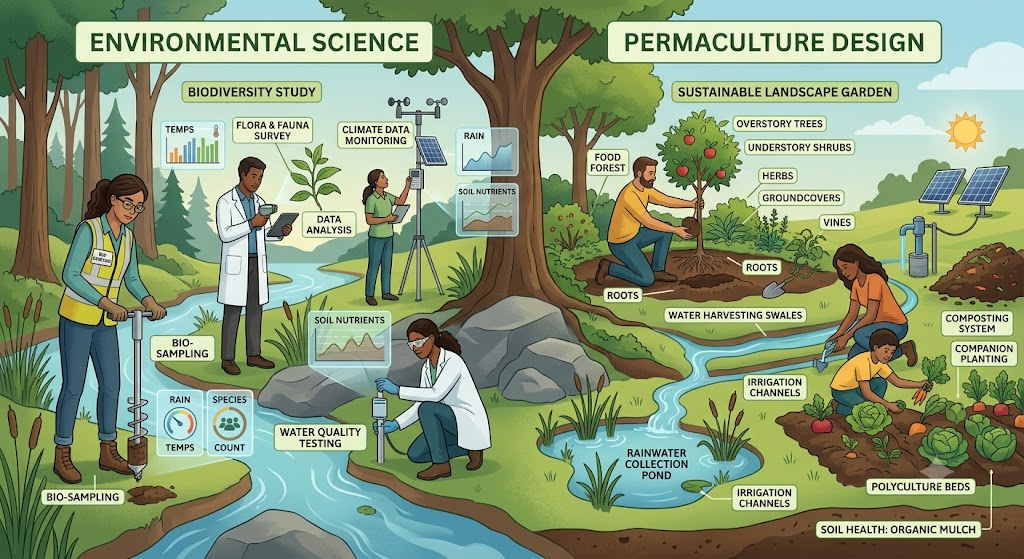
A permaculture design course may introduce concepts such as water harvesting, infiltration, drainage, storage, swales, ponds, greywater considerations, and landscape-based water management.
The objective is not simply to use less water. It is to understand how water moves through a system and identify opportunities to slow, spread, store, filter, and reuse it where appropriate.
Understanding water movement can significantly influence how a landscape is designed.
Soil and Regenerative Land Management
Healthy soil supports productive and resilient ecosystems.
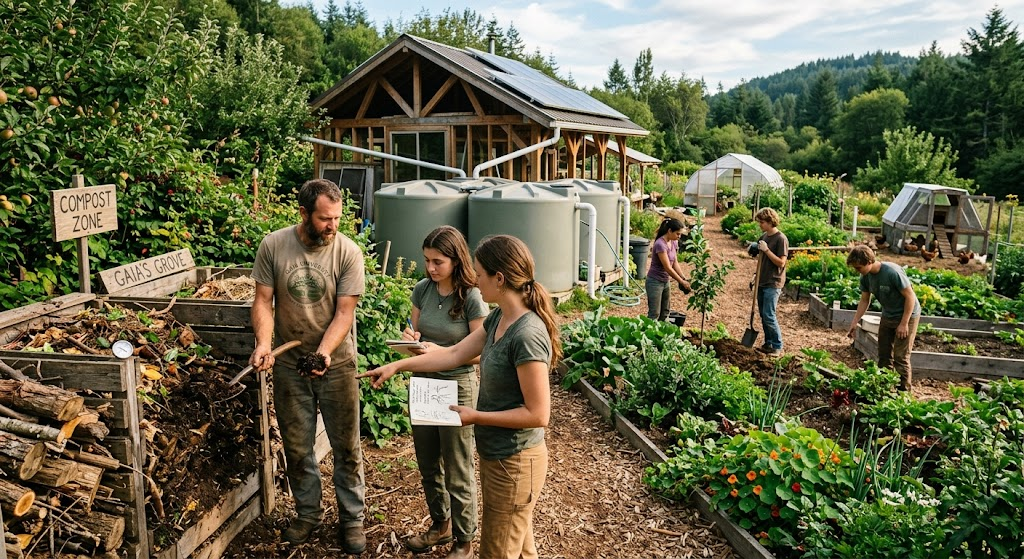
Students may explore soil structure, organic matter, nutrient cycling, erosion prevention, composting, mulching, cover crops, perennial systems, and other regenerative approaches.
The emphasis is generally on building ecological relationships rather than relying exclusively on external inputs.
Students can also learn how soil management connects with water retention, biodiversity, plant health, and long-term productivity.
Plants, Food Systems, and Agroecology
Plants are an important component of many permaculture designs, but permaculture is not simply gardening.
A course may introduce food forests, polycultures, companion planting, perennial crops, annual crops, agroforestry, seed systems, and ecological relationships between plants and animals.
The broader question is how plants can be arranged and managed to provide multiple functions.
A single element might provide food, habitat, shade, biomass, erosion control, soil improvement, or other benefits. Learning to identify these multiple functions is central to permaculture thinking.
Ecological Building and Infrastructure
Permaculture design can also extend beyond landscapes.
Depending on the course, students may encounter topics related to natural building, energy efficiency, appropriate technology, renewable energy, sustainable materials, passive design, and low-impact infrastructure.
The purpose is to consider buildings and infrastructure as components of larger systems.
A house, for example, interacts with sunlight, wind, water, food production, energy use, transportation, and human behavior. Permaculture encourages designers to consider these relationships rather than treating each issue separately.
Social Systems and Community Design
Permaculture also applies to human systems.
Students may explore community resilience, cooperation, local economies, decision-making, education, and social organization.
This is particularly important for students who want to work beyond private gardens or individual properties.
A successful ecological project depends not only on physical design but also on communication, participation, maintenance, and appropriate decision-making.
How Does Online Permaculture Education Work?
An online course can use several learning methods to create a structured educational experience.
Video and Written Lessons
Digital lessons provide foundational information that students can review at their own pace.
Video can be useful for demonstrations and visual explanations, while written resources can provide more detailed information for reference and reflection.
The combination allows students to revisit difficult concepts rather than relying on a single classroom session.
Practical Assignments
Assignments are an important part of effective online learning.
Rather than simply answering theoretical questions, students may be asked to observe a site, create maps, analyze resources, identify patterns, or develop a design proposal.
These exercises help transform abstract concepts into practical skills.
Design Projects
A major advantage of studying permaculture online is the opportunity to work on a real location.
Students can use their own garden, property, community space, educational project, or another suitable site as a learning laboratory.
A project might begin with observation and site analysis before progressing toward mapping, goal setting, conceptual design, detailed design, implementation planning, and evaluation.
Discussion and Community Learning
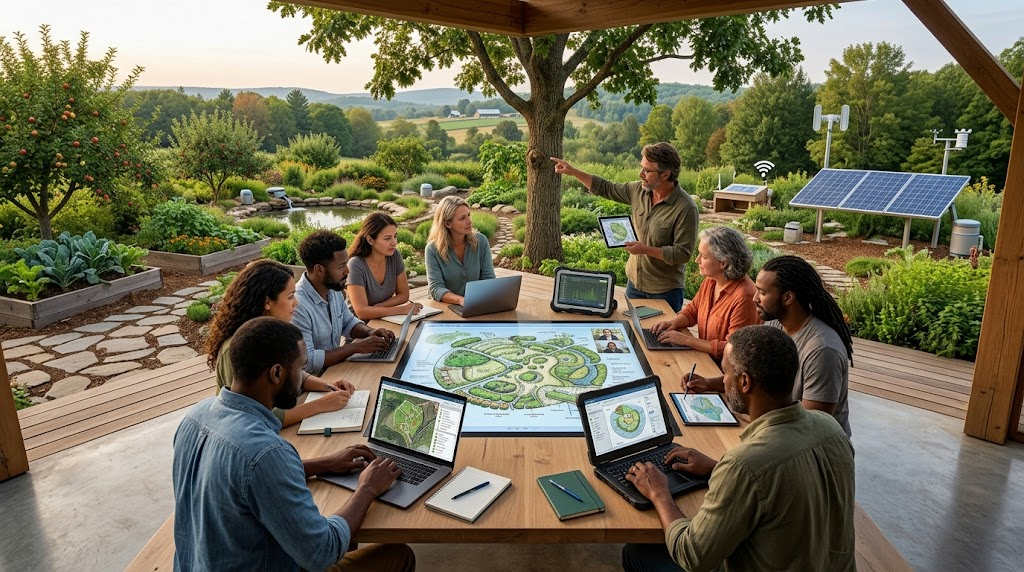
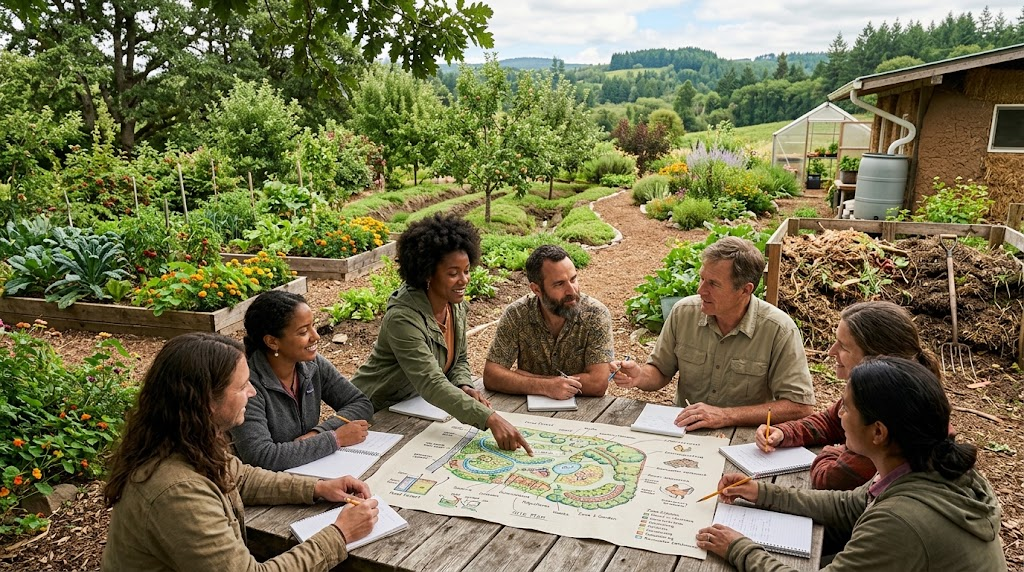
Permaculture is highly collaborative, so interaction with other students can add significant value to an online program.
Discussions allow students to compare different climates, landscapes, cultures, challenges, and design approaches.
An online community can also provide opportunities to receive feedback and discover how the same principles can produce different solutions in different contexts.
Benefits of Taking a Permaculture Design Course Online
There are several reasons aspiring students may choose an online format.
Flexible Learning
Online education can make it easier to study around work, family responsibilities, travel, or existing projects.
Instead of attending classes at a fixed physical location, students can often access learning materials according to their own schedules.
This flexibility is particularly useful for people who cannot commit to a residential program.
Learn from Your Own Environment
One of the most valuable advantages is the ability to connect lessons with a real location.
Instead of studying a hypothetical landscape, you can observe your local climate, soil, vegetation, water movement, and community context.
This can make the learning process highly relevant.
Access to a Wider Learning Community
Physical location does not have to limit who you learn with.
An online program can bring together students from different countries and climatic regions. This diversity can expand your understanding of how permaculture is adapted to different ecological and cultural circumstances.
Integrate Learning with Existing Projects
If you already have a garden, homestead, community project, educational initiative, or ecological business idea, coursework can potentially be connected with that work.
This creates a feedback loop between theory and practice.
What to Look for in an Online Permaculture Design Course
Not every online course offers the same educational experience. Before enrolling, consider several important factors.
A Structured Curriculum
Look for a program with a clear progression from foundational concepts to practical application.
A strong curriculum should help you understand not only individual permaculture topics but also how they fit into a coherent design methodology.
Practical Design Experience
If your goal is to become a capable designer, theory alone is unlikely to be enough.
Check whether the course includes practical assignments, site analysis, mapping, design development, project work, or other opportunities to apply concepts.
Instructor Feedback
Feedback can significantly improve the learning process.
Consider whether instructors or mentors review assignments and provide meaningful guidance.
The ability to understand why a design decision works—or does not work—can be more valuable than simply receiving a completion certificate.
A Strong Student Community
Look for opportunities to interact with other learners.
Peer discussion can expose you to different perspectives and help you develop the ability to explain and defend design decisions.
A Curriculum That Goes Beyond Gardening
If you want a broader understanding of permaculture, look for coursework that covers ecological, social, and economic systems in addition to food production.
Permaculture design becomes more powerful when students understand connections between landscapes, people, resources, infrastructure, and communities.
Clear Information About Certification
If receiving a certificate or diploma is important to you, understand exactly what the program provides.
A certificate of completion, a professional qualification, and a diploma can represent different educational experiences. Review the program’s curriculum, assessment process, learning requirements, and credential structure before enrolling.
Is an Online Permaculture Design Course Right for You?
Online study can work well for many students, but it requires active participation.
If you prefer independent learning, digital resources, flexible schedules, and the opportunity to apply lessons to your own environment, an online course may be a suitable format.
However, online education should not be viewed as a way to avoid practical experience.
Permaculture is fundamentally applied. Observation, design, implementation, evaluation, and adaptation are all important skills.
The best approach is to treat your surroundings as a living classroom.
You can observe seasonal changes, record rainfall, study sunlight patterns, examine soil, map existing resources, identify problems, and experiment with appropriate interventions.
The more actively you engage with your environment, the more useful your online education can become.
How to Get the Most from Your Online Permaculture Studies
Enrolling in a course is only the beginning. Your learning habits will strongly influence what you gain from the experience.
Create a Regular Study Routine
Set aside consistent time for lessons, reading, assignments, and reflection.
A regular schedule helps prevent online coursework from becoming something you continually postpone.
Keep a Permaculture Design Journal
A design journal can become one of your most useful learning tools.
Record observations, sketches, questions, measurements, ideas, successes, and mistakes.
Over time, the journal can help you recognize patterns and track how your thinking changes.
Practice Observation Before Intervention
One common mistake is trying to solve a problem before fully understanding it.
Give yourself time to observe.
Look at how water moves after rain, where shadows fall throughout the day, how people move through a space, where wind accumulates, and which plants naturally thrive.
Observation often reveals solutions that are less obvious when you immediately begin planning.
Use Your Own Site as a Case Study
If possible, choose a real location and progressively apply course concepts to it.
Start with observation and mapping. Then identify resources, constraints, patterns, and goals.
Gradually develop design ideas rather than attempting to create a complete master plan immediately.
Ask Why
Permaculture design is not about copying techniques.
A swale, food forest, compost system, or pond that works well in one location may not be appropriate in another.
Instead of asking, “What technique should I use?” ask, “What function do I need, what resources are available, and what relationships could address this need?”
This shift from technique-based thinking to systems thinking is one of the most valuable skills you can develop.
From Online Learning to a Permaculture Diploma
For students considering a longer educational pathway, an online permaculture design course can serve as an important step toward more advanced study.
A diploma-level learner typically needs more than familiarity with permaculture terminology. The ability to analyze systems, develop designs, communicate ideas, and connect ecological principles with practical constraints becomes increasingly important.
This means students should look for opportunities to develop a portfolio of work.
Your portfolio might eventually include site assessments, maps, design drawings, written rationales, planting plans, water-management concepts, implementation strategies, and reflections on completed projects.
A portfolio demonstrates how you think as a designer rather than simply what information you have studied.
For those exploring structured permaculture education, Gaia University provides an educational environment focused on transformative learning and practical engagement.
Building a Permaculture Design Portfolio
A portfolio can become a valuable record of your development.
Start with small projects rather than waiting for a large property or professional commission.
For example, you could document the redesign of a small garden, analyze water flow around a property, develop a community garden concept, or create a plan for improving biodiversity in an existing landscape.
For every project, explain:
- What was the original situation?
- What were the main goals?
- What resources were available?
- What constraints influenced the design?
- What patterns did you observe?
- Which permaculture principles influenced your decisions?
- What alternatives did you consider?
- How would the design be implemented?
- How would you evaluate the results?
This process demonstrates systems thinking and makes your work easier for others to understand.
Common Mistakes to Avoid When Choosing an Online Course
Choosing Based Only on Price
Cost is an important consideration, but it should not be the only factor.
Compare curriculum depth, instructor involvement, assignments, community support, project requirements, and credential information.
Focusing Too Much on the Certificate
A credential can be useful, but the practical knowledge and design capability developed during the course are also important.
Ask what you will actually be able to do after completing the program.
Expecting Online Learning to Be Passive
Watching videos without applying the information is unlikely to develop strong design skills.
Plan to observe, map, analyze, draw, write, discuss, and revise.
Copying Designs Without Understanding Context
Permaculture emphasizes context.
Climate, topography, culture, available resources, regulations, labor, finances, and community needs all influence design.
Learn the reasoning behind a technique rather than simply reproducing its appearance.
Trying to Solve Everything at Once
Large systems can become overwhelming.
Start by identifying patterns and priorities. Break complex problems into smaller relationships and functions.
Good design often emerges through gradual refinement.
Questions to Ask Before Enrolling
Before selecting a permaculture design course online, consider asking:
- What topics are included in the curriculum?
- Does the program include practical design assignments?
- Will I work on a real site?
- How much instructor feedback is provided?
- Is there an active student community?
- How flexible is the learning schedule?
- How are students assessed?
- What type of certificate or diploma is provided?
- How much independent work is expected?
- Does the course teach a complete design process rather than isolated techniques?
- Can coursework contribute to a design portfolio?
- Does the program align with my longer-term educational or professional goals?
These questions can help you distinguish between a course designed primarily to introduce permaculture concepts and a deeper educational experience focused on design competency.
Frequently Asked Questions About Permaculture Design Courses Online
Can I learn permaculture design completely online?
You can learn a substantial amount of permaculture theory and design methodology online. The practical component depends on how actively you apply the knowledge to real environments.
Using your own site for observation, mapping, experimentation, and design exercises can make online study much more practical.
Is an online permaculture course suitable for beginners?
Many online programs are designed to introduce students to foundational concepts before progressing toward more advanced design work.
However, prospective students should review the curriculum to make sure its starting level matches their previous experience.
Do online permaculture courses include practical work?
Some do. Practical requirements vary considerably between programs.
Look for coursework involving site observation, mapping, design exercises, case studies, project development, or implementation planning if practical experience is important to you.
What can I do after completing a permaculture design course?
Your options depend on your education, experience, location, and goals.
You may use your knowledge for personal land projects, community initiatives, education, ecological design, regenerative agriculture, consulting, or further study.
A course can provide knowledge and skills, but professional opportunities generally depend on the broader experience and qualifications you develop.
Is a certificate enough to become a permaculture designer?
A certificate can document completion of an educational program, but design capability develops through study and practice.
Building a portfolio, working on real projects, receiving feedback, and continuing to learn can help you develop practical competence.
How long does an online permaculture design course take?
The duration varies significantly.
Some introductory courses are relatively short, while comprehensive programs require substantially more time for coursework, projects, research, and independent study.
When comparing programs, consider the total learning commitment rather than looking only at the number of weeks or months.
Conclusion: Turning Online Learning into Practical Design Skills
A permaculture design course online can provide a flexible and accessible pathway into ecological design education. For aspiring permaculture diploma seekers, it can offer an opportunity to study design principles, explore regenerative systems, work on practical projects, and connect with a wider learning community without being limited by geographic location.
The most valuable online education goes beyond presenting information. It helps students develop the ability to observe systems, recognize relationships, identify functions, analyze constraints, develop thoughtful solutions, and adapt designs to specific contexts.
If you are considering an online program, look beyond the course title. Examine the curriculum, practical assignments, instructor support, student community, assessment methods, and credential structure. Most importantly, consider whether the program will help you develop the practical design thinking needed to work with real ecological and social systems.
Permaculture is learned through both study and observation. The landscape around you can become your classroom, while an online course can provide the structure, knowledge, and community needed to understand what you are seeing.
With consistent practice, thoughtful observation, and a commitment to applying what you learn, online permaculture education can become more than a convenient way to study. It can be a foundation for developing the skills and perspective needed to design more resilient, regenerative, and connected systems.
Responses