
Permaculture Design Certificate Online: A Complete Guide for Diploma Seekers

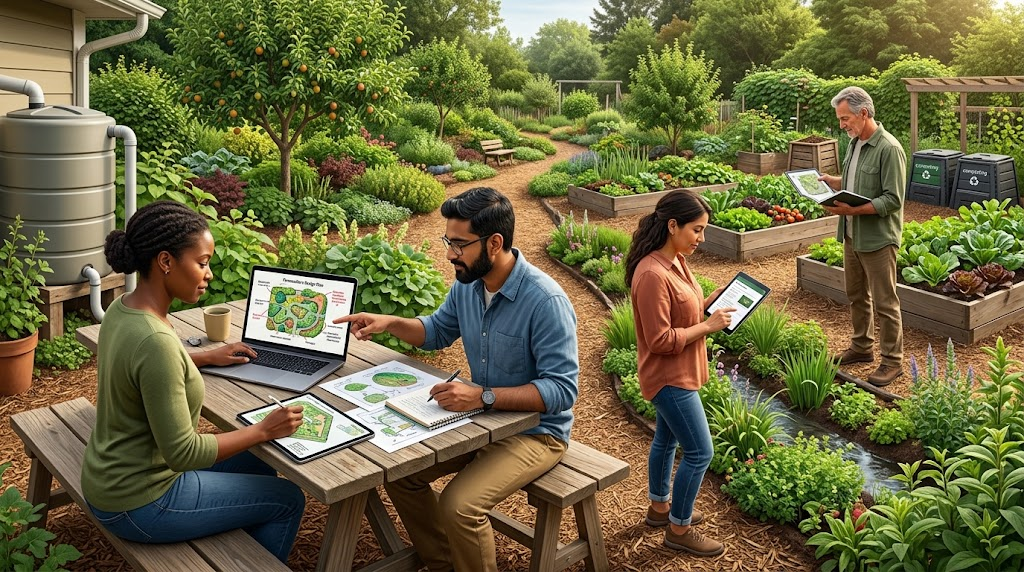
Interest in regenerative agriculture, ecological restoration, resilient communities, and sustainable living has made permaculture an increasingly relevant field of study. For learners who want to move beyond introductory knowledge and eventually pursue advanced training, a permaculture design certificate online can provide a flexible starting point.
Online learning is particularly useful for students who cannot relocate or attend a fixed classroom program. More importantly, the right certificate should do more than provide information. It should help you understand ecological systems, practice design thinking, develop practical skills, and prepare for continued learning.
For someone considering a permaculture diploma, choosing an online certificate is therefore an important decision. The certificate can become the foundation on which more advanced project work, mentoring, documentation, and professional development are built.
This guide explains what an online permaculture design certificate involves, what you can learn, how to evaluate programs, and how certificate-level education can connect with a longer-term permaculture diploma pathway.
What Is a Permaculture Design Certificate Online?
A permaculture design certificate online is a structured educational program that teaches the foundational principles and methods of permaculture through an online learning environment.
PDC commonly stands for Permaculture Design Certificate. A PDC introduces learners to ways of observing ecosystems, understanding relationships between different elements, and designing human environments that work more effectively with natural systems.
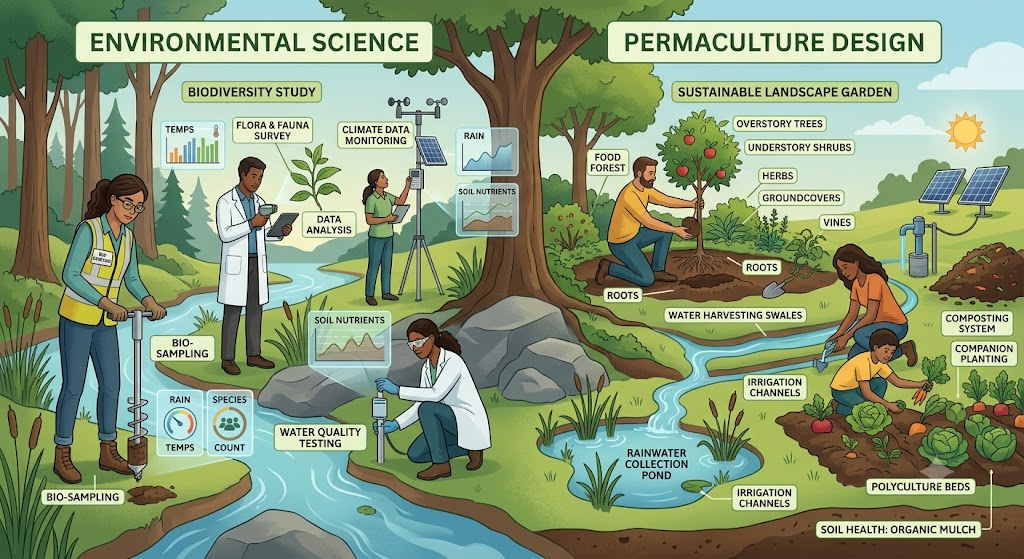
Although permaculture has strong connections to agriculture and land management, its applications extend much further. Depending on the curriculum, learners may explore:
- Permaculture ethics and principles
- Ecological observation
- Systems thinking
- Landscape and site analysis
- Soil and water systems
- Food production
- Renewable resources
- Community resilience
- Regenerative practices
- Design methodologies
- Human ecology
- Project planning
An online format delivers these concepts through digital materials, activities, discussions, webinars, assignments, mentoring, or other forms of remote learning.
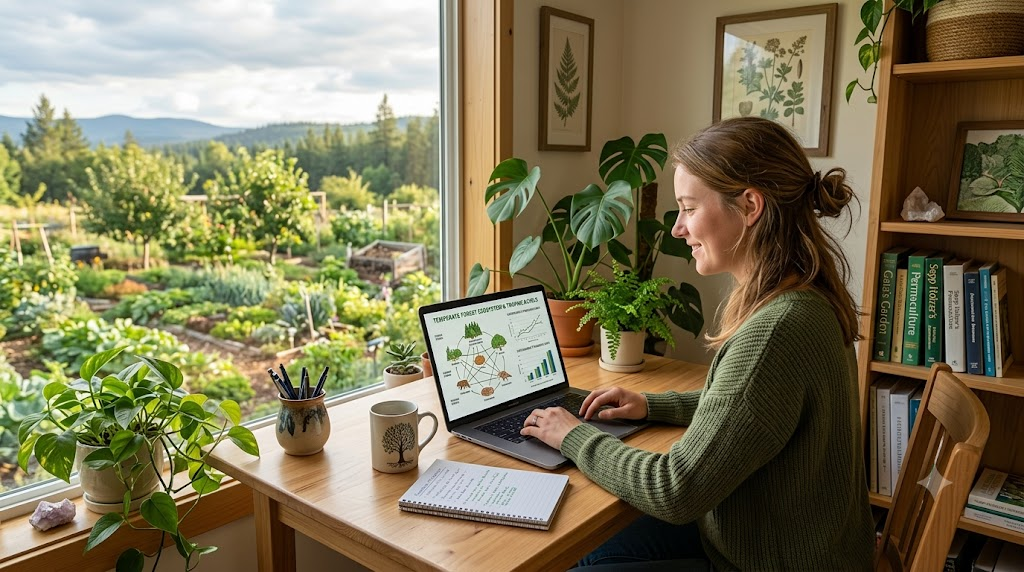
The important distinction is that online does not necessarily mean theoretical. A well-designed program can encourage students to apply concepts to real situations while studying remotely.
Why Choose an Online Permaculture Design Certificate?
One of the main advantages of online study is flexibility.
A traditional in-person course may require travel, accommodation, and a fixed schedule. An online certificate can allow learners to study from their existing location while managing other commitments.
This can be especially valuable for aspiring diploma students who are already working, volunteering, managing land, participating in community projects, or developing a sustainability-related initiative.
Flexible Learning
Online study can make it easier to organize learning around your existing responsibilities. Instead of treating education as something completely separate from everyday life, you can potentially connect your studies with projects already happening around you.
Access to Global Perspectives
Permaculture is practiced in many different ecological and cultural contexts. An online learning environment can bring together participants from different regions, allowing students to encounter approaches that may differ from those used in their local area.
This matters because permaculture is fundamentally contextual. A design appropriate for one climate, landscape, community, or resource base may not be appropriate somewhere else.
Learn While Applying
A major benefit of studying permaculture online is the opportunity to immediately test ideas through observation and practical projects.
For example, while learning about water management, you might examine water flows around a local site. While studying systems thinking, you could map relationships between resources, people, infrastructure, and ecological processes.
The combination of study and application can make concepts easier to understand and remember.
What Do You Learn in an Online Permaculture Certificate?
The curriculum varies between providers, so prospective students should examine the actual learning outcomes rather than choosing a course based solely on its title.
A strong foundational program should introduce both permaculture knowledge and design thinking.
1. Permaculture Ethics
Permaculture education commonly introduces three foundational ethical ideas:
- Care for the Earth
- Care for People
- Fair Share
These ethics provide a framework for evaluating design decisions. They encourage learners to consider ecological health, human needs, resource distribution, and long-term consequences together.
2. Systems Thinking
Systems thinking is central to permaculture.
Instead of treating soil, water, plants, buildings, energy, and people as isolated subjects, learners examine how they interact.
For example, a water-management decision can affect soil conditions, vegetation, food production, biodiversity, and maintenance requirements. Understanding these connections can produce more effective designs than addressing each issue independently.
3. Observation and Site Analysis
Before designing a system, you need to understand the system that already exists.
Permaculture therefore emphasizes careful observation. Students may learn to consider:
- Climate
- Sun and shade
- Wind
- Water movement
- Terrain
- Existing vegetation
- Soil
- Infrastructure
- Human activity
- Available resources
- Constraints and opportunities
This helps shift the design process from imposing a predetermined solution toward responding to actual conditions.
4. Ecological Design
Ecological design involves looking at how human systems can function in relationship with natural processes.
Students may explore how natural patterns and ecosystem relationships can inform decisions about food production, water, landscapes, buildings, communities, and resource use.
The goal is not simply to copy nature. Instead, natural systems can provide useful models for thinking about efficiency, diversity, relationships, resilience, and resource cycles.
5. Regenerative Practices
Many contemporary permaculture programs connect traditional permaculture principles with regenerative approaches.
Learners may investigate ways to improve ecological function rather than simply minimizing environmental damage.
This can include topics such as soil regeneration, biodiversity, responsible resource use, resilient food systems, and community-based approaches.
Is an Online Certificate Enough to Become a Permaculture Designer?
A certificate can provide an important foundation, but completing a course is not the same as becoming an experienced designer.
Design competence develops through practice.
Think of a certificate as the beginning of a learning pathway rather than the endpoint. After studying the fundamentals, learners benefit from applying design methods repeatedly, receiving feedback, documenting their work, and learning from both successful and unsuccessful projects.
This distinction is particularly important for people considering a diploma.
A diploma-level pathway can provide an opportunity to move from learning concepts toward demonstrating competence through projects.
How a Certificate Can Lead to a Permaculture Diploma
For many learners, the most important question is not simply, “Which certificate should I take?”
The better question is:
“How does this certificate fit into my longer-term educational pathway?”
Gaia University, for example, offers an International Diploma of Permaculture Design that builds on previous Permaculture Design Course education. Its diploma structure combines advanced content with project design, documentation, mentoring, advising, and peer support.
Explore Gaia University’s International Diploma of Permaculture Design
Gaia University also describes its diploma programs as pathways in which learners begin with online certificate programs before moving into mentored, self-directed project work.
This illustrates an important principle for diploma seekers: certificate education and diploma education do not have to be isolated experiences.
The strongest pathway is one where each stage develops skills that become useful at the next stage.
What Should Diploma Seekers Look for in a Permaculture Certificate?
Not every online course will provide the same educational value.
Before enrolling, evaluate the program according to several criteria.
Curriculum Depth
Look for a curriculum that goes beyond general sustainability concepts.
A useful permaculture certificate should introduce actual design principles and methods while developing your ability to analyze interconnected systems.
Practical Application
Ask whether you will have opportunities to apply what you learn.
Practical assignments, site observations, design exercises, case studies, or project work can make online learning substantially more useful.
Feedback and Mentoring
Feedback is particularly valuable when learning design.
Reading about a design method can help you understand the theory, but feedback from experienced practitioners can help you identify assumptions, weaknesses, and opportunities for improvement.
If your long-term goal is a diploma, mentoring can be especially useful because advanced programs often require increasing levels of independence.
Documentation
Consider whether the program teaches you how to document your learning and projects.
Documentation can include:
- Design decisions
- Research
- Observations
- Reflections
- Drawings
- Project plans
- Implementation records
- Outcomes
- Lessons learned
Over time, this material can become evidence of your development.
Learning Community
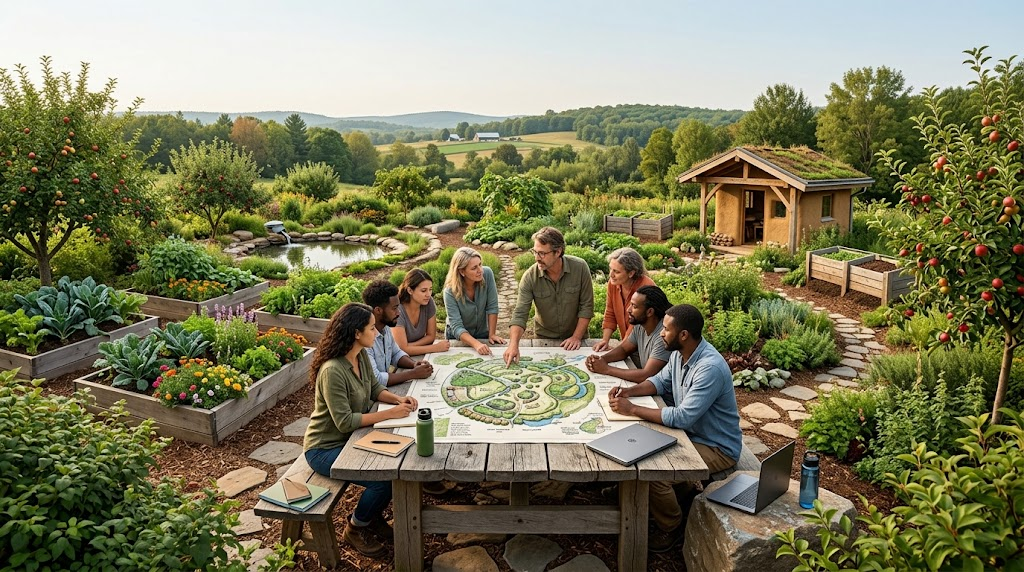
Permaculture is strongly connected to collaboration and community.
An online course with meaningful interaction can help you learn from other students while developing communication and collaborative skills.
Progression Opportunities
If you already know that you want a diploma, investigate how the certificate fits into your intended pathway.
Ideally, your foundational studies should prepare you for increasingly independent project work rather than leaving you with knowledge that is disconnected from future education.
Online vs. In-Person Permaculture Education
Both formats can be valuable. The better choice depends on your goals and circumstances.
| Online Learning | In-Person Learning |
| Flexible location | Direct physical experience |
| Easier to fit around existing commitments | Structured classroom or field schedule |
| Can connect learners globally | Strong local community interaction |
| Useful for theory and design thinking | Useful for hands-on demonstrations |
| Can support long-term project work | Immediate access to physical sites |
| Often easier for international learners | May require travel and accommodation |
The choice does not have to be either-or.
A learner can use online education to build conceptual and design skills while gaining practical experience through local projects, volunteering, gardening, land work, community initiatives, or other appropriate activities.
For diploma seekers, combining different forms of learning can create a richer portfolio of experience.
How to Get the Most From a Permaculture Design Certificate Online
Simply completing lessons is unlikely to provide the maximum benefit.
Instead, treat the certificate as an opportunity to develop a personal practice.
Start an Observation Journal
Keep notes about ecological and human systems around you.
Record things such as:
- Seasonal changes
- Water movement
- Plant relationships
- Soil conditions
- Resource flows
- Human activity
- Energy use
- Potential design opportunities
Over time, these observations can help you recognize patterns that are easy to miss when studying only from textbooks.
Apply Every Major Concept
Whenever you learn a new principle, ask:
Where can I observe this in the real world?
Then look for an example.
This turns passive learning into active learning.
Develop Small Design Projects
You do not need to begin with a huge property or complicated landscape.
A small garden, community space, educational project, household resource system, or local initiative can provide an opportunity to practice observation and design thinking.
The purpose is to learn how to move from:
Observation → Analysis → Design → Action → Reflection
That cycle is valuable far beyond permaculture.
Document Your Progress
Save your notes, diagrams, photographs, research, design iterations, reflections, and project outcomes.
A documented learning journey can become much more valuable than a certificate sitting by itself.
For someone planning a diploma, documentation can also help demonstrate how your thinking and practical abilities have developed.
From Certificate Student to Advanced Permaculture Practitioner
The transition from introductory study to advanced practice involves a change in mindset.
At the beginning, your primary question may be:
“What is permaculture?”
As your knowledge develops, the questions become more complex:
- What does this site need?
- What relationships already exist?
- Which interventions have the greatest leverage?
- What are the ecological consequences?
- Who is affected by the design?
- What resources are available?
- How can the design adapt over time?
- How will I know whether the intervention is working?
This progression—from learning principles to making informed decisions—is one reason practical project work is so important.
A diploma can provide a structured environment for developing this deeper level of competence.
What Can You Do After an Online Permaculture Certificate?
Your next step depends on your interests.
Some learners use foundational permaculture education for personal projects. Others become involved in community initiatives, ecological restoration, education, regenerative agriculture, landscape design, or sustainability-related work.
Potential applications include:
Regenerative Food Systems
Permaculture principles can inform approaches to food production that consider soil, biodiversity, water, energy, and long-term resilience.
Community Projects
Permaculture design can be applied at community scale, where social relationships and ecological considerations need to work together.
Land and Landscape Design
Students can apply observation and systems thinking to gardens, farms, homesteads, educational sites, and other landscapes.
Education
A strong foundation can support people who want to communicate ecological principles and design approaches to others.
Further Study
For diploma seekers, perhaps the most significant outcome is preparation for advanced education.
Gaia University’s program offerings describe the International Diploma of Permaculture Design as an advanced pathway combining practical project design, documentation, expert mentoring, and feedback.
View Gaia University’s diploma and certificate program offerings
Questions to Ask Before Enrolling
Before choosing a permaculture design certificate online, create a short evaluation checklist.
Ask:
- What are the learning outcomes?
- Does the curriculum cover core permaculture principles?
- Is there practical design work?
- How much independent study is required?
- Are live sessions included?
- Is mentoring available?
- Will I receive meaningful feedback?
- Can I interact with other learners?
- How is learning assessed?
- Will I produce documented project work?
- Does the certificate connect to a diploma or advanced pathway?
- Can I realistically manage the required time commitment?
These questions can help you distinguish between a course that simply delivers information and an educational program designed to develop capability.
How Much Time Should You Expect to Commit?
The answer depends entirely on the provider and course structure.
Do not judge a course solely by its advertised duration. A program that takes several months may require only a few hours per week, while another intensive course may require significantly more concentrated study.
Look at:
- Weekly workload
- Assignment deadlines
- Live sessions
- Reading requirements
- Project work
- Mentoring sessions
- Independent research
Then compare those requirements with your existing schedule.
A sustainable learning rhythm is more valuable than enrolling in a program that becomes impossible to maintain.
Is an Online Permaculture Certificate Worth It?
For a learner who wants only a basic introduction, a short course may be sufficient.
For someone pursuing a permaculture diploma, however, a well-designed certificate can have considerably greater value.
It can provide:
- Foundational ecological knowledge
- A structured introduction to design
- Systems-thinking skills
- Practical exercises
- A learning community
- Early project experience
- Documentation habits
- Preparation for advanced study
The key is choosing a program that matches your longer-term goals.
A certificate should not be viewed simply as a credential to collect. Its real value comes from what you can understand, apply, document, and continue developing after completion.
A Practical Pathway for Aspiring Diploma Students
If your ultimate goal is advanced permaculture education, consider a progression like this:
Step 1: Build foundational knowledge
Learn permaculture ethics, principles, systems thinking, and ecological design.
Step 2: Complete a structured certificate
Use an online program to develop a consistent foundation.
Step 3: Apply your knowledge
Work on appropriate real-world projects and observations.
Step 4: Document your learning
Keep evidence of your designs, decisions, experiments, results, and reflections.
Step 5: Seek feedback
Learn from mentors, peers, practitioners, and project stakeholders.
Step 6: Develop a project portfolio
Build a body of work that demonstrates how your capabilities are developing.
Step 7: Progress into diploma-level learning
Use advanced study to deepen your design abilities through increasingly independent projects and reflective practice.
This approach turns education into a continuous development process rather than a series of disconnected certificates.
Final Thoughts
A permaculture design certificate online can be an accessible and flexible way to begin developing ecological design knowledge. For people interested in pursuing a permaculture diploma, it can also serve as an important foundation for more advanced learning.
The most valuable program is not necessarily the one with the most lessons or the most impressive title. Look for an educational experience that combines sound foundational knowledge with practical application, reflection, feedback, and opportunities for continued development.
Permaculture is ultimately about relationships: between people and ecosystems, resources and needs, observation and action, and knowledge and practice. Your education should reflect those same relationships.
If your goal is to progress toward diploma-level study, approach your certificate as the beginning of a longer learning journey. Learn the principles, practice the methods, document your development, and gradually take on more complex projects.
That is how an online certificate can become more than a qualification—it can become the foundation for developing the skills, experience, and confidence needed for advanced permaculture design work.
Responses