
Permaculture Design Certificate Online: A Flexible Path Toward Advanced Permaculture Study

Introduction
Interest in regenerative agriculture, ecological design, resilient communities, and sustainable living continues to grow. As more people look for practical ways to respond to environmental and social challenges, permaculture has become an increasingly valuable framework for understanding how human systems can work more effectively with nature.
For people who want to study permaculture but cannot attend a traditional classroom course, a permaculture design certificate online can provide a flexible alternative. Online learning makes it possible to study foundational concepts, complete design activities, connect with other learners, and develop skills while remaining in your existing location.
For aspiring permaculture professionals, however, a certificate should not necessarily be viewed as the final destination. It can be the beginning of a longer educational pathway that combines foundational knowledge with practical projects, mentoring, documentation, and continued learning.
This is particularly important for permaculture diploma seekers. A strong certificate program can establish the conceptual foundation needed before moving into more advanced project-based work.
In this guide, we explore what an online permaculture design certificate involves, what you can learn, how to evaluate programs, and how certificate-level study can fit into a broader permaculture diploma pathway.
What Is a Permaculture Design Certificate Online?
A permaculture design certificate online is a structured educational program that teaches the foundational concepts and methods of permaculture through an online learning environment.
PDC generally stands for Permaculture Design Course, with a certificate awarded after successful completion. Rather than focusing exclusively on gardening or organic farming, permaculture education examines relationships between ecological systems, human needs, resources, landscapes, communities, and built environments.
An online program can introduce learners to topics such as:
- Permaculture ethics and principles
- Systems thinking
- Ecological observation
- Landscape and site analysis
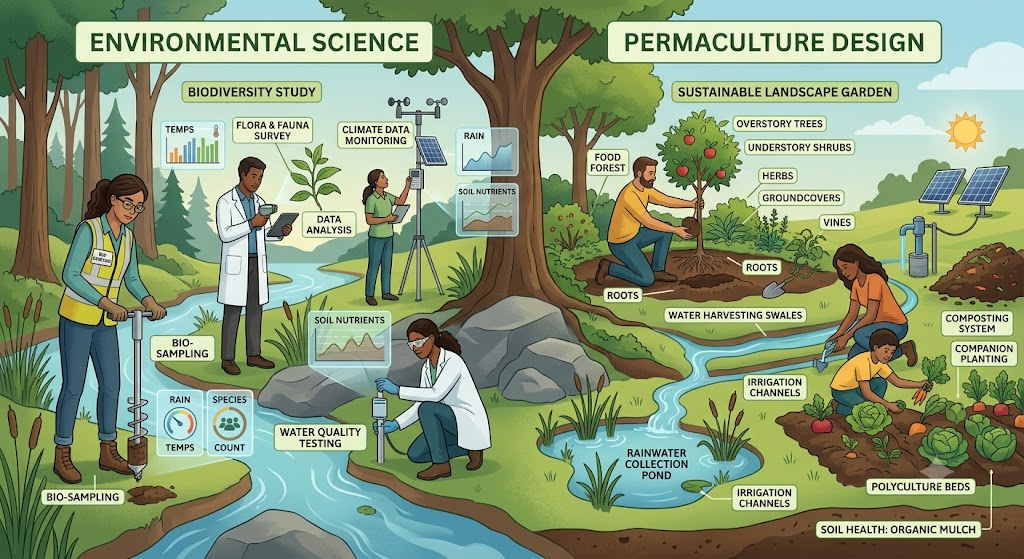
- Soil and water systems
- Food production
- Natural patterns
- Regenerative practices
- Resource management
- Community resilience
- Design methodologies
- Practical project development
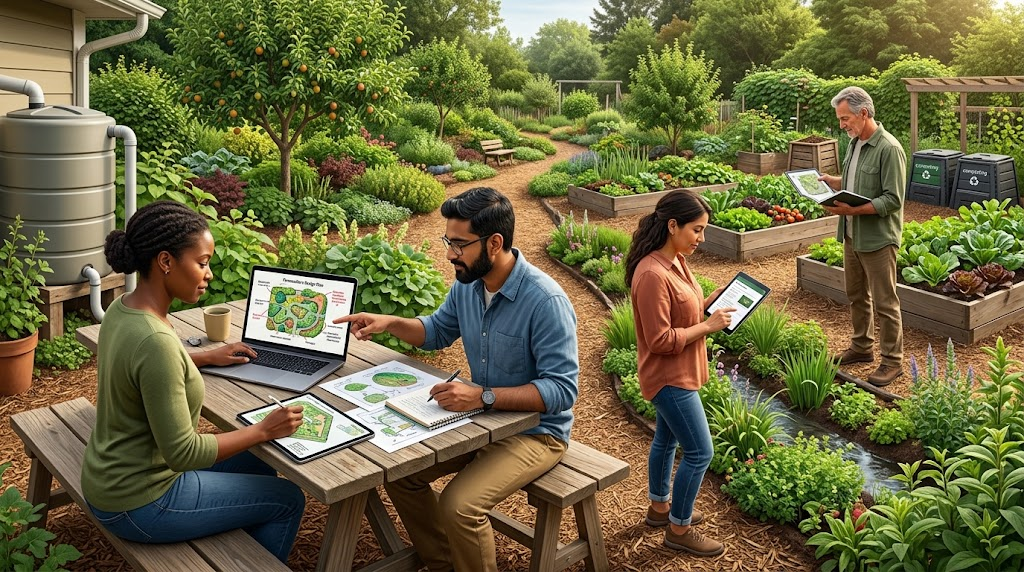
The online format can be especially useful for learners who need flexibility. Instead of relocating or attending a fixed schedule of classroom sessions, students can engage with educational materials and activities from their existing environment.
However, online learning is most valuable when it goes beyond simply watching lessons. Permaculture is fundamentally an applied discipline, so meaningful activities, design exercises, reflection, feedback, and practical implementation can make the learning experience much stronger.
Why Study Permaculture Design Online?
One of the biggest advantages of an online permaculture design certificate is accessibility.
Traditional courses may require students to travel, take time away from employment, or relocate temporarily. An online program can reduce those barriers and allow students to integrate learning into their existing routines.
1. Greater Flexibility
Online education can accommodate learners with different schedules and responsibilities. This is particularly valuable for people already working in agriculture, education, community development, environmental work, or other fields.
A flexible schedule can also make it easier to apply new ideas immediately rather than waiting until a course ends.
2. Learn From Your Own Environment
Permaculture emphasizes observation and context. Your local environment provides an opportunity to examine ecological relationships directly.
While studying online, you can observe:
- Water movement
- Sun and shade
- Soil conditions
- Vegetation
- Microclimates
- Existing food systems
- Human activity
- Resource flows
This can make theoretical concepts more concrete.
3. Connect With a Global Learning Community
Online permaculture programs can bring together students from different geographical and cultural backgrounds.
This diversity matters because permaculture design is context-dependent. A solution that works in one climate, landscape, or community may not be appropriate somewhere else.
Learning alongside people from different environments can therefore expand your understanding of design.
4. Continue Learning While Working
Many prospective diploma students do not want to stop working while they study. Online learning can make it possible to develop new skills while continuing employment, volunteering, farming, entrepreneurship, or community projects.
For adult learners especially, this combination of learning and doing can be highly valuable.
What Do You Learn in an Online Permaculture Design Certificate?
The exact curriculum varies between providers, but a comprehensive program should help students develop an understanding of both permaculture concepts and design processes.
Permaculture Ethics
Permaculture commonly begins with three ethical foundations:
- Care for the Earth
- Care for People
- Fair Share
These ethics provide a framework for thinking about ecological and social consequences.
Rather than treating sustainability as a collection of isolated techniques, permaculture asks learners to consider how decisions affect interconnected systems.
Systems Thinking
Systems thinking is central to permaculture design.
A garden, farm, household, organization, or community can be understood as a system containing multiple interacting elements.
For example, water can influence plant growth, soil health, food production, biodiversity, and human labor. Instead of treating each issue separately, permaculture looks for relationships between them.
Developing this way of thinking is especially useful for diploma seekers because advanced design work requires learners to analyze complex relationships rather than simply apply individual techniques.
Observation and Site Analysis
Good design begins with observation.
Students may learn to examine factors such as:
- Climate
- Topography
- Sun exposure
- Wind
- Water
- Soil
- Existing vegetation
- Wildlife
- Human activity
- Access and movement
The purpose is to understand what already exists before proposing interventions.
Regenerative Food Systems
Food production is an important area of permaculture education.
Depending on the course, learners may explore topics such as:
- Polycultures
- Soil regeneration
- Agroforestry
- Food forests
- Composting
- Biodiversity
- Perennial systems
- Integrated food production
The emphasis is not simply on producing food but on designing systems where different elements support one another.
Water and Resource Management
Water is another important component of ecological design.
Students can learn to think about water as part of a broader system, considering rainfall, runoff, storage, infiltration, soil, vegetation, and human requirements.
Similar systems thinking can be applied to energy, materials, waste, and other resources.
Community Resilience
Permaculture extends beyond landscapes.
Human communities are also systems. A permaculture education may therefore explore resilience, collaboration, local resources, livelihoods, social relationships, and community-scale initiatives.
This broader perspective can be valuable for diploma seekers interested in applying permaculture to organizations, neighborhoods, enterprises, education, or social projects.
Is an Online Permaculture Design Certificate Suitable for Beginners?
Yes. A certificate-level course can be an appropriate starting point for someone who is new to permaculture.
You do not necessarily need to be an experienced farmer, gardener, architect, environmental professional, or landowner to begin studying permaculture design.
The important qualities are curiosity, willingness to observe, and a desire to understand interconnected systems.
Beginners can use certificate-level study to build vocabulary and foundational knowledge before progressing to more demanding project work.
At the same time, experienced practitioners can use an online certificate to organize existing knowledge, explore new perspectives, and develop a more systematic approach to design.
Permaculture Design Certificate vs. Permaculture Diploma
A common question among learners is whether they should pursue a certificate or a diploma.
The two levels generally serve different purposes.
A certificate provides foundational education. It helps students understand the principles, concepts, and basic methods of permaculture design.
A diploma typically involves deeper application and development of practical competency.
For example, a diploma pathway may involve:
- Independent projects
- Advanced design work
- Documentation
- Mentoring
- Feedback
- Research
- Portfolio development
- Reflection
- Real-world implementation
This distinction matters for students who have a long-term goal of becoming professional permaculture designers.
A certificate can provide the foundation. A diploma can provide a structured environment for continuing to practice, document, and develop that knowledge.
How a Certificate Can Support a Permaculture Diploma
For aspiring diploma students, the value of an online certificate extends beyond the certificate itself.
It can help establish the knowledge needed to approach advanced project work with greater confidence.
For example, a learner might begin by studying ecological design concepts and then move into a diploma pathway where those concepts are applied to an actual project.
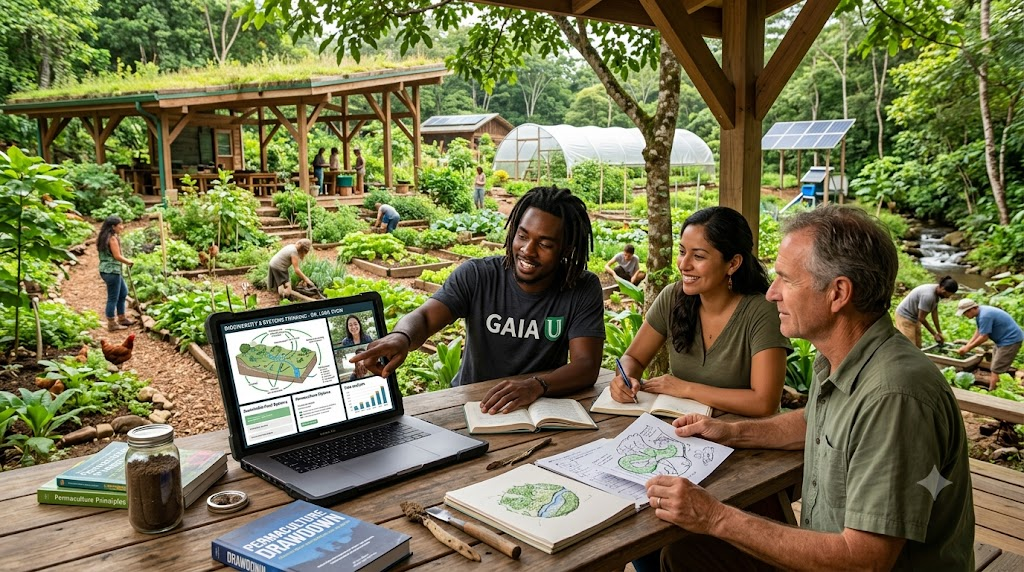
Gaia University describes its International Diploma of Permaculture Design as an advanced program that builds on Permaculture Design Course education through project design, documentation, mentoring, and feedback.
Explore Gaia University’s International Diploma of Permaculture Design
This type of progression illustrates an important principle: learning becomes more valuable when knowledge is repeatedly tested and refined through action.
What Makes a Good Online Permaculture Design Certificate?
Not every online course provides the same depth of learning. If you are considering a permaculture design certificate online, evaluate the educational structure rather than choosing solely on price or convenience.
Look for Comprehensive Content
A strong program should cover more than gardening techniques.
Look for education involving:
- Ethics
- Systems thinking
- Ecological principles
- Design processes
- Observation
- Resource management
- Social systems
- Practical application
A broad curriculum can provide a better foundation for advanced study.
Look for Practical Activities
Permaculture is an applied discipline. A program that combines theory with practical exercises can help you translate ideas into skills.
Activities might include:
- Site observations
- Mapping
- Design exercises
- Reflection
- Case studies
- Project planning
- Documentation
Consider Feedback and Mentoring
Feedback can significantly improve learning.
When learners receive constructive responses to their ideas and designs, they can identify assumptions, improve their reasoning, and experiment with alternative approaches.
Mentoring becomes particularly important as learners transition from introductory education toward professional-level project work.
Examine the Learning Community
Permaculture education can be collaborative.
A course that provides opportunities to interact with other learners can expose you to different experiences, climates, cultures, and approaches.
This can help prevent the assumption that there is one universal permaculture solution.
Check the Learning Format
Consider how the course is delivered.
Possible components include:
- Recorded lessons
- Readings
- Online activities
- Live webinars
- Group discussions
- Assignments
- Mentoring
- Independent project work
The best format depends on your learning preferences and schedule.
How Online Learning Can Become Practical
One concern people sometimes have about online environmental education is whether it can provide enough practical experience.
The answer depends largely on how the learner approaches the course.
You can make online study more practical by connecting lessons to your surroundings.
For example, instead of studying water management only as an abstract concept, observe how rainfall moves through a local landscape.
Instead of simply reading about biodiversity, document the plants and ecological relationships around you.
Instead of learning design principles only through examples, apply them to a real site or community challenge.
This approach turns your environment into a living classroom.
Building a Permaculture Portfolio
For diploma seekers, documentation can be as important as learning itself.
A portfolio can demonstrate how you think, what you have learned, and how you apply design principles.
Potential portfolio material can include:
- Site assessments
- Maps
- Design drawings
- Project descriptions
- Photographs
- Research
- Reflections
- Implementation records
- Lessons learned
- Project revisions
A portfolio also creates a record of development over time.
Rather than saying that you understand permaculture, you can demonstrate your process through documented work.
Gaia University emphasizes project documentation and ePortfolio development as part of its broader learning model.
The Importance of Project-Based Learning
Permaculture is particularly well suited to project-based education.
Consider the difference between memorizing information about water systems and designing a response to a real water-management challenge.
The second approach requires you to:
- Observe the situation.
- Identify relationships.
- Research possible solutions.
- Develop a design.
- Implement or test ideas.
- Observe the results.
- Reflect on what happened.
- Revise the design.
This cycle develops practical judgment.
It also reflects how regenerative projects actually evolve. Conditions change, assumptions prove incomplete, and designs often need modification.
For diploma seekers, learning how to adapt can be just as important as learning specific techniques.
How Much Time Does Online Study Require?
The time commitment varies considerably between programs.
A short introductory course may require only a few hours per week, while a certificate integrated into a larger diploma pathway can require significantly more sustained engagement.
Gaia University’s current program information, for example, describes its Certificate in Ecosocial Design as a four-to-six-month program and its International Diploma of Permaculture Design as a longer pathway involving advanced certificates and project phases.
Before enrolling, consider your realistic weekly availability.
A sustainable study schedule is generally better than choosing a demanding course and struggling to maintain participation.
Can an Online Certificate Lead to Professional Permaculture Work?
A certificate can provide foundational knowledge, but completing a certificate alone does not automatically make someone an experienced professional designer.
Professional competence develops through practice.
Learners who want to pursue permaculture as a career should consider building experience through:
- Personal projects
- Community initiatives
- Volunteer work
- Collaborative design projects
- Land-based experimentation
- Research
- Teaching or facilitation
- Documentation
- Continued education
The combination of training, practice, evidence, and reflection can create a stronger professional foundation.
This is one reason a diploma may appeal to learners who want to move beyond introductory study.
Choosing an Online Permaculture Pathway as a Diploma Seeker
If your long-term goal is a permaculture diploma, think about the entire learning pathway rather than selecting a certificate in isolation.
Ask yourself:
What do I want to do with permaculture?
Your answer could involve land design, regenerative agriculture, community development, education, ecological restoration, entrepreneurship, or another field.
What skills do I currently have?
Identify your strengths and gaps. This can help you choose learning that complements your existing experience.
How much practical experience do I have?
If you have mostly studied theory, prioritize opportunities for application.
Do I want mentorship?
Mentoring can become increasingly useful as project complexity increases.
Will I be able to document my work?
Documentation helps turn experience into demonstrable learning.
What comes after the certificate?
If you already know that you want a diploma, investigate how the certificate fits into the broader pathway.
Gaia University states that its diploma programs begin with online certificate programs before learners transition into mentored, self-directed project phases.
See Gaia University’s diploma pathways
Benefits of Choosing a Flexible Permaculture Education Model
A flexible education model can be particularly useful for learners who want to integrate study with real-world action.
Instead of separating “education” from “life,” you can use your existing projects as opportunities for learning.
For example:
- A garden can become a design laboratory.
- A community initiative can become a resilience project.
- A small business can become a regenerative enterprise case study.
- A local environmental challenge can become a research project.
- A landscape can become an opportunity for observation and mapping.
This model can make education more relevant because learning is connected to actual decisions.
Gaia University describes its broader educational approach as a “learning and doing” model that combines online study, hands-on action learning, and documented self-directed project work.
Common Mistakes When Choosing an Online PDC
Choosing Based Only on Price
The cheapest course is not necessarily the best value.
Consider curriculum depth, instructor experience, practical assignments, feedback, mentoring, community, and how the course fits your long-term goals.
Expecting a Certificate to Replace Practice
A certificate can demonstrate education, but design ability develops through application.
Continue practicing after the course ends.
Focusing Only on Gardening
Gardening is one application of permaculture, but the discipline is broader.
A comprehensive education should help you understand relationships among ecological, social, economic, and built systems.
Ignoring Documentation
If you intend to progress toward a diploma or professional work, start documenting your projects early.
Your notes, designs, reflections, photographs, and revisions can become valuable evidence of your development.
Looking for Universal Solutions
Permaculture design is highly contextual.
Avoid assuming that a technique that worked in another climate, landscape, or community will automatically work in yours.
Start with observation.
Frequently Asked Questions About Permaculture Design Certificate Online Programs
What is a permaculture design certificate online?
It is an online educational program covering foundational permaculture principles, ethics, ecological systems, and design methods. The certificate is generally awarded after completing the required course work.
Can I study permaculture completely online?
Yes, foundational permaculture education can be delivered online. However, students can gain additional value by applying what they learn to real environments and projects.
Is an online PDC suitable for beginners?
Yes. Certificate-level permaculture education can provide an introduction for beginners while also helping experienced practitioners organize and expand their knowledge.
Is a certificate enough to become a permaculture designer?
A certificate provides foundational education, but professional design competency generally requires continued practice, project experience, feedback, and learning.
Can an online certificate lead to a permaculture diploma?
It can, depending on the institution and pathway. Some diploma programs are specifically structured around certificate-level foundations followed by advanced project work.
What should I look for in an online permaculture certificate?
Look for comprehensive curriculum, practical activities, experienced educators, meaningful feedback, opportunities for interaction, and a learning structure that aligns with your long-term goals.
How long does an online permaculture certificate take?
Duration varies by provider and course structure. Some programs may take several weeks, while more comprehensive certificate programs can extend across several months.
Can I work while studying for a permaculture certificate?
Online study is often compatible with work because of its flexibility. However, you should evaluate the actual weekly workload before enrolling.
How to Prepare for a Permaculture Diploma
If your ultimate goal is a diploma, you can begin preparing before the certificate is finished.
Start keeping a learning journal.
Record:
- What you learn
- What you observe
- Questions you develop
- Projects you undertake
- Mistakes you make
- Feedback you receive
- Changes you make to your designs
You can also begin developing a small project portfolio.
The project does not need to be large. A backyard, community garden, educational initiative, or local resilience project can provide opportunities to practice observation and design thinking.
The goal is to develop the habit of moving from observation → analysis → design → action → reflection → adaptation.
That cycle can become a powerful foundation for advanced study.
Final Thoughts
A permaculture design certificate online can be an accessible and flexible way to begin developing ecological design knowledge. For beginners, it offers a structured introduction to permaculture ethics, systems thinking, observation, and practical design. For experienced practitioners, it can provide a framework for organizing knowledge and exploring new approaches.
For permaculture diploma seekers, the certificate can be even more significant when it forms part of a longer learning pathway.
The most valuable education is not simply about collecting credentials. It is about developing the ability to observe systems, understand relationships, make thoughtful design decisions, take action, learn from results, and adapt.
If your goal is to progress toward advanced permaculture practice, look for an educational pathway that connects foundational learning with real-world projects, documentation, mentoring, and continued development.
Online education can provide the flexibility to begin that journey from wherever you are. The next step is to turn knowledge into practice—and practice into demonstrated capability.
Responses