
Indigenous Knowledge and Education: Powerful Ways Traditional Wisdom Strengthens Permaculture Learning

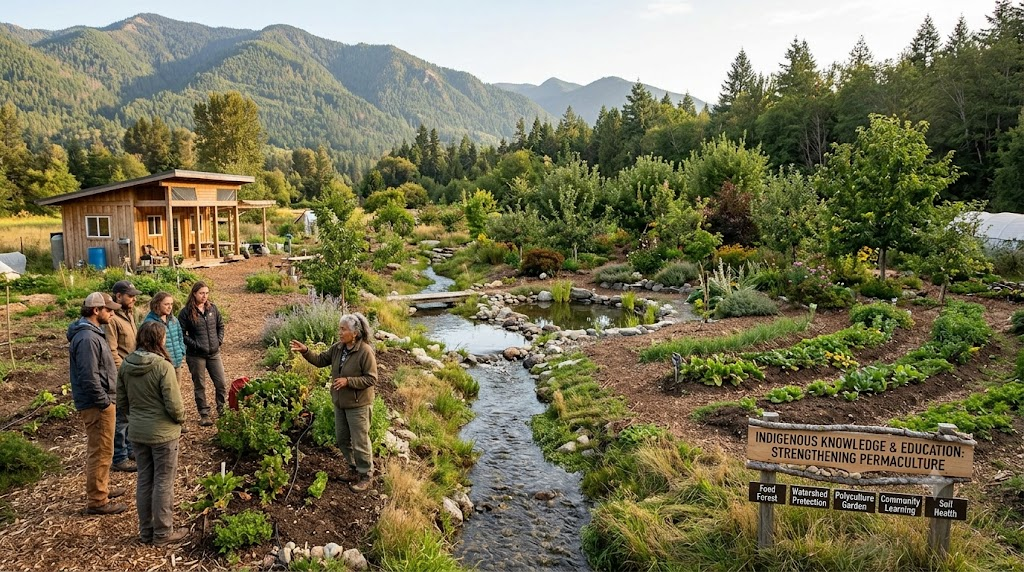
The growing interest in regenerative agriculture, ecological restoration, and sustainable communities has renewed appreciation for indigenous knowledge and education. Around the world, Indigenous peoples have developed sophisticated systems for caring for landscapes, producing food, conserving biodiversity, and teaching future generations through lived experience rather than formal classrooms.
For Permaculture Diploma seekers, understanding these knowledge systems is not simply an academic exercise. It is an opportunity to deepen ecological literacy, cultivate humility, and recognize that many principles considered “innovative” today have been practiced successfully for thousands of years.
Rather than viewing Indigenous knowledge as a collection of historical techniques, modern permaculture practitioners increasingly recognize it as a living, adaptive way of understanding relationships among people, ecosystems, and future generations.
Understanding Indigenous Knowledge and Education
Indigenous knowledge and education refers to systems of learning that originate within Indigenous communities and have been developed through continuous interaction with local ecosystems over generations.
Unlike conventional education, which often separates subjects into disciplines, Indigenous education typically integrates:
- Ecology
- Agriculture
- History
- Spiritual values
- Ethics
- Community responsibilities
- Storytelling
- Practical experience
Learning is deeply connected to place.
Children and adults alike acquire knowledge by observing seasonal cycles, participating in community activities, caring for land, listening to Elders, and practicing skills repeatedly over many years.
This educational model emphasizes relationships instead of isolated facts.
For permaculture students, this perspective aligns remarkably well with whole-systems thinking.
Why Indigenous Knowledge Matters in Modern Permaculture
Permaculture was developed as a design framework for creating sustainable human settlements. Many of its foundational ideas resonate strongly with traditional Indigenous practices.
Examples include:
| Permaculture Principle | Indigenous Perspective |
| Observe and interact | Learn directly from the land over generations |
| Produce no waste | Everything has value within ecological cycles |
| Integrate rather than segregate | Communities, plants, animals, and landscapes function together |
| Value diversity | Biodiversity creates resilience |
| Use renewable resources | Respect ecological limits |
These similarities do not mean the two systems are identical.
Permaculture is a modern design methodology, whereas Indigenous knowledge represents thousands of unique cultural traditions developed independently across different regions of the world.
Recognizing both the similarities and differences helps students appreciate Indigenous contributions without oversimplifying them.
Historical Development of Indigenous Educational Systems
Long before universities existed, Indigenous societies developed highly effective educational systems.
Knowledge was preserved through:
- Oral histories
- Ceremonies
- Apprenticeship
- Observation
- Community participation
- Seasonal work
- Artistic expression
- Ecological practice
Learning occurred every day.
Fishing taught ecology.
Hunting taught animal behavior.
Gathering plants taught botany.
Building homes taught engineering.
Ceremonies reinforced ethics and social responsibility.
Because education was inseparable from daily life, learners developed both practical competence and cultural identity simultaneously.
Core Principles Shared by Indigenous Knowledge and Permaculture
Observation Before Intervention
Many Indigenous cultures spend years observing landscapes before making significant changes.
Patterns of rainfall, wildlife migration, plant succession, soil moisture, and seasonal timing guide decisions.
This mirrors one of permaculture’s most famous principles:
Observe first. Design second.
Instead of immediately applying technology, practitioners first learn how ecosystems already function.
Observation reduces unnecessary intervention while increasing long-term resilience.
Reciprocity with Nature
One of the most profound lessons within Indigenous knowledge is reciprocity.
Rather than asking:
“How can I extract more?”
the guiding question becomes:
“How can I give back?”
Reciprocity may include:
- protecting watersheds
- restoring habitat
- harvesting selectively
- sharing surplus
- maintaining biodiversity
- honoring seasonal limits
For permaculture practitioners, reciprocity strengthens ethical decision-making far beyond technical design.
Community-Based Learning
Education is rarely individualistic.
Knowledge is shared across generations.
Everyone has responsibilities.
Young people learn from:
- grandparents
- parents
- skilled artisans
- farmers
- hunters
- healers
- community leaders
This collaborative approach reflects the importance of learning communities in successful permaculture education.
Instead of competing for grades, learners contribute to shared ecological wellbeing.
Indigenous Ecological Knowledge in Land Stewardship
Healthy landscapes are rarely accidental.
Indigenous communities have refined management strategies through centuries of observation and adaptation.
Examples include:
- rotational harvesting
- controlled cultural burning
- agroforestry
- polyculture farming
- watershed protection
- seasonal grazing
- wildlife habitat management
- seed saving
These practices increase resilience by working with ecological processes rather than attempting to dominate them.
Many ecological restoration projects now recognize that landscapes previously considered “untouched wilderness” were actually carefully stewarded for generations using sophisticated ecological knowledge.
Water, Soil, and Forest Management Practices
Indigenous land stewardship demonstrates that long-term productivity depends upon maintaining ecosystem health rather than maximizing short-term yields.
Soil
Healthy soils are protected through:
- permanent vegetation
- organic matter recycling
- minimal disturbance
- diverse plant communities
Water
Water management often includes:
- protecting springs
- slowing runoff
- restoring wetlands
- harvesting rainfall
- respecting watershed boundaries
Forests
Forest stewardship may involve:
- selective harvesting
- maintaining habitat diversity
- encouraging natural regeneration
- protecting culturally important species
These approaches align closely with regenerative land management principles promoted throughout modern permaculture education.
Food Sovereignty and Traditional Agriculture
Traditional agricultural systems frequently combine remarkable biodiversity with long-term resilience.
Examples include:
- perennial food systems
- intercropping
- seed preservation
- wild food management
- agroforestry
- integrated livestock systems
Rather than relying upon monocultures, Indigenous farming often embraces complexity.
Multiple species support one another.
Different harvest times reduce risk.
Natural nutrient cycling minimizes dependence on external inputs.
For Permaculture Diploma seekers, studying these systems provides valuable inspiration for designing productive landscapes that remain resilient under changing environmental conditions.
Oral Traditions as Educational Systems
One of the defining characteristics of Indigenous education is the use of oral traditions.
Stories are not merely entertainment—they serve as living libraries of ecological knowledge, ethics, history, and practical guidance.
Narratives may encode information about:
- Seasonal weather patterns
- Animal migrations
- Safe harvesting practices
- Watershed boundaries
- Fire management
- Social responsibilities
- Conflict resolution
- Relationships between species
Because these teachings are repeated across generations, they preserve complex knowledge in memorable forms. Storytelling also encourages critical thinking, as learners interpret meanings within cultural and environmental contexts rather than memorizing isolated facts.
For permaculture learners, this highlights an important lesson: education is most powerful when knowledge is connected to real experiences, places, and relationships.
Ethical Considerations When Learning from Indigenous Communities
As interest in regenerative agriculture grows, many learners seek inspiration from Indigenous cultures. While this curiosity can foster respect and understanding, it also brings important ethical responsibilities.
Learning from Indigenous knowledge requires more than adopting techniques. It calls for recognizing that these knowledge systems belong to living communities with their own histories, governance, and cultural identities.
Permaculture students should strive to:
- Learn with humility rather than assuming expertise.
- Acknowledge the origins of ideas and practices.
- Respect cultural protocols when knowledge is shared.
- Avoid presenting Indigenous practices as new inventions.
- Understand that some teachings are community-specific and may not be intended for public dissemination.
Ethical learning also means recognizing that no single Indigenous perspective represents all Indigenous peoples. Every nation, tribe, and community has developed knowledge that reflects its unique environment, language, and cultural traditions.
For future regenerative practitioners, respect is just as important as technical skill.
Integrating Indigenous Knowledge into Permaculture Education
Permaculture education benefits when it encourages learners to see landscapes through multiple perspectives.
Instead of treating Indigenous knowledge as a separate subject, it can become part of broader ecological literacy.
Meaningful integration may include:
| Learning Area | Indigenous Perspective | Permaculture Application |
| Landscape observation | Seasonal indicators | Site analysis |
| Food production | Diverse cropping systems | Food forest design |
| Water stewardship | Watershed protection | Rainwater harvesting |
| Community governance | Collective decision-making | Community resilience |
| Biodiversity | Respect for all species | Ecosystem restoration |
This integrated approach helps students recognize that effective design depends on understanding relationships—not simply applying techniques.
Observation, adaptation, and continuous learning remain central to both traditions.
How Gaia University Supports Regenerative Learning
For learners pursuing a Permaculture Diploma, educational pathways that encourage experiential learning can provide opportunities to connect theory with practice.
Gaia University emphasizes self-directed, project-based learning that allows students to engage with real-world regenerative initiatives while reflecting on ecological, cultural, and community contexts.
Students interested in the university’s approach to regenerative education can explore the academic philosophy through https://gaiauniversity.org/.
Those considering diploma pathways may also review the available learning programs.
Rather than separating classroom knowledge from lived experience, project-based learning encourages students to continually observe, apply, evaluate, and improve their understanding within actual ecosystems.
Practical Applications for Permaculture Diploma Seekers
Studying indigenous knowledge and education becomes most valuable when translated into everyday practice.
Below are examples of ways learners can apply these principles responsibly.
1. Spend More Time Observing
Before redesigning a property:
- Watch seasonal water flow.
- Identify wildlife patterns.
- Observe prevailing winds.
- Record sunlight changes.
- Notice native vegetation.
Careful observation often reveals solutions that expensive technologies overlook.
2. Learn Local Ecological History
Every landscape has a history.
Research questions such as:
- Which Indigenous communities traditionally cared for this land?
- What native ecosystems existed here?
- Which species have declined?
- What restoration opportunities remain?
Understanding place enriches design decisions.
3. Increase Biodiversity
Rather than simplifying landscapes, encourage ecological complexity through:
- Native plants
- Mixed species
- Pollinator habitat
- Perennial systems
- Habitat corridors
Diversity strengthens resilience.
4. Think in Generations
Many Indigenous cultures consider how today’s decisions will affect future generations.
Permaculture designers can adopt similar long-term thinking by asking:
- Will this design improve soil after fifty years?
- Will future caretakers inherit healthier ecosystems?
- Does this decision increase resilience?
Long-term perspectives often lead to better outcomes than short-term optimization.
5. Build Community Relationships
Permaculture extends beyond gardening.
Strong communities share:
- knowledge
- seeds
- tools
- labor
- experiences
- mutual support
Learning together creates resilience that no individual can achieve alone.
Challenges and Misconceptions
Although interest in Indigenous ecological knowledge continues to grow, several misconceptions remain.
Misconception 1: Indigenous Knowledge Is Primitive
In reality, Indigenous knowledge systems often reflect thousands of years of careful experimentation, observation, and adaptation.
Many practices now studied by ecologists—including polycultures, controlled burning, and watershed stewardship—have long histories within Indigenous communities.
Misconception 2: There Is One Indigenous Perspective
There is no single Indigenous worldview.
North America alone includes hundreds of distinct Indigenous nations, each with unique languages, histories, ecological conditions, and educational traditions.
Responsible learners avoid generalizations.
Misconception 3: Traditional Knowledge Cannot Adapt
Indigenous knowledge is dynamic.
Communities continue adapting practices to changing climates, technologies, and social conditions while maintaining cultural continuity.
Adaptation has always been part of these living knowledge systems.
Misconception 4: Sustainability Is Only About the Environment
Indigenous education often integrates environmental stewardship with cultural wellbeing, governance, language preservation, spirituality, and community health.
Permaculture similarly recognizes that ecological sustainability depends upon healthy human relationships.
Future Directions for Indigenous Knowledge and Education
Climate change, biodiversity loss, soil degradation, and water scarcity have increased interest in knowledge systems that promote resilience.
Future regenerative education is likely to place greater emphasis on:
- Long-term ecosystem observation
- Community-led restoration
- Local food systems
- Traditional ecological indicators
- Cultural diversity
- Collaborative governance
- Landscape restoration
- Interdisciplinary learning
For Permaculture Diploma seekers, these developments offer opportunities to deepen both ecological understanding and cultural awareness.
The most effective regenerative practitioners will combine scientific inquiry with careful observation, ethical reflection, and respect for place-based knowledge.
Educational institutions that encourage experiential learning, systems thinking, and ecological design can help prepare learners for these emerging challenges. Additional information about regenerative learning opportunities can be found through https://gaiauniversity.org/admissions/.
Frequently Asked Questions
What is indigenous knowledge and education?
Indigenous knowledge and education refers to culturally rooted systems of learning developed by Indigenous communities through long-term interaction with local ecosystems. These systems integrate ecological understanding, cultural values, practical skills, and intergenerational teaching.
How does Indigenous knowledge relate to permaculture?
Both emphasize observing natural systems, working with ecological processes, valuing biodiversity, and building resilient communities. While they have different origins, they share many complementary principles.
Why is Indigenous ecological knowledge important today?
It offers practical insights into sustainable land stewardship, biodiversity conservation, climate adaptation, and community resilience that remain highly relevant for modern environmental challenges.
Can non-Indigenous students learn from Indigenous knowledge?
Yes, provided they approach learning respectfully, acknowledge knowledge sources, avoid cultural appropriation, and recognize Indigenous communities as living custodians of their own traditions.
How does experiential learning support permaculture education?
Experiential learning encourages students to develop understanding through observation, practical projects, reflection, and ongoing adaptation, helping bridge theory and real-world application.
Why should Permaculture Diploma seekers study Indigenous perspectives?
Studying Indigenous perspectives expands ecological literacy, strengthens ethical decision-making, improves systems thinking, and helps learners design landscapes that work in harmony with natural processes and local communities.
Conclusion
The growing recognition of indigenous knowledge and education reflects an important shift in how society understands sustainability and regenerative living. These knowledge systems demonstrate that effective stewardship is built upon careful observation, reciprocal relationships, cultural continuity, and long-term responsibility rather than short-term extraction.
For Permaculture Diploma seekers, engaging with Indigenous perspectives can deepen both practical design skills and ethical awareness. It encourages learners to move beyond viewing landscapes as collections of resources and instead see them as interconnected living systems that support ecological, cultural, and community wellbeing.
By integrating systems thinking, experiential learning, and respect for place-based knowledge, future regenerative practitioners will be better equipped to restore ecosystems, strengthen communities, and contribute to a more resilient future. Indigenous wisdom does not replace scientific understanding or modern design frameworks; rather, it complements them by offering enduring lessons about living responsibly within the limits and possibilities of the natural world.

Responses