
Teach Indigenous Knowledge: A Guide for Permaculture Diploma Seekers

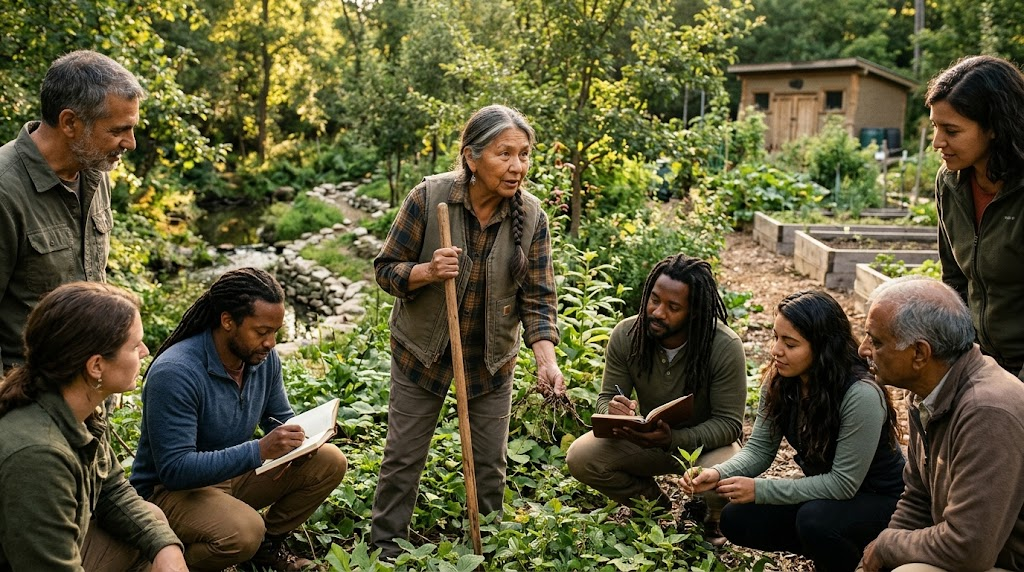
Indigenous knowledge offers valuable insights into how people can live in balance with nature, manage resources responsibly, and build resilient communities. Developed and refined over generations, these knowledge systems reflect deep relationships between people, land, water, plants, animals, and local ecosystems. For anyone interested in permaculture, regenerative design, and sustainable living, understanding how to teach Indigenous knowledge is an important step toward creating more meaningful and culturally responsible approaches to environmental education.
As environmental challenges become increasingly complex, conventional approaches to sustainability are not always sufficient. Climate change, biodiversity loss, soil degradation, and resource depletion require solutions that consider ecological relationships as well as social and cultural contexts. Indigenous communities have developed diverse practices for responding to environmental changes, maintaining ecosystem health, and passing practical knowledge between generations.
Learning to teach Indigenous knowledge involves more than sharing traditional techniques. It requires understanding cultural context, respecting Indigenous intellectual and cultural rights, recognizing community leadership, and creating educational experiences that connect traditional wisdom with contemporary ecological challenges.
For permaculture diploma seekers, this approach can deepen their understanding of ecological design, community development, and regenerative systems. It also provides an opportunity to examine how different knowledge systems can contribute to more sustainable futures without treating Indigenous knowledge as a resource to be freely extracted.
This guide explores what it means to teach Indigenous knowledge, why it matters in permaculture education, which learning methods are appropriate, and how students can apply these principles in their own educational and regenerative projects.
What Is Indigenous Knowledge?
Indigenous knowledge refers to the knowledge, practices, values, and understandings developed by Indigenous peoples through long-standing relationships with their territories and environments.
It is often described as traditional ecological knowledge, although Indigenous knowledge encompasses much more than environmental management. It can include agriculture, food systems, medicine, architecture, navigation, astronomy, governance, languages, spirituality, craftsmanship, and community organization.
These knowledge systems are diverse. Different Indigenous communities have developed distinct approaches based on their geographical environments, histories, cultures, and experiences.
For example, Indigenous knowledge may include:
- Understanding local weather patterns and seasonal changes.
- Identifying native plants and their ecological relationships.
- Managing forests through culturally specific stewardship practices.
- Growing food using locally adapted agricultural systems.
- Conserving water in dry or seasonally variable environments.
- Maintaining biodiversity through traditional land management.
- Passing knowledge through storytelling, observation, and practical experience.
- Organizing communities around shared responsibilities and reciprocal relationships.
An important characteristic of Indigenous knowledge is that it is often place-based. It develops through direct observation, experimentation, experience, and intergenerational learning.
Unlike educational models that separate subjects into individual disciplines, many Indigenous knowledge systems understand ecosystems as interconnected relationships. Soil, water, plants, animals, people, and cultural practices are not necessarily treated as independent elements.
This holistic perspective has significant relevance to permaculture, which also emphasizes ecological relationships, systems thinking, and responsible resource management.
Why Teach Indigenous Knowledge in Permaculture Education?
Permaculture is based on observing natural systems and designing human environments that work with ecological processes rather than against them.
Although contemporary permaculture has its own principles and design frameworks, many of its practical applications overlap with longstanding Indigenous approaches to living within ecological limits.
Teaching Indigenous knowledge can therefore enrich permaculture education in several important ways.
1. Develop a Deeper Understanding of Local Ecosystems
One of the foundations of permaculture is careful observation.
Before designing a garden, food forest, farm, or community project, students need to understand the characteristics of the landscape. These include climate, soil, water availability, vegetation, wildlife, and seasonal patterns.
Indigenous communities often possess detailed knowledge of these local conditions.
Learning from community knowledge holders can help permaculture students understand:
- Which native plants are adapted to particular conditions.
- How seasonal changes influence food production.
- Where water naturally collects or moves through a landscape.
- Which species support local biodiversity.
- How traditional land management practices respond to environmental variation.
This knowledge can improve ecological observation and help students develop designs that respond to the actual conditions of a place.
2. Understand Long-Term Ecological Stewardship
Many Indigenous traditions emphasize responsibilities toward the land and future generations.
This perspective encourages people to consider the long-term consequences of their decisions rather than focusing exclusively on immediate productivity.
In permaculture, this can translate into more thoughtful approaches to:
- Soil conservation and regeneration.
- Forest and woodland stewardship.
- Protection of watersheds.
- Maintenance of native biodiversity.
- Sustainable harvesting.
- Community food security.
Teaching Indigenous knowledge can help students recognize that sustainability is not simply about reducing environmental damage. It can also involve maintaining reciprocal relationships with ecosystems and supporting their continued capacity to flourish.
3. Strengthen Community-Based Learning
Indigenous knowledge is frequently transmitted through relationships and shared experiences.
Learning may take place while planting, harvesting, preparing food, building structures, managing land, or participating in community activities.
This offers an important lesson for permaculture educators: meaningful learning does not always happen in a classroom.
Community-based education can help students understand the social dimensions of regenerative design. It also demonstrates why local participation and shared responsibility are essential for long-term project success.
4. Encourage Systems Thinking
Permaculture students study relationships between different elements of a landscape.
For example, a food forest is not simply a collection of productive trees. It is an interconnected system involving soil organisms, vegetation layers, pollinators, water cycles, wildlife, and human activities.
Many Indigenous knowledge systems similarly emphasize relationships between ecological and social processes.
Studying these perspectives can help students move beyond isolated solutions and develop a more comprehensive understanding of regenerative systems.
How to Teach Indigenous Knowledge Responsibly
Teaching Indigenous knowledge requires cultural awareness, respect, and careful consideration of who has the authority to share particular knowledge.
Not all traditional knowledge is public. Some information may be restricted, sacred, community-owned, or governed by specific cultural protocols.
Therefore, educators should not assume that knowledge becomes freely available simply because it has been documented or discussed publicly.
The following principles can help create responsible learning environments.
1. Recognize Indigenous Knowledge Holders as Experts
Indigenous elders, farmers, craftspeople, ecological practitioners, cultural educators, and community leaders may hold specialized knowledge developed through generations of experience.
They should be recognized as knowledge holders and educators rather than treated merely as sources of information.
When designing educational programs, establish relationships with relevant communities and invite them to determine whether, how, and by whom particular knowledge may be shared.
Where appropriate, provide fair compensation, recognition, and opportunities for community participation in program development.
2. Respect Cultural Context
Traditional practices should be understood within their original cultural, ecological, and historical contexts.
A technique that works in one environment may not be suitable for another. Likewise, a practice that has cultural or spiritual significance should not be reduced to a simple agricultural technique.
For example, traditional forest management may involve specific relationships between communities, ancestral territories, seasonal responsibilities, and culturally significant species.
Teaching only the practical technique without understanding these relationships can result in an incomplete or misleading interpretation.
Permaculture educators should therefore explain the broader context whenever knowledge holders have authorized its inclusion.
3. Obtain Permission Before Sharing Knowledge
Consent is essential when working with Indigenous knowledge.
Educators should ask permission before recording interviews, photographing cultural activities, publishing traditional practices, or incorporating community knowledge into courses and learning materials.
Consent should be informed, voluntary, and specific to the intended use.
Communities should also be able to establish boundaries around what may be shared publicly and what should remain within their own cultural settings.
4. Avoid Treating Indigenous Knowledge as a Single System
There is no universal Indigenous knowledge system.
The experiences of communities in tropical forests, mountain regions, grasslands, deserts, islands, and Arctic environments differ considerably.
Their languages, land relationships, food systems, governance structures, and ecological practices also vary.
Avoid making broad statements that suggest all Indigenous peoples share identical beliefs or techniques.
Instead, focus on specific communities, geographical contexts, and authorized knowledge sources.
5. Support Knowledge Sovereignty
Indigenous communities have rights and interests concerning their knowledge, cultural heritage, and traditional practices.
Knowledge sovereignty involves recognizing their authority over how their knowledge is documented, interpreted, shared, and used.
This principle is particularly important in modern education, where information can easily be copied, published, commercialized, or incorporated into digital learning platforms.
Responsible educators should ensure that educational activities do not undermine community ownership or control.
Practical Methods to Teach Indigenous Knowledge
The most effective ways to teach Indigenous knowledge often involve experiential, participatory, and place-based learning.
These approaches allow students to develop a deeper understanding of the relationships between culture, ecology, and practical skills.
1. Place-Based Ecological Learning
Place-based education connects learning directly to the environment in which students live.
Rather than studying ecosystems only through textbooks, students observe local landscapes and explore how people interact with them.
Activities may include:
- Observing local vegetation and seasonal changes.
- Identifying native species using approved educational resources.
- Studying local soil characteristics.
- Mapping watersheds and natural drainage patterns.
- Exploring traditional approaches to food production.
- Learning about historical land-use patterns.
Where possible, collaborate with Indigenous educators and community representatives who can explain the cultural and ecological significance of the landscape.
For permaculture diploma seekers, place-based learning provides an excellent foundation for site assessment and ecological design.
2. Storytelling and Oral Knowledge Transmission
Storytelling is an important educational method in many Indigenous cultures.
Stories can communicate ecological observations, community histories, ethical responsibilities, and relationships between humans and the natural world.
In an educational setting, storytelling can help students understand concepts that might otherwise seem abstract.
For example, a community-approved story about seasonal changes may provide insights into local weather patterns, plant cycles, or animal behavior.
However, educators must recognize that not all stories are intended for public circulation. Permission and cultural protocols should guide their use.
Students should also learn to listen carefully rather than assuming that every story must be translated into a scientific explanation or practical design principle.
3. Learning Through Demonstration
Practical demonstrations can help students understand traditional ecological skills.
Depending on community permission and educational objectives, demonstrations may involve:
- Traditional food-growing methods.
- Seed selection and preservation.
- Preparation of natural building materials.
- Sustainable harvesting practices.
- Food processing and preservation.
- Traditional craft techniques.
- Ecological restoration practices.
These activities should be led or approved by appropriate knowledge holders.
The purpose is not simply to reproduce a technique but to understand the environmental conditions, cultural responsibilities, and knowledge that make the practice meaningful.
4. Community-Led Workshops
Workshops can create opportunities for knowledge exchange between Indigenous educators, permaculture students, local practitioners, and community members.
A well-designed workshop should begin with community priorities rather than assuming what participants need to learn.
Possible themes include:
- Local food systems and food sovereignty.
- Traditional ecological stewardship.
- Native plants and biodiversity.
- Community resilience.
- Cultural relationships with water.
- Traditional architecture and natural materials.
- Intergenerational knowledge transmission.
The most valuable workshops encourage dialogue and participation while recognizing that knowledge holders determine what they are comfortable sharing.
5. Reflective Learning and Documentation
Reflection helps students examine how their understanding develops over time.
After participating in a community-led learning activity, students can document their observations, questions, and personal learning outcomes.
Reflection activities may include:
- What did I learn about this ecosystem?
- Which relationships between people and nature became clearer?
- How did the cultural context influence my understanding?
- What assumptions did I need to reconsider?
- Which knowledge can I apply ethically in my own environment?
- What information should remain confidential?
Documentation should respect community consent and avoid recording restricted knowledge.
Indigenous Knowledge and Key Permaculture Principles
Indigenous knowledge can provide valuable perspectives for understanding several foundational permaculture concepts.
However, it is important to distinguish between Indigenous knowledge systems and contemporary permaculture frameworks. They may share practical similarities, but they have different histories, cultural foundations, and intellectual traditions.
Earth Care
Earth Care emphasizes maintaining and regenerating the natural systems that support life.
Many Indigenous approaches to land stewardship reflect responsibilities toward ecosystems, including soil, water, forests, wildlife, and native vegetation.
For students, this connection encourages a broader understanding of environmental responsibility.
Earth Care can be explored through community-approved examples of:
- Biodiversity conservation.
- Watershed protection.
- Soil regeneration.
- Traditional land stewardship.
- Habitat restoration.
- Responsible harvesting.
People Care
People Care recognizes that healthy communities are essential to sustainable systems.
Indigenous knowledge can help students understand the importance of cultural continuity, intergenerational relationships, community participation, and local food systems.
These perspectives are particularly relevant when developing permaculture projects that aim to improve community resilience.
Students should consider how design decisions affect different groups, whose knowledge is included, and whether local communities have meaningful control over projects that affect them.
Fair Share
Fair Share focuses on responsible resource distribution and recognizing ecological limits.
Indigenous perspectives can introduce students to different ways of thinking about collective responsibility, resource access, and the needs of future generations.
For example, community-based harvesting arrangements may reflect responsibilities to maintain ecological resources while supporting present and future community needs.
The specific principles and practices vary between communities, so students should avoid assuming that one example represents Indigenous approaches everywhere.
Observe and Interact
Observation is fundamental to ecological understanding.
Indigenous knowledge holders may possess detailed knowledge of plant behavior, seasonal indicators, animal movements, and environmental changes.
Students can learn from these approaches by developing consistent observation practices and recognizing the value of long-term relationships with a particular landscape.
Use and Value Diversity
Biodiversity contributes to ecosystem resilience.
Traditional food systems, agroforestry practices, and landscape management approaches can offer examples of how people maintain diverse species and productive ecological relationships.
Permaculture students can explore these examples while considering the importance of native species, local adaptation, and community-specific knowledge.
Applying Indigenous Knowledge to Permaculture Design Projects
Permaculture diploma students are often expected to demonstrate their understanding through practical design work.
Integrating Indigenous knowledge into these projects requires careful research, collaboration, and ethical decision-making.
The following approach can help students develop responsible and meaningful designs.
Step 1: Understand the Land and Its History
Begin by studying the ecological and cultural history of the project site.
Consider:
- Historical land use.
- Local ecosystems and native species.
- Soil conditions and water availability.
- Seasonal climate patterns.
- Existing community relationships with the land.
- Known Indigenous connections to the territory.
Where relevant, consult appropriate Indigenous representatives and community-approved sources.
Understanding land history can reveal ecological changes and cultural relationships that might otherwise be overlooked.
Step 2: Build Relationships With Local Communities
Before using Indigenous knowledge in a project, identify whether relevant communities are interested in participating.
Approach relationships with patience and respect.
Avoid assuming that community members are obligated to provide knowledge or participate in educational projects.
Discuss the project’s objectives, intended outcomes, documentation practices, and any possible commercial applications.
Step 3: Identify Appropriate Learning Opportunities
Work with community representatives to identify knowledge that may be shared in an educational context.
This might include general ecological observations, authorized agricultural practices, native plant knowledge, or community-led stewardship activities.
The community should determine the appropriate boundaries.
Step 4: Translate Learning Into Responsible Design Decisions
Students can use what they learn to improve their understanding of ecological conditions and design opportunities.
For example, authorized information about local vegetation may influence species selection in a food forest.
Knowledge about seasonal water availability may help inform water management decisions.
Community perspectives on local food systems may help shape the goals of a shared growing space.
The aim is not to claim ownership of traditional knowledge but to develop a design that responds more appropriately to its ecological and social context.
Step 5: Evaluate Ecological and Social Outcomes
A successful permaculture project should be evaluated through more than productivity.
Students should consider:
- Has soil health improved?
- Is local biodiversity being supported?
- Are water resources being managed responsibly?
- Does the project respond to community priorities?
- Are cultural boundaries being respected?
- Have participating knowledge holders been appropriately recognized?
- Are benefits distributed fairly?
This evaluation helps ensure that regenerative design includes social and cultural responsibilities alongside ecological outcomes.
Challenges When Teaching Indigenous Knowledge
Although teaching Indigenous knowledge can enrich environmental education, several challenges require attention.
Cultural Appropriation
Cultural appropriation can occur when traditional practices, symbols, or knowledge are taken out of their cultural context and used without permission or appropriate recognition.
For example, an educator might incorporate a culturally significant practice into a commercial course without consulting the community associated with it.
To prevent this, educators should establish clear agreements, respect cultural protocols, and ensure that communities retain control over how their knowledge is represented.
Loss of Traditional Languages
Language is often closely connected to Indigenous knowledge.
Local names for plants, animals, landscapes, and seasonal processes may contain meanings that are difficult to translate accurately.
When traditional languages become less widely spoken, important cultural and ecological knowledge can also become harder to transmit.
Supporting Indigenous language education and community-led documentation can therefore contribute to cultural continuity.
Differences Between Traditional and Academic Knowledge
Indigenous knowledge and academic science may use different methods, terminology, and ways of validating information.
These differences do not automatically mean that one approach is superior.
Academic research can contribute valuable ecological data, while Indigenous knowledge may provide long-term observations and place-based insights that are difficult to capture through short-term research.
Responsible education should create opportunities for dialogue without forcing Indigenous knowledge into scientific categories or dismissing it when it does not conform to conventional academic frameworks.
Commercialization of Traditional Knowledge
There is a risk that traditional knowledge may be used to develop products, educational programs, or commercial services without appropriate permission or benefit-sharing arrangements.
Permaculture educators should be especially careful when incorporating Indigenous knowledge into paid courses, consultancy services, publications, or business models.
Transparency, consent, community participation, and fair agreements are essential.
How Permaculture Diploma Seekers Can Develop Their Understanding
Students pursuing a permaculture diploma can use several approaches to deepen their knowledge of Indigenous ecological perspectives.
Study Local Indigenous Histories
Begin by learning about the Indigenous peoples connected to the geographical region where you live or plan to work.
Explore publicly authorized educational materials, community-led publications, and local histories.
Understand the historical relationships between Indigenous communities and their territories.
Avoid relying exclusively on generalized information about Indigenous cultures.
Participate in Community-Led Learning
Look for educational opportunities organized or authorized by Indigenous communities.
These may include public workshops, cultural education programs, ecological stewardship initiatives, or community-based learning projects.
Prioritize opportunities where Indigenous educators establish the learning objectives and determine what knowledge can be shared.
Improve Your Ecological Observation Skills
Spend time observing local landscapes throughout different seasons.
Record changes in vegetation, weather, soil moisture, water movement, and wildlife activity.
Compare your observations over time and identify patterns.
This practice develops a stronger foundation for understanding ecological relationships and complements the place-based learning approaches used in many Indigenous communities.
Incorporate Ethical Reflection Into Your Diploma Work
Include questions about cultural responsibility and knowledge ownership in your design process.
For example:
- Whose land am I working on?
- Which communities have historical relationships with this place?
- Whose knowledge is influencing my design?
- Have I obtained permission to use or document that knowledge?
- Who benefits from the project?
- How can the project support local community priorities?
These questions can help students develop more responsible and comprehensive design proposals.
Connect Traditional Wisdom With Contemporary Regenerative Practice
Explore how locally authorized knowledge can inform modern ecological challenges.
Potential areas of investigation include:
- Regenerative agriculture.
- Agroforestry.
- Forest restoration.
- Water conservation.
- Biodiversity protection.
- Community food systems.
- Climate adaptation.
- Sustainable settlement design.
The goal is to encourage meaningful collaboration between knowledge systems rather than simply combining techniques.
The Role of Regenerative Education in Preserving Knowledge
Regenerative education goes beyond transferring information from teachers to students.
It encourages learners to develop relationships with people, communities, and ecosystems while taking responsibility for the consequences of their actions.
This approach is especially relevant to Indigenous knowledge because traditional knowledge is often maintained through ongoing relationships and practical participation.
Educational programs can support knowledge continuity by:
- Creating opportunities for intergenerational learning.
- Supporting Indigenous-led educational initiatives.
- Recognizing the authority of traditional knowledge holders.
- Protecting cultural and intellectual rights.
- Encouraging place-based ecological education.
- Supporting Indigenous language and cultural continuity.
- Promoting ethical collaboration between different knowledge systems.
Regenerative education should not position Indigenous communities as passive sources of traditional information. Instead, it should recognize them as active leaders, educators, innovators, and decision-makers.
For permaculture students, this distinction is important. A regenerative project is not truly community-oriented if it excludes the people whose relationships with the land are central to its success.
Why Teach Indigenous Knowledge for a More Sustainable Future?
The environmental challenges facing societies today require a broader understanding of sustainability.
Technical solutions are important, but they are not sufficient on their own. Sustainable development also depends on cultural continuity, community participation, ecological responsibility, and long-term thinking.
Indigenous knowledge offers diverse perspectives on these interconnected challenges.
By learning from Indigenous communities through respectful and authorized educational relationships, students can develop a deeper understanding of ecological stewardship and the social dimensions of regenerative design.
For permaculture diploma seekers, this learning can improve practical design skills while encouraging a more responsible approach to working with communities and landscapes.
It also highlights an important principle: meaningful environmental education should not simply teach people how to manage natural resources. It should help them understand their responsibilities within the larger systems that sustain life.
Conclusion: Teach Indigenous Knowledge Through Respect, Collaboration, and Ecological Understanding
Learning to teach Indigenous knowledge is an important part of developing more inclusive and responsible approaches to permaculture and regenerative education.
Indigenous knowledge systems offer valuable perspectives on biodiversity, food production, ecological observation, resource stewardship, community relationships, and long-term resilience. Their diversity and place-based character provide opportunities for students to deepen their understanding of how human communities can live in relationship with their environments.
However, sharing this knowledge requires more than collecting traditional techniques or incorporating cultural examples into educational materials. It requires permission, respect for knowledge sovereignty, recognition of Indigenous expertise, and meaningful collaboration with the communities concerned.
For permaculture diploma seekers, the most valuable starting point is to understand the land, listen to local knowledge holders, develop practical ecological observation skills, and approach every learning opportunity with cultural humility.
Through community-led education and responsible knowledge exchange, permaculture can become more connected to local realities and more effective in supporting regenerative futures.
Ultimately, to teach Indigenous knowledge is to recognize that sustainability is not only about designing better systems. It is also about respecting relationships, protecting cultural continuity, and learning how to live responsibly within the ecological communities we are part of.
Explore regenerative learning opportunities with Gaia University, where systems thinking, experiential education, and transformative approaches to sustainability can help learners develop the knowledge and skills needed to contribute to a more regenerative world.
Responses