Dr Yates’ REPAIR Lab: Healing Our Relational Wiring

[Author’s Note: This article is based on a recorded interview with Dr Hazel-Grace Yates, PhD, a sexologist and relational coach, conducted for Gaia University on December 18. The following synthesises the key themes and insights from our conversation.]
In a cultural moment marked by a profound resurgence of somatic awareness, the journey from trauma to healing is being radically reimagined—not merely as personal recovery, but as an act of interrupting inherited cycles. At the forefront of this shift are practitioners like Dr. Hazel-Grace Yates, whose work underscores a fundamental truth:
At the interface where mind moves muscle lies the Human nervous system. Its well-being is the non-negotiable foundation for harmonious, sustained action and relationship at every level, from the personal to the collective.
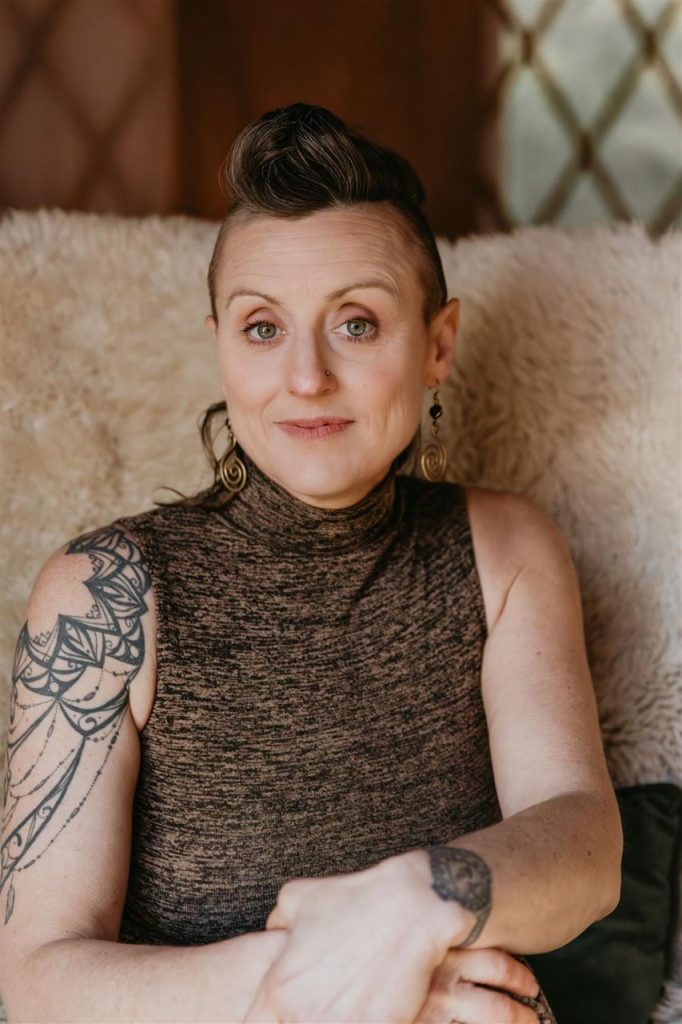
In a recent interview for Gaia University, Dr Yates, sexologist and relational coach detailed how her methodology, born from their own somatic awakening, provides a map for this essential repair.
From Personal Wound to Professional Purpose
For Dr Yates, the path to becoming a leading voice in relational health wasn’t born from abstract theory, but from a personal journey through profound trauma and a transformative, body-based healing. Their story is a powerful testament to the current wave of somatic healing. They describe growing up in Texas in an environment of “mixed love and violence,” which led to early trauma and two decades of toxic relationships. “I was replicating learned patterns, seeking love but unconsciously recreating familiar dynamics,” they recount.
The pivotal turn occurred at age 29; an experience with Orgasmic Meditation at the Burning Man Festival catalysed a dramatic release. “What began as severe pain from touch—a level 8 or 9—transformed almost instantly into bliss; It was a somatic release of stored trauma… In a safe, consensual container, I felt 29 years of shame dissolve.”
This awakening—a direct engagement with the nervous system’s capacity to shift from protection to connection—re-routed their career. Inspired, they earned a PhD in human sexuality and has since established a 15-year practice.
The Necessity of Repair: Healing the Rupture
These days, they are concerned with a central question: How do we systematically heal relational ruptures?
“We often come to relationships seeking connection, but we’re blocked by the unaddressed ruptures. My clients would seek better sex or deeper intimacy, but we first had to learn how to navigate the hurt that inevitably arises. That’s where true connection is forged.”
Dr Yates’s core insight is that relational ruptures—moments of miscommunication, hurt, or betrayal—are inevitable. Left unaddressed, they create blocks to intimacy, breed resentment, and reinforce insecure attachment patterns.
“Repair is not about avoiding conflict,” they clarify. “It’s the skilled process of navigating the breach to restore trust and connection. The conversation is the vehicle for that restoration, but it’s the preparation that determines whether the vehicle crashes or arrives safely.”
The REPAIR Framework: Regulating the System to Navigate the Conversation
This is where her “Art of Repair” (REPAIR) framework provides a trauma-informed structure. Grounded in Attachment Theory, it recognises that to have a constructive conversation about a rupture, we must first exit the biologically driven states of fight, flight, or freeze. The methodology’s genius is its insistence that productive dialogue is impossible without first addressing the physiological state.
Dr Yates emphasises that the critical work happens before the actual discussion of the event. The first three steps are individual preparation designed explicitly for nervous system regulation:
- (R)esourcing: “You must first regulate your own nervous system,” they state. “You cannot have a productive conversation from a reactive, flooded state. This step—a walk, deep breathing—moves you from survival brain to rational brain.”
- (E)mpathy: “With a calmer system, you can access the prefrontal cortex for self-empathy and other-empathy. You can validate your own hurt as well as consider their perspective. This capacity is biologically offline when we’re triggered.”
- (P)ermission: This step initiates the dialogue by asking for consent and framing it around a shared, positive “North Star” outcome. “Asking, ‘Can we talk about what happened yesterday?’ and naming a shared value like ‘because our partnership matters to me’ soothes both nervous systems before the topic is even introduced.”
This pre-work establishes the safety required to then move through the conversational steps: mutually (A)cknowledging each person’s reality, sharing the emotional (I)mpact using reflective listening, and co-creating actions to (R)estore Integrity and trust.
Only after this foundation is laid do the conversational steps begin: Acknowledge (seeking mutual understanding, not agreement), Impact (sharing feelings using Nonviolent Communication, followed by reflective listening), and Restore Integrity (co-creating actionable steps to rebuild trust).
“The hardest step is ‘Acknowledge,’” Dr Yates reveals. “We want to jump to being right. But the goal is simply to say, ‘This is what I experienced,’ and to hear, ‘That is what you experienced.’ Until both realities are on the table, you can’t safely move to impact.”
The Scalable Skill for Collective Harmony
Dr Yates confirms the process is scalable from couples to communities, though group dynamics add complexity. The essential skill, regardless of scale, is reflective listening— “What I heard you say is…”—which they identify as the most powerful tool for creating harmony. “It ensures understanding before problem-solving. It makes the other person feel deeply heard, which disarms defensiveness. It’s the practical engine of empathy.”
Ultimately, Dr. Yates’s work points toward a hopeful synthesis. By moving through the repair work that heals the stasis induced by trauma, we regain our natural creative flow. The regulated nervous system becomes more than a tool for conflict resolution; it is the gateway to tapping into the ultimate pool of regeneration: a state of inner peace and the effortless joy that flourishes in its wake. Intimacy, their work suggests, is the beautiful destination, but a skillfully regulated and repaired nervous system is the pathway.
*Dr. Hazel-Grace Yates is a sexologist, relational coach, and facilitator. Their methodology, “The Art of Repair,” is taught through workshops and private coaching. For Gaia University, this is Brian Simpson.